
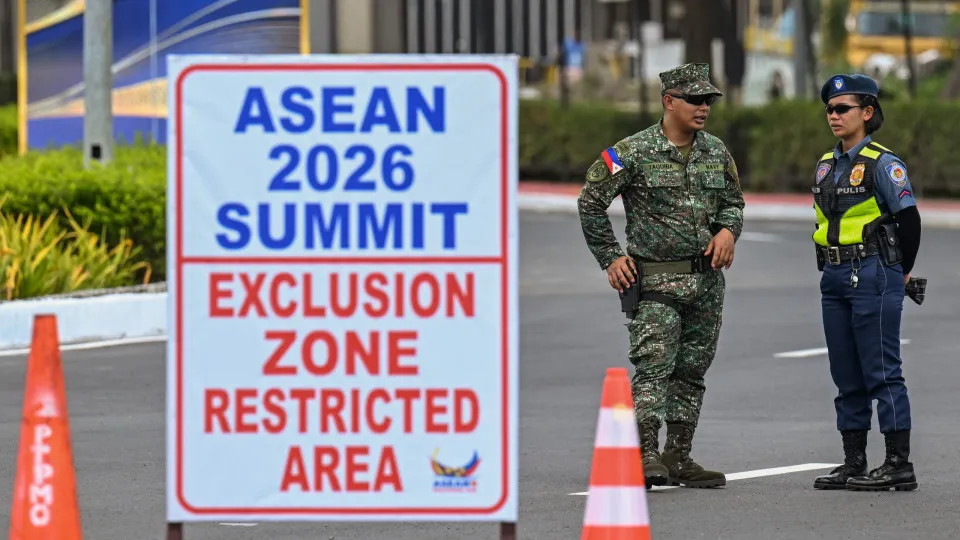
The presence of two dozen leaders, strong security measures and trade talks are some of the highlights of the summit of the Association of Southeast Asian Nations (ASEAN) that Manila hosts between Sunday and Tuesday.
© Jam STA ROSA / AFP via Getty Images
14/11/2026
by
Lusa
A the presence of two dozen leaders, strong security measures and trade talks are some of the highlights of the summit of the Association of Southeast Asian Nations (ASEAN) which Manila hosts between Sunday and Tuesday.
The President of the United States, Donald Trump, is one of the guests of the 49th ASEAN summit, with which the host, Filipino counterpart Ferdinand Marcos Jr., closes a year of rotating presidency of the marked bloc.
The Filipino presidency of the regional bloc was marked by the war in Iran, the energy crisis and tensions with China, with the archipelago's economy at one of the lowest times.
Here are some key points to follow the summit, highlighted by the Spanish EFE agency:
Security for a complicated summit
The capital, adorned with posters announcing the meeting, shielded itself with almost 20,000 personnel from the security forces.
The government declared three days of holiday to relieve traffic in the capital of almost two million inhabitants, but a much higher number in the metropolitan area, before the arrival of more than 10,000 foreign delegates and visitors.
“It’s not a simple summit and we want to demonstrate the capacity of the Philippines to host,” said presidential spokesman Claire Castro, who listed more than 550 meetings of the year of the Filipino presidency, almost twice as much as in 2017.
What ASEAN is
Created in 1967 and with a population of about 700 million people, ASEAN is composed of Singapore, Malaysia, Vietnam, Indonesia, Thailand, Philippines, Myanmar, Brunei, Laos, Cambodia and East Timor, which became the 11th member in 2025.
The Timorese Prime Minister, Xanana Gusmão, arrived today in Manila and, in his style, danced during the official reception ceremony, according to images released by the digital publication Rappler.
The summit starts on Sunday at the renewed International Convention Center of the Philippines (PICC), with the sessions of the 11 members of the bloc, and continues on Monday and Tuesday with meetings with partners and invited countries.
At the close, the ASEAN presidency will be handed over to Singapore, which will lead the group in 2027.
Those attending the summit
In addition to Trump, among others, the Prime Ministers of China, Li Qiang, Japan, Sanae Takaichi, India, Narendra Modi, and Australia, Anthony Albanese, as well as UN Secretary General António Guterres.
As special guests of the Filipino presidency attend the newly elected Brazilian President, Luiz Inácio Lula da Silva, Canadian Prime Minister Mark Carney, and the director-general of the International Monetary Fund (IMF), Kristalina Georgieva.
What results are expected
The safest result is the signing of the block’s digital economy agreement (DEFA), with which the group members expect to double the benefits in digital trade.
It is also expected that the free trade treaty between ASEAN and Canada will be signed and new accessions to the Treaty of Friendship and Cooperation in South-East Asia of some invited countries will be signed.
It is more difficult to close the code of conduct in the South China Sea, negotiated since 2002 and promised by Manila for this year.
The Philippines does not see it as lost, according to spokesperson Castro, despite the usual tensions between ASEAN and China, which claims almost the entire area.
Trump's express visit
After nine years without stepping on the country and with a program designed to suit it, Trump will land on Tuesday in Manila, an hour and a half before the end of the summit for a special meeting between ASEAN and the United States.
The next day, after a bilateral conversation with President Marcos, Trump will head for the Chinese city of Shenzhen, where Chinese counterpart Xi Jinping awaits him, to attend the Asia-Pacific Economic Cooperation Forum (APEC).
The crisis of Ormuz
The energy crisis will also occupy a large part of the talks in a region hit by the blockade of the Ormuz Strait, in particular the Philippines, which imports 98% of crude oil from the Middle East.
The Philippines was the only country in Southeast Asia to declare the energy emergency in March.
“ We feel the rising prices of basic products and oil (...). Many of these problems we cannot solve alone, so ASEAN is so important”, said Marcos.
The Filipino leader asked the whole block to “attune together” against crises ranging from the price of oil to the impact of the weather phenomenon El Niño.
Philippines in difficult stages
Tormented by the energy crisis, corruption and slower than expected economic growth, the Philippines arrive at the summit in a delicate situation.
Marcos' approval rate is 30% and Vice President Sara Duterte is facing a process of destitution.
The archipelago, with about 118 million inhabitants, part of a “weaker economic position”, pointed UnionBank’s chief economist Ruben Carlo Asunción to EFE.
“ The challenge is to convert this diplomatic visibility [given by the presidency of ASEAN] into concrete results of trade, investment and economy,” said Asunción.