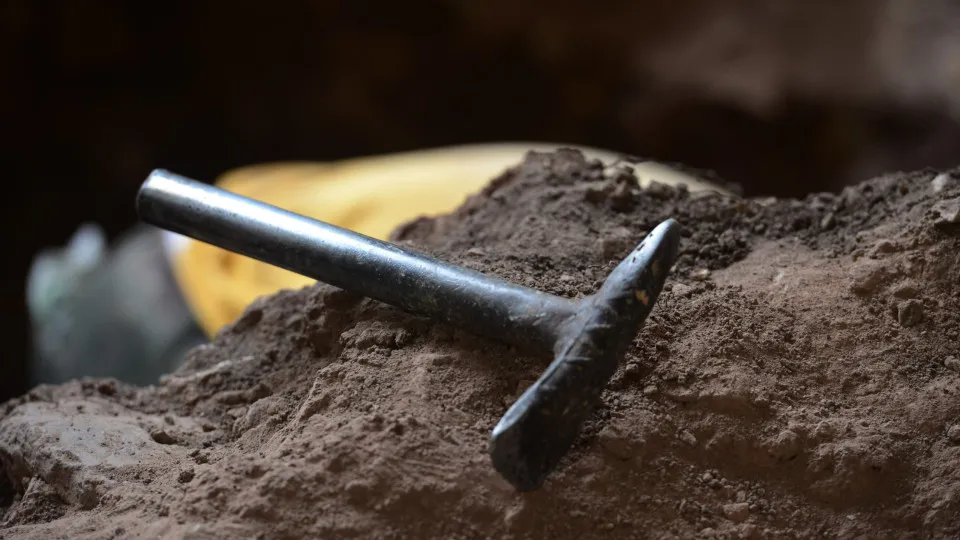
The first archaeological mission of the University of Lisbon in Egypt, held in Akoris last December, found a city with nearly 4,000 years of history, very closely linked to the Red Sea, in a different context of excavations in pharaonic spaces.
© ORANDO SIERRA/AFP via Getty Images
18/11/2026
by
Lusa
A the first archaeological mission of the University of Lisbon in Egypt, held in Akoris last December, found a city with nearly 4,000 years of history, very linked to the Red Sea, in a different context of excavations in pharaonic spaces.
The assessment of this first mission, which is presented today, at the Embassy of Egypt in Lisbon, describes “a site with enormous potential”, due to the extent, complexity and much work still to be done, not only from the point of view of what is still to be explored, but also the “great potential linked to conservation”, according to researchers Catarina Viegas and Rogério de Sousa, from the Faculty of Letters of the University of Lisbon.
“What we have is an entire city. With a very complete structure of how the city works”, highlighted to Lusa Rogério de Sousa.
Akoris, 230 kilometres south of Cairo, is located on the east bank of the Nile River, between the desert and the Red Sea, and was “a caravan’s warehouse,” said Lusa Catarina Viegas of the Archaeology Unit of the Faculty of Letters of the University of Lisbon, who led the mission together with Rogério de Sousa, of the History Center, of the same college.
“The uniqueness of our mission is to be working in a city that does not belong” to Thebes or Memphis, the two capitals of Pharaonic Egypt, “is outside of these urban centers,” Rogério de Sousa explained, adding: “It is a city with very different characteristics than the cities that were a political headquarters.”.
“The mission proceeded to the documentation of the necropolis, the Roman temple of Serapis and the Byzantine structures that developed over the pagan necropolis,” said Catherine Viegas.
Akoris presents “fully specific features, very linked to the Red Sea, and so what we see there is a city that, being in the Nile, at the end and in the end, is a city that is implemented in the desert and with links to the Red Sea and therefore what we are seeing there we do not find anywhere else in Egypt,” he said.
“ A city with very marked cultural characteristics and large commercial links,” he emphasized, referring to the “amazing scene of the excavation zone”, where since the 1980s a Japanese mission has been found.
The city, explained Catherine Viegas, presents “a long diachrononia” covering from the period of the Old Empire (2686 – 2181 before Christ), the Greco-Roman period, the Byzantine until the 6th and 7th centuries. “A caravan warehouse that gives you this specificity”.
The area granted to the Portuguese mission has “a set of tombs excavated in the mountain rock”, which overlap with structures in adobe, “an area corresponding to a temple [Roman] to Serapis [a Greek-Egyptian syncretic deity created in the 4th century, by Ptolemy I] dating from the 2nd century, and which is partially preserved, still having in place a large set of petreous blocks, architectural elements that allow its reconstruction, or at least a proposal for restitution of its ancient form”, said Catarina Viegas.
“ This is a place that the overwhelming majority of the archaeological missions that work in Egypt do not work, because they focus on Thebes and Memphis, and this is the great novelty ", highlighted Rogério de Sousa.
“It’s a place with huge potential, because it already has a huge extension. It is a place with significant complexity, which means that we have a lot of work to do there, not only from the point of view of the [scientific] questionnaire, which we want to explore there, about the evolution of the city in the most advanced stages, and the way it adapted in Roman times and in later times, but also a great potential of work linked to the conservation of the site, with a view, as a final end also, to the [its] presentation to the public”, and the creation of “visiting tours” by people who travel to that region, said Catarina Viegas.
“What we have is an entire city. With a very complete structure of how the city works. We have a Roman forum, a Roman temple and we have an acropolis, we can call it that, which is Egyptian, with pharaonic characteristics, and all this in a place that is, scenically, extremely impacting ", highlighted to Lusa Rogério de Sousa.
“Everything is dug into the rock. Therefore, the city is at the top of a sacred mountain and the temples are dug into the rock, the tombs are dug into the rock and the city itself grew from that mountain.”.
The archaeological area, said Catarina Viegas, was somewhat preserved, due to the deviation of the Nile River, “allowing the village to develop not above the archaeological site, which is more common to happen, but towards the new course of the Nile and thus saving the site [archaeological] to this overlap”.
The present village, Tahna el-Guebel, whose origin dates back to the third millennium before Christ, “has reached its peak in the Roman Empire due to its privileged position as a crossroads between the Red Sea and the Nile,” said Catherine Viegas.
The Portuguese mission, multidisciplinary, counts about 25 people. The mission of the University of Lisbon plans to return to Egypt early next year.
The presentation of the balance sheet of the Portuguese mission is presented today at 17:00 at the Embassy of Egypt in Lisbon.
To Lusa, Catarina Viegas highlighted “the importance of collaboration with Egyptian entities, the possibility of the University of Lisbon having a project in a scenario that is international, where there are hundreds of teams from around the world, and also bring to Portuguese archeology, or bring from Portuguese archeology, a little of what we do in our territory, bring now also to Egypt, to actually develop this mission”.