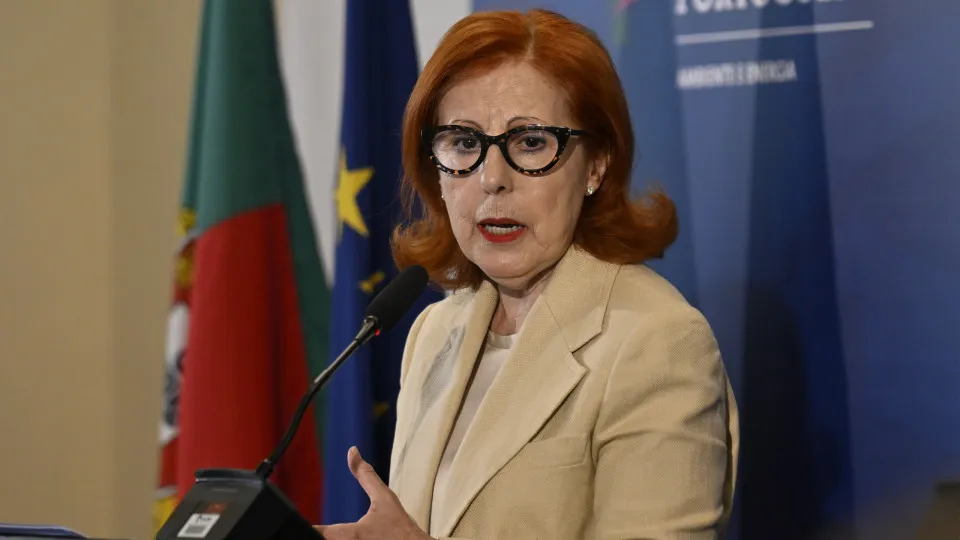
The Minister for Environment and Energy, Maria da Graça Carvalho, highlighted that mitigating climate change is an absolute priority for Portugal, defending concrete actions at COP31.
© Horacio Villalobos#Corbis/Corbis via Getty Images
18/11/2026
by
Lusa
A minister of Environment and Energy, Maria da Graça Carvalho, said today that mitigating climate change is an “absolute priority” for Portugal, arguing in COP31 that international commitments should translate into concrete action.
“We cannot dissociate the mitigation of adaptation. We have a country of extensive coastline and high exposure to climate impacts,” said the minister, in a speech in Portuguese, in the high-level segment of the 31st Conference of the Parties to the United Nations Framework Convention on Climate Change (COP31) in Antalia, Turkey.
For this reason, the minister stressed that the country is committed to making the territory and infrastructure “more resilient”.
“ For all this, Portugal arrives at COP31 with a policy focused on action defending the implementation of the Paris Agreement, where mitigation is an absolute priority ", said Maria da Graça Carvalho.
“Science is unambiguous and must continue to guide our decisions,” he said, sustaining that, in a “particularly demanding” international context, also marked by conflicts, Portugal arrives at the conference with a clear message: “the commitments made must be translated into concrete action”.
“ It is this coherence between national action and international responsibility that we want to affirm,” he said.
The minister also highlighted the Social Plan for the Climate, with an estimated investment of about €1.6 billion, “directed to families, micro-enterprises and vulnerable territories”.
“Portugal takes climate action as a strategic priority for its development. It is not just about reducing emissions. It is about transforming our economy, strengthening energy independence and increasing competitiveness,” he said.
Among the national results, it pointed out that renewable sources ensure more than 75.5% of electricity production in Portugal.
“ We want to go further, so we are betting on storage, self-consumption and energy communities, on the energy efficiency of buildings, on electrification of consumption and on increasingly sustainable mobility,” he said.
Maria da Graça Carvalho also mentioned a new step in defining a strategy to abandon fossil fuels, which she classified as “programmed, fair and inclusive”.