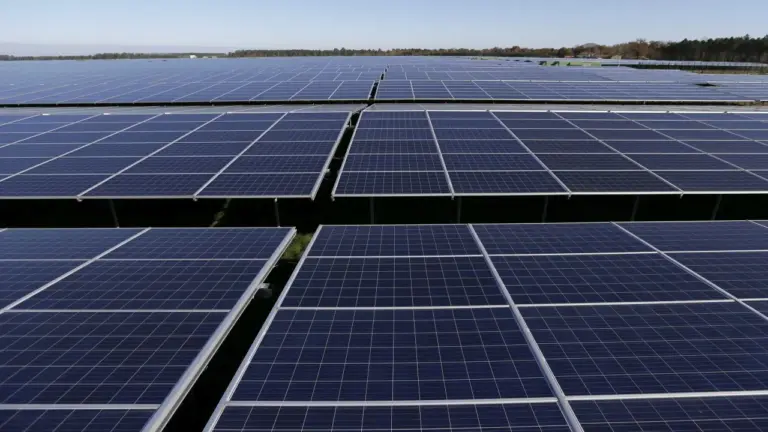
The movement against megaprojects, such as wind farms and lithium mines, sent a manifesto to the government demanding respect for the opposition of the people and requested a hearing to the Presidency of the Republic.
© Reuters
27/11/2026
by
Lusa
Megaprojects
O movement against megaprojects, such as wind farms and lithium mines, announced today that it sent a manifesto to the government to demand respect for the opposition of the people to these enterprises and requested a hearing to the Presidency of the Republic.
In a note, the Mega-Protesto movement (MP), which brought together a few hundred people on Saturday in a demonstration in front of the parliament, stated that the group's manifesto was sent to several members of the government, such as the Prime Minister, the Ministers for the Environment and Justice and the Ministers for Territorial Cohesion, Agriculture and Fisheries and Housing, as well as to the Assembly of the Republic and the Presidency of the Republic, to which it requested an audience.
In the manifesto, the group “refuses the imposition of mega-projects – whether solar and wind farms, mines, data centers, intensive agriculture or real estate projects – that threaten water, soils, biodiversity, landscapes and communities living there.”.
“ The mega-projects multiply throughout the country and attack the natural goods, destroying the lives of populations on an unheard of scale ", highlighted, quoted in the statement, Graça Passos, president of the Castelo Branco Center of Quercus, which has challenged the projects of the mega-central Sophia and Beira in Beira Baixa.
Subscribers consider that the Government is imposing on communities the Renewable Energy Acceptance Plan, under the State Budget, transferring to companies the task of “convincing populations and municipalities of the supposed benefits”.
According to Graça Passos, “it is increasingly clear that the ‘energy transition’, instead of mitigating climate change and responding to the needs of the populations, aims above all to ensure the supply of energy to large private interests”, highlighting the cases of the mines planned for Barroso or the data center of Sines, in Southwest Alentejo, which “would consume 14% of all electricity in Portugal – an energy expenditure greater than three million families”.
In the manifesto, the 62 associations demand “respect for the voice of populations and territories”, which “includes the right of people to say no”.
“ Rural territories have life and voice. They are not mere merchandise, or reserves of resources, for the consumption of large urban centers. The ‘Acceptance of Renewable Energy’ already exists: it means decentralized production, on a small scale and in already artificialized areas, such as roofs of public, associative or industrial buildings, through renewable energy communities,” Francisco Pedro explained, from the ATERRA movement, which has resisted airport expansion projects.
Among the requirements is also the carrying out of environmental impact studies accessible, transparent and independent from the interests of project promoters.
Among the associations are several movements that challenge the lithium mines in Barroso, the solar megaprojects in Beira Baixa and the projects of data centers planned for the Southwest Alentejo, such as the Association Dunas Livres (Setúbal), Association Together by the Southwest (Beja), Barroso's People and Nature Association, UDCB – Barroso's Covas and Movement No to Minas – Montalegre (Vila Real), BRAVA – Rural Resistance Network, the International Tagus Defense Platform and Gardunha's Trucks (Castelo Branco), as well as ProTejo – Movement for Tejo (Santarém) and several cores of Quercus.
On Saturday, November 21, MP protesters, from Trás-os-Montes, Alentejo and Beira Baixa, marched between the Marquis de Pombal and the Assembly of the Republic, in Lisbon, in a demonstration for the right to housing.