
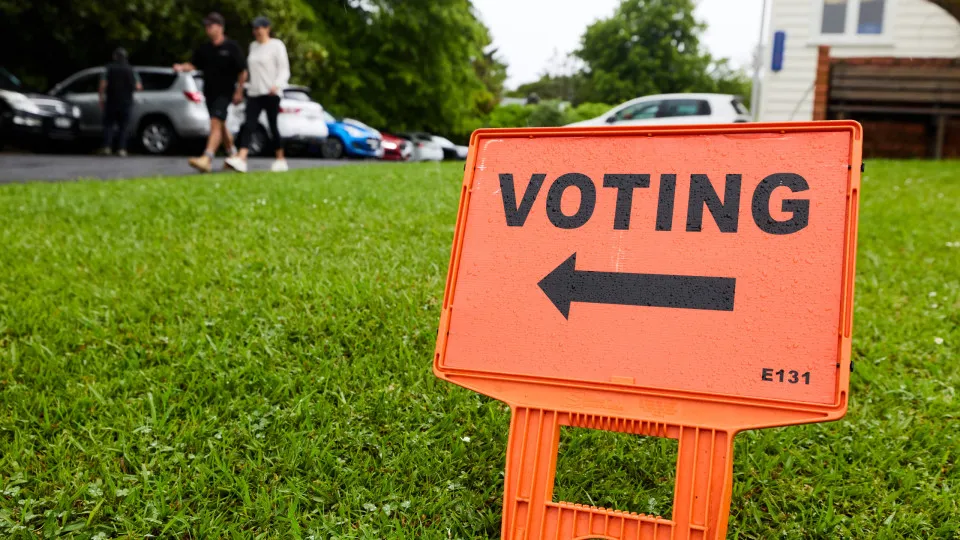
The counting of 50% of the votes in the legislative elections in New Zealand, dominated by the cost of living concerns, gives no majority to either of the two major parties, according to the figures released by the election committee.
© Brendon O’Hagan/Bloomberg via Getty Images
07/11/2026
by
Lusa
A a 50% count of the votes of today's legislative elections in New Zealand, dominated by the cost of living concerns, gives no majority to either of the two major parties.
According to the figures reported by the election committee at 21:45 locals (08:45 in Lisbon), the National Party conservatives in power, and the centre-left opposition of the Labour Party, each get 29.4% of the votes.
The two parties are separated by only a few thousand votes and none seem to be able to have enough seats to rule alone, according to these numbers.
However, opposition leader and former Labour Prime Minister Chris Hipkins, who seeks to establish himself as an alternative, asked for an “understanding”.
Its party proposed a number of measures to relieve economic pressure on New Zealanders: the price of first-needed products remains very high and unemployment has reached its highest level in over a decade.
The acting Prime Minister, Christopher Luxon, hopes that his promises not to introduce new taxes will help his right-wing coalition to remain in power after three years of tumultuous mandate, with two frustrated attempts by his own party to remove it and a declining economy.
As polls do not point to a winner, attention also turns to emerging movements, such as the central Party of Opportunities (TOP).
“ It is certainly one of the most contested elections and one of the most difficult to predict of my entire career,” says David Capie, a professor at Victoria University of Wellington.
On the streets of Wellington, many New Zealanders have confessed to AFP that they are having trouble reaching the end of the month and think twice before spending.
“ Prices are really high,” explains Jay Ikaua, cultural advisor: “I need to make weighted decisions. Should I buy that?”
Rachel Shardlow, a 26-year-old public employee, considered the situation “shocking”. “I only pay my income and my bills, and I have difficulty saving and saving for my future,” he laments.
A last poll published on Friday put the Labour Party slightly ahead of the National Party, with 30% of the voting intentions.
The polls assign more than 5% of the votes to the Party of Opportunities (TOP), which would allow it to enter Parliament. It would be a historic debut in New Zealand, for a small party with no connection with the two main political parties to win seats, observe analysts, cited by AFP.
The party is led by Qiulae Wong, former adviser to KPMG and an emerging figure in New Zealand politics, who has pledged to collaborate with either of the two major parties if elected.
“ I think the New Zealanders are really tired of offenses between politicians, disputes and political maneuvers to score points,” Wong told AFP last week.
And he added: “They want something different, and they really aspire to hope and optimism for the future.”.