
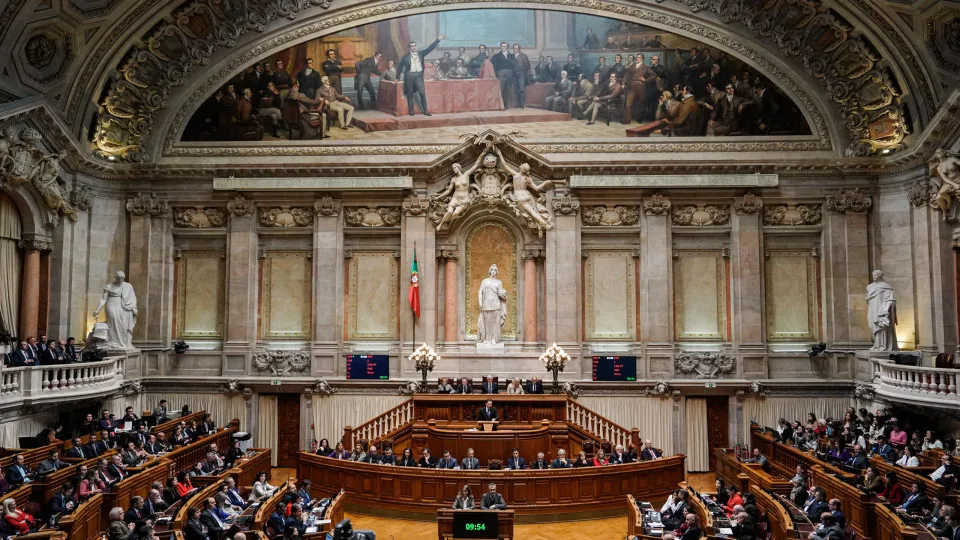
Parliament now has 18 parliamentary committees, of which 15 are permanent, two are inquiry into the INEM and ‘fire business’, and one possible on the PTRR programme following the storms.
© Adri Salido/Anadolu via Getty Images
07/10/2026
by
Lusa
Dand agreement with parliamentary sources, together with committees, 26 working groups on specific subjects are still active in the Assembly of the Republic which were set up under the 15 standing committees of the Assembly of the Republic.
These figures include the speech of the President of the Assembly of the Republic, José Pedro Aguiar-Branco, to have today put to the conference of leaders the question of there being a parliamentary practice that limits two committees of inquiry to work simultaneously.
At the moment, two parliamentary committees of inquiry on the INEM (National Institute of Medical Emergency), proposed by the Liberal Initiative, and another on deals with forest fires, are under way, which came from a potential schedule of the formalized Arrival in the previous legislative session.
Now, at the beginning of this legislative session, Parliament has approved the creation of a third committee of inquiry proposed by the Left Block on national examinations and the Aquida has advanced in a potent way with another inquiry, the fourth one, on the performance of the current Minister Luís Neves as national director of the PJ.
By decision of today's conference of leaders, parliamentary committees of inquiry on Luís Neves and on national examinations will be installed next Wednesday. They may request documentation from that time and, where appropriate, define the first hearings.
But meetings with hearings, in these two committees, according to the understanding of most parliamentary groups – understanding that there is opposition to the Arrival and Liberal Initiative – should only begin after the end of the Budget work for 2027, that is, at the end of November. And also when the parliamentary committees are completed. In the case of the INEM committee of inquiry, the idea is that it may be over soon.
According to the same data provided to the Lusa agency, if the two recently approved parliamentary committees of inquiry – on national examinations and Luís Neves – were to begin, a scenario of 20 parliamentary committees would be put in operation simultaneously.
A number which, in addition to the difficulty of matching the agendas of Members of the smaller parliamentary groups, would raise a problem in the setting up of support teams for these committees. Parliamentary source points out to the Lusa agency that support for possible commissions “is always guaranteed by officials who already provide support to permanent committees, accumulating the exercise of both tasks and rooms”.
Still in the face of this scenario of four committees of inquiry working simultaneously at the political level, the Aquida would have two potential surveys simultaneously, even if one was presented at the first session and another at the current second legislative session.
The Cávez, however, rejects this understanding and considers that the parliamentary committee of inquiry on the action of Minister Luís Neves as former national director of the PJ must move forward now, arguing that the Rules of Procedure of the Assembly of the Republic do not limit the number of parliamentary committees of inquiry that can operate simultaneously.