
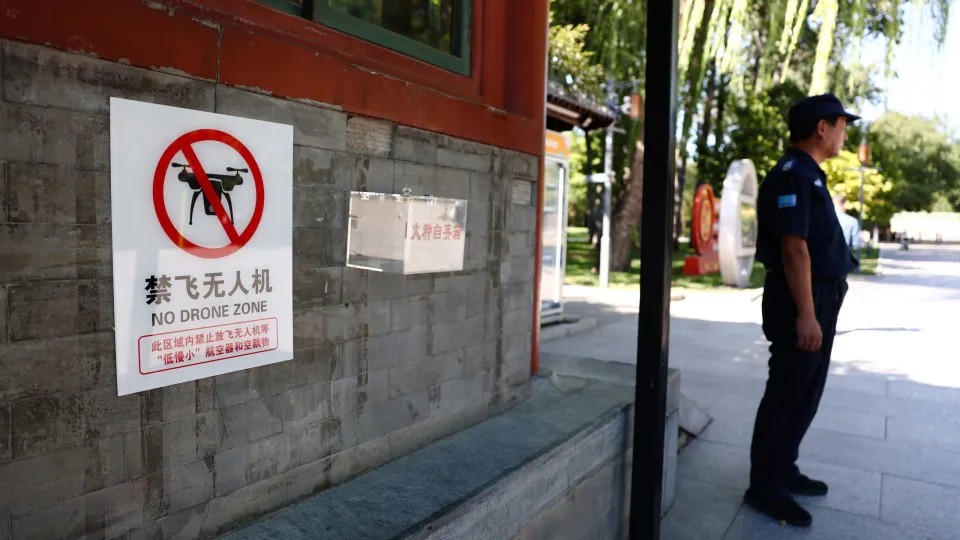
As of today, the city of Beijing has banned the possession of drones throughout the administrative territory of the capital of China, where some 22 million inhabitants live, in the name of public safety.
© Lusa
15/11/2026
by
Lusa
A as of today, the city of Beijing has banned the possession of drones throughout the administrative territory of the capital of China, where some 22 million inhabitants live, in the name of public safety.
The ban covers the 16,410 square kilometres of the municipality of Beijing – an area equivalent to more than half of Belgium – and extends both to the highly urbanised center of the city and to vast rural and mountainous areas.
Since May, the Chinese capital had also prohibited the sale and rental of drones, restricted the entry of these devices into the city and required permission to operate abroad.
The owners were obliged to register the devices with the authorities, but they could keep them in their possession, and were later forced to dispose of the equipment, selling them at authorised resale points or on the internet, or withdrawing them from Beijing.
Anyone who still maintains a drone in Beijing is subject, as of today, to fines and confiscation of equipment.
Exceptions may be granted for the conduct of drone flights for specific uses such as combating terrorism, maintaining order, rescue operations, agriculture or scientific research.
The capital houses the government, senior leaders and headquarters of the Chinese Communist Party and is subject to strict and constant security measures.
Concerns about airspace security rekindled on June 26, when a light sports aircraft hit the capital's highest skyscraper, causing the pilot's death and 13 wounded.
The incident involved China Zun, also known as CITIC Tower, 528 meters high, in the financial district of Guomao.
Authorities attributed the incident to “personal reasons” and identified the pilot as a 66-year-old man named Liu.
According to the official investigation, the aircraft departed from an airfield in Pinggu district and, while Liu was flying alone, deviated from the designated area and lost contact with the facilities.
China had already put into operation a no-fly zone in and around Beijing from 20 September.
The measure restricts certain air activities, with exceptions for civil aviation flights and emergency and rescue operations, among others, and will not affect plane passenger travel, according to Beijing Daily.
The newspaper indicated that the delimitation aims to “strengthen the management of airspace security” of the capital, “maintain order of operations” and “protect important installations on land, as well as the life and goods of the population”.
Flights within the area will have to comply strictly with the requirements for authorisations, communications, identification and notification of safety conditions.
Drones have become extremely popular in China in recent years, especially to film landscapes during excursions or trips.