
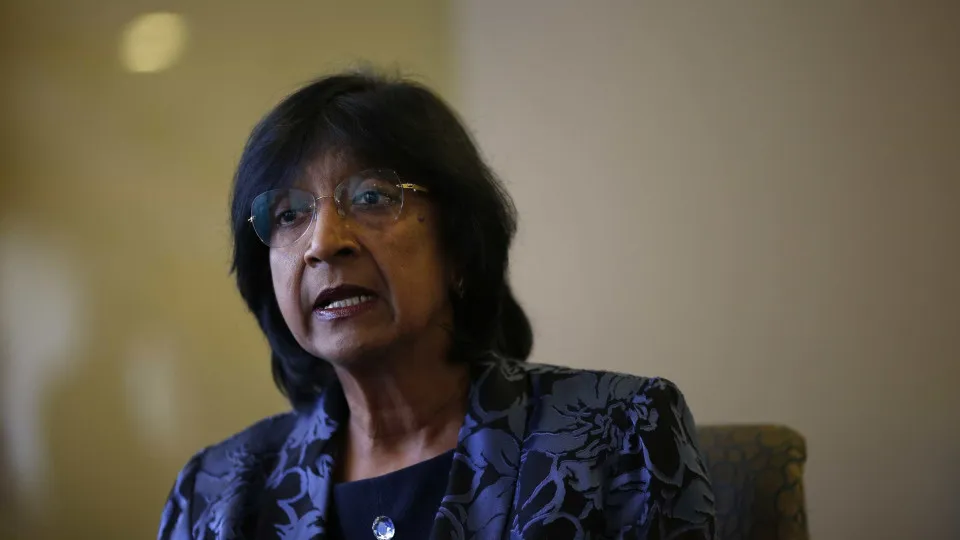
South African Navanethem “Navi” Pillay, winner of the Nobel Peace Prize of 2026, was the judge who accused Rwanda and Israel of committing genocide. Former United Nations High Commissioner, he presided over the first international sentence that determined the genocide in Rwanda and led a commission that concluded that Israel committed genocide in Gaza.
© Reuters
09/10/2026
by
Lusa
A south African Navanethem “Navi” Pillay, winner of the Nobel Peace Prize of 2026 “for her work for peace and international law”, was the judge who accused Rwanda and Israel of committing genocide.
Former UN High Commissioner for Human Rights (2008-2014), Pillay was judge of the International Criminal Court for Rwanda, where he presided over the first international sentence that determined genocide.
In addition, by November 2025, he headed the United Nations Independent International Commission of Inquiry into the Palestinian Territories. Occupied who concluded that Israel was committing genocide against the Palestinians in Gaza.
In an interview released in December last year, Navi said that the conflict in Gaza was “the most painful” he has ever looked at and stressed that one of the challenges in drafting the report was “Israel’s refusal to allow entry into its territory and the Palestinian Territories to investigate.”.
A taste for international humanitarian law began in youth when living in South Africa marked by the apartheid regime.
Born in 1941 in Durban, South Africa, in a modest family from Sri Lanka, she became, in the late 1960s, the first non-white woman to open a law firm in this South African province, where she defended several political prisoners detained without trial, many of whom anti-apartheid activists.
In 1982, he finished a Master's in Law at Harvard University, specializing in human rights and international law, and 10 years later he co-founded an international women's rights group called “Equality Now” (Equity Now).
After the end of the apartheid regime, then President Nelson Mandela appointed her, in 1995, as interim judge of the Supreme Court of South Africa and, in the same year, was elected by the United Nations General Assembly as judge of the International Criminal Tribunal for Rwanda, where she remained until 2003.
It was in this last function that he gained particular prominence, as he presided over the first international decision that determined the existence of genocide in that country in accordance with the criteria laid down in the 1948 Genocide Convention.
This decision also determined that rape may constitute an act of genocide, thus reformulating international humanitarian law and promoting justice for survivors of sexual violence in conflicts.
Four years later, in 1999, he became judge of The Hague International Criminal Court (ICC), a position he held until 2008, when he was appointed UN High Commissioner for Human Rights, the highest post of human rights in the United Nations system.
During his UN mandate, he denounced violations in conflicts such as those in Syria, Gaza and Sri Lanka, pressed for accountability for war crimes and defended the rights of women and minorities.
In August 2014 he left office, but not without criticising the UN Security Council for failing with the Syrian people by not preventing violence or investigating the crimes committed.
After leaving the UN, he remained very active in the defense of human rights, participating in reflection groups on migration, integration and justice in South Africa and acting as an ‘ad hoc’ judge of the International Court of Justice in the implementation of the Convention for the Prevention and Suppression of Genocide Crime, in the Gambia vs Myanmar case.
He returned to the service of the UN in 2021 when he led the United Nations Independent International Commission of Inquiry into the Occupied Palestinian Territories. In September, the committee concluded that Israel was committing genocide against the Palestinians in Gaza.
Last year, he left the committee, claiming issues of age, health and personal commitments.
Currently, at the age of 85, Navi presides over the International Commission against the Death Penalty, based in Madrid.
Among the awards and recognitions that Nobel Peace now received are the PGA’s Defense of Democracy Prize (2014), the Stockholm Human Rights Prize (2010) and the Sydney Peace Prize (2025) “for a life dedicated to the defense of fundamental human rights, peace with justice and women’s rights”.
She was also awarded the Olof Palme Award along with John Dugard (2026).