
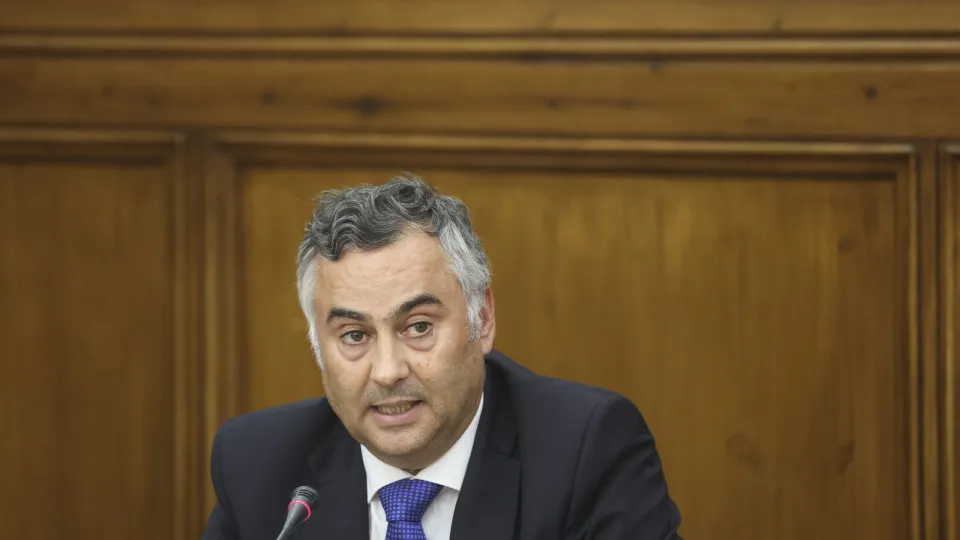
The Minister of Education today considered that the degradation of the learning of Portuguese students, confirmed in the last edition of PISA, reflects the negative impacts of social networks, but also the devaluation of external evaluation by previous governments.
© Lusa
06/10/2026
by
Lusa
Othe portuguese students had the worst academic performances ever in the reading exam of the international program PISA, aggravating a descending trajectory whose results represent already more than a year of lost study, but the degradation of learning also extended to Mathematics and Sciences.
This has been the case since 2018 and, called to parliament to comment on the latest PISA results – Programme for Interactive Student Assessment, published in September, the Minister of Education, Science and Innovation explained that “the loss of learning did not happen by chance.”.
Among the main factors, Fernando Alexandre points to early access to social networks and the use of smartphones, with negative impacts on children's ability to concentrate, affecting, in particular, the reading capacity and, consequently, the entire school path of students.
“There are factors that are common and that help explain this very negative trajectory in almost all the countries of the Organization for Economic Cooperation and Development (OECD), but each country can and must take steps to counter,” he said.
Underlining that the dimension of social networks is “more and more evident”, the ruler added that, therefore, his ministry did not need to wait for the results of PISA to regulate the use of smartphones in schools, with a recommendation in 2024 and later advanced for the ban that will be extended from January to the 9th year.
On the other hand, Fernando Alexandre considered that the degradation of learning over the last few years also results from the devaluation of external evaluation by former socialist executives.
On the contrary, he argues that the introduction, in 2024/2025, of the Modernization of Learning (ModA) tests in the 4th and 6th years allows to follow the evolution of student results.
“ The absence of this instrument was one of the reasons why it was not possible to have an effective learning recovery strategy”, he considered, adding that, also with regard to external evaluation, the Government did not have to wait for the results of the PISA.
In addition to the results of Portugal in PISA 2025, which motivated the request for hearing submitted by Aquida, the minister was also in parliament to answer, at the request of IL, on the delays in the dissemination of the results of the ModA tests and the ranking of the schools.
Regarding the ModA tests, Fernando Alexandre regretted that it was not possible to send the results of the 2025/2026 evaluations to schools by the beginning of the school year.
“ This year, and contrary to what was foreseen, the Institute of Education, Quality and Evaluation (EduQA) was unable to make the results available in good time”, he explained, justifying the delay with the problems recorded in the digital classification process of the secondary examination examinations.
Regardless of this embarrassment, the minister admitted the need for more time to work on this data and said that, therefore, the schedule of the ModA tests should be anticipated, starting in April, and not at the end of May.
“ Leaving on October 20, it will continue to be very useful for schools, but it became evident that the ModA tests have to be carried out a little earlier”, he added.
As for the rankings, Fernando Alexandre clarified that the data related to secondary education are “ready since March”, but the process of validating the data related to the 9th year was longer due to the implementation of the digital format.
The databases have already been made available to the media and will be published on October 30.