
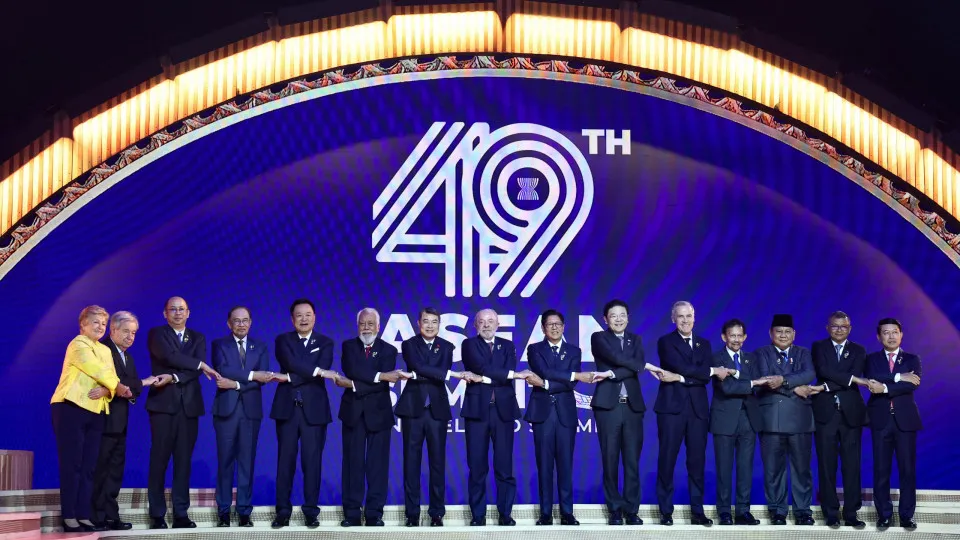
Southeast Asian leaders began a summit in Manila, where they discuss trade, security and energy crisis before the arrival of American President Donald Trump, scheduled for Tuesday.
© Getty Images
15/11/2026
by
Lusa
Uthe regional summit began today in Manila, where leaders of Southeast Asian countries discuss trade, security and energy crisis, before the arrival of American President Donald Trump, scheduled for Tuesday.
Trump will arrive at the end of the South East Asian Nations Association (ASEAN) summit on a visit to include a meeting with leaders from India, Japan and Australia, the other members of the so-called Quad.
The meeting of this group, designed to counterbalance China's regional influence, precedes a tripartite meeting on Thursday between Donald Trump and Russian counterparts, Vladimir Putin, and Chinese, Xi Jinping, in Shenzhen, China.
“ We should ask ourselves not only about where ASEAN is going, but also about what it should become,” said Filipino President Férinand Marcos Jr. at the opening of the summit, quoted by the Spanish agency EFE.
Brazilian President Luiz Inácio Lula da Silva, also invited to Manila, evoked the “extraordinary lesson” removed by Brazil from the imposition of prohibitive tariffs by Trump.
“Instead of crying and begging (...) we have looked for other partners”, which resulted in a 60% increase in the country’s trade surplus, a proof that “multilateralism is much more effective than unilateralism,” according to the French agency AFP.
The Australian Prime Minister, Anthony Albanese, today presided over the signing of a defence agreement with the Philippines in the context of increased Chinese military presence in Southeast Asia.
About 20,000 police officers were deployed to Manila due to the summit, and progressive organizations are expected to gather thousands of protesters on Tuesday for an anti-Trump march.
The protest is primarily aimed at the North American program Pax Silica, aimed at countering China's domination of the supply of semiconductors and rare earths.
The main project of the program, an industrial complex of 1,620 hectares north of Manila, threatens to force the displacement of indigenous families.
A series of meetings began on Saturday, with the announcement by Canadian Prime Minister Mark Carney of the conclusion of negotiations on a vast free trade agreement with the Philippines.
ASEAN leaders have also made efforts to understand issues such as fire-related air pollution in Indonesia or fuel-sharing strategies to address the consequences of the war in Iran.
Two issues that have haunted regional relations for several years — that of a “code of conduct” in the South China Sea and that of relations with Myanmar — should remain for Singapore when the city-state takes over the rotating presidency of the bloc in 2027.
Former Burma has been excluded from ASEAN high-level meetings since the military coup d'état of 2021 which overthrew the elected government of Aung San Suu Kyi and sparked a civil war, still ongoing.
Philippine Foreign Secretary Theresa Lazaro told journalists on Saturday that there was no progress on the stance to be taken against Myanmar, which faces accusations of genocide against the Rohingya Muslim minority.
As for the “code of conduct” in the South China Sea between ASEAN and China, Lazaro said that 80% of the negotiations were concluded, but diplomatic sources admitted to AFP that it will be difficult to finalize them in Manila.
Beijing claims most of the South China Sea, despite a contrary decision of international justice, and there are regularly incidents between the Chinese coast guard and that of the Philippines.
At a meeting of the ASEAN Defense Ministers in October, China sent only one embassy attaché, expressing displeasure after statements by Filipino officials.
This time China is represented at the summit in Manila by Prime Minister Li Qiang.