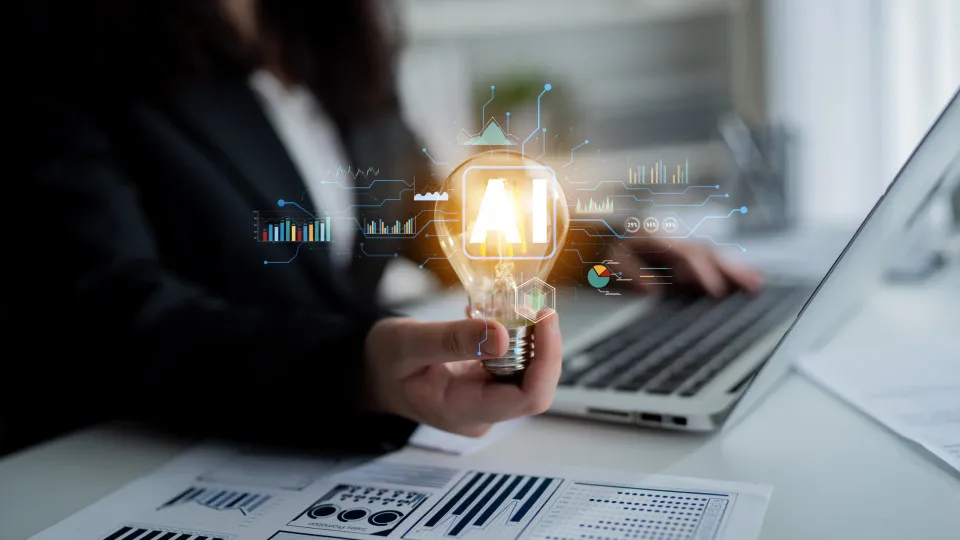
The first round of artificial intelligence (AI) “didn’t take gender equality into account at all” and “not only discriminated against but increased discrimination”, found a specialist at the Gender Equality Forum, which today ended in Brussels.
© Shutterstock
17/11/2026
by
Lusa
A the first round of artificial intelligence (IA) “didn’t take gender equality into account at all” and “not only discriminated against but increased discrimination,” a specialist at the Gender Equality Forum, which today ended in Brussels.
Videoconferencing speaker at the event organised by the European Institute for Gender Equality (EIGE, European Union agency based in Vilnius, Lithuania), Alessandra Sala noted – in a subsequent interview with Lusa – that “some companies are already taking a more careful approach, considering gender equality and diversity as variables to be taken into account”.
However, she pointed out the researcher and scientist in the field of artificial intelligence, public defender of a responsible and inclusive AI, “there are still basic problems”, both among creators and among suppliers.
“ We are investing a lot in creating an intelligent system, but that system is not being built with care and principles of gender equality”, recognizing, urging entities that provide services or AI products to do more, “because it is your responsibility to continue improving” the tool, fulfilling “principles of security and transparency and mitigating bias and discrimination”.
An inclusive AI is the one that “guarantees the same opportunities, regardless of gender, social class, cultural or religious differences”, explained, making concrete: “All people [as users] have the right to receive the same level of research.”
For this to happen, “the model must be constructed with an inclusion perspective, taking into account the risk of bias and discrimination”, he proposes.
EIGE has brought together dozens of experts in the Belgian capital to reflect on gender equality and its challenges.
Closing the meeting, Hadja Lahbib, the European Commissioner for Equality pointed out that women continue to do six more weeks of unpaid work than men and that this difference has decreased “only a day or days”.
In 2026, it will be three days from now, on November 20th, that women will work for free by the end of the year, a gap that, at this rate, will continue for decades.
On the Gender Equality Index revealed today, which places the EU area at 64.5 points (in 100), an increase of only 0.9 points since last year, the Commissioner pointed out that “all Member States have moved forward, but too slowly and since 2020 even slower”.
At the same time, “some went backwards,” he pointed out, stressing: “The index tells the truth even when it hurts and hurts.”
At this rate, it will take at least two generations for the EU to estimate the EIGE.
In this year's index (tool used to measure gender equality in the EU area), Sweden loses its leadership for the first time since 2013 for France.
Portugal ranks 9th and was the fourth most evolved country since 2025.
Cyprus, Hungary and Greece record the lowest equality performances.