
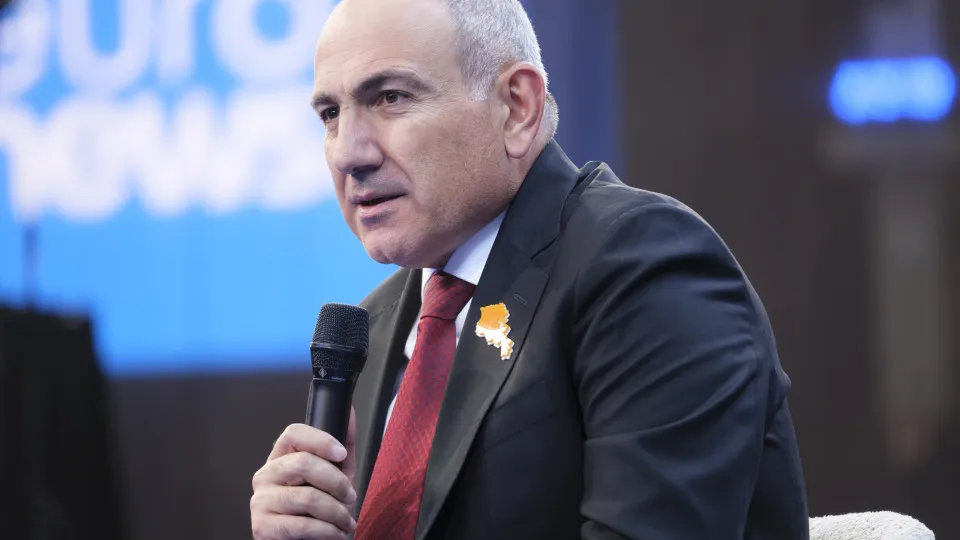
The Armenian Prime Minister, Nikol Pashinyan, announced that he plans to visit Russia three times during December in further attempts to maintain diplomatic relations with Moscow, despite tensions between the two countries.
© Thierry Monasse/Getty Images
14/11/2026
by
Lusa
O armenian Prime Minister Nikol Pashinyan, who advocates his country's approach to the European Union, announced in Dublin, Ireland, which plans to visit Russia three times in December, today reported to the Armenian press.
“I will visit the Federation Russian on the 3rd, 11nd and 22nd of December to hold conversations, and I hope we can preserve a friendly atmosphere in our relations,” Nikol Pashinyan said just before leaving the Irish capital, where he attended a summit of the European Political Community.
The last visit of the Armenian Prime Minister to Russia took place last July, for a meeting in Ecaterimburg with Russian government leader Mikhail Mishustin.
The news of the next three trips from Pashinyan to Russia comes after the Collective Security Treaty Organization (OTSC) — an intergovernmental military alliance in Eurasia, led by Russia — on Wednesday withdraws its right to vote and the ability to appoint representatives for leadership positions in the military alliance, due to the country's approach to the West.
Armenia, which was Russia's main ally in the Caucasus, froze its participation in the OTSC in February 2024 and has not since participated in any meeting of the bloc, nor has it hosted military exercises of the OTSC.
The problems between the two countries began with the 2020 war in Nagorno-Karabakh, won by Azerbaijan — with the support of Turkey — and with the subsequent raids of Azerbaijani troops on Armenian territory.
Despite close relations with European countries, Russia remains Armenia's main trading partner.
In September, the Council of the European Union (EU) adopted temporary measures of trade liberalisation for Armenian products, suspending customs duties on around 80% of Armenian exports to the European market, with the aim of supporting the Armenian economy following the trade restrictions imposed by Russia.
According to the body that brings the European Member States together, customs duties have been suspended on a wide range of products, including agricultural products, which will be applied for two years to strengthen trade flows between Armenia and the EU, in line with the objectives of the Comprehensive and Reinforced Partnership Agreement.