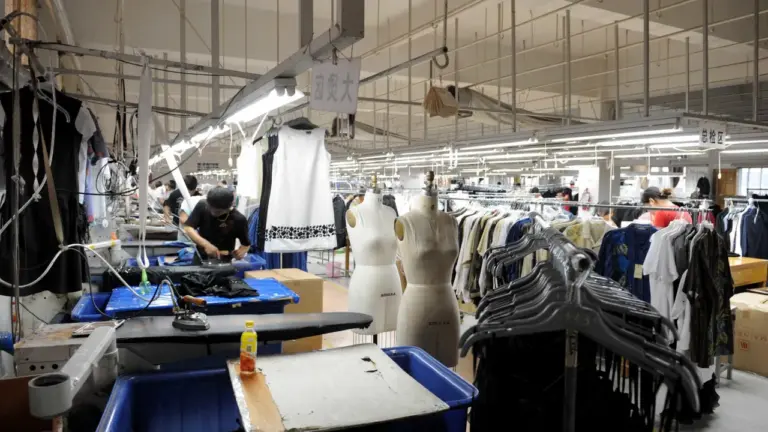
The Lusitano Project, a “mobilising agenda” for the textile industry, created new products and recycling processes and inaugurated today, in Santo Tirso, the largest company in Europe dedicated to the transformation of flax fiber into yarn.
© Getty Images
26/11/2026
by
Lusa
O Project Lusitano, a “mobilizing agenda” for the textile industry, has created new products and recycling processes and inaugurated today, in Santo Tirso, the largest company in Europe dedicated to the transformation of flax fiber into yarn.
Located in that district of Porto, Nau Verde, an investment of 30 million euros that aims to create more than 250 jobs by 2028, represents the “return of flax spinning” to Europe.
“Nau Verde is an innovative project, it is a flax spinning. Linen left Europe more than 70 years ago [but] is a raw material produced in Europe [...] What was missing? The wiring was missing, because this raw material went to Asia or other countries and then returned to Europe”, explained in statements to journalists the president of the Lusitano consortium and CEO of Calvelex, César Araújo.
According to the person responsible, the goal was that raw material, “in addition to being planted in Europe, is that it was from producer to consumer”.
This new unit occupies about 15,000 square meters in the old Filatex industrial facilities and was created under the Lusitano Project, supported by the Recovery and Resilience Plan (PRR) and valued at around EUR 111.5 million.
The Lusitano Project is a Mobilizing Agenda for Business Innovation of the Textile and Clothing Industry (ITV) of Portugal, which intended to “promote the reindustrialization of the Brazilian Textile and Clothing Industry (ITV)” and “bring back to Europe a crucial part of the value chain of ITV, namely the ability to manufacture recycled and natural fibre yarns, and subsequently new and innovative textile and clothing products of higher added value”.
The agenda, which involved a total of 17 entities, between companies, universities and research centres, and whose results have been presented today, has enabled the construction of new industrial units and the development of new production capacities.
Under the Lusitano Project, according to a video released this morning about the project, it was possible to create “new yarns, fabrics and meshes with natural and recyclable fibers, recycling technologies, automation, traceability and water recovery”.
“The Lusitano Project transformed research into concrete solutions and contributed to modernizing different stages of the Portuguese textile clothing industry,” he stressed in that presentation.
One of the “large areas of the project” was the “value of textile waste”, and it was possible to develop “technologies to improve the quality of recovered fibers and increase the incorporation of recycled material into new yarns”, processes that were then developed on an industrial scale.
The project also allowed the creation of new fabrics and non-wovens, materials that “enlarge the possibility of using textile waste, from fashion and clothing to technical applications”.
Investments were made in equipment for the treatment of natural fibers and adaptation of water reuse network, mechanical recycling and production of non-wovens.
“Combining technologies that allow the recovery of fibers and new uses, from geotextiles, to the automotive industry, allowing materials that would be discarded as waste to return to the Economy,” the video explained.
The modernization of productive equipment and the reduction of dependence on fossil fuels were another concern to which the Lusitano Project tried to respond, investing in “efficient use of water, solutions for the treatment of textile tributaries”.