
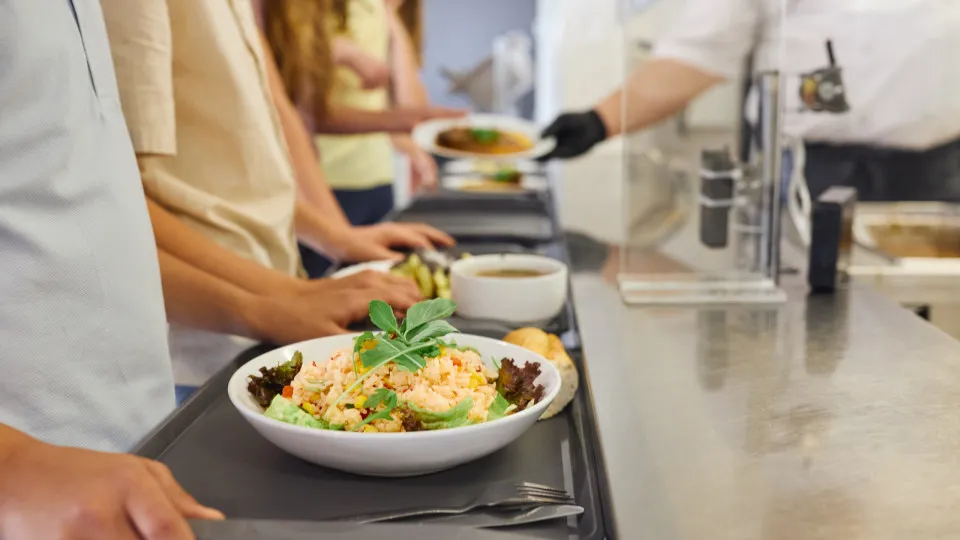
Yes, school meals can be deducted from the Singular Persons Income Tax (IRS), according to the Tax and Customs Authority (AT). Learn how it works.
© Shutterstock
08/10/2026
by
News to Minutes
S, expenditure on school meals can be deducted from the Income Tax for Singular Persons (IRS), clarifies the Tax and Customs Authority (AT) at the Finance Portal.
“Yeah. Expenditure on school meals can be deducted as education expenses, provided that they include invoices that claim services in the respective sector of activity and are issued by taxpayers identified as providers of school meals in the files communicated to the OT by the General Directorate of School Establishments and the Institute of Financial Management and Education within the legal deadline”, can be read on the website of Tax.
Thus the “acquirer shall properly indicate and classify, on its e-invoice page, invoices bearing services relating to this type of meals as training and education expenses“.
Erasmus student: Do IRS have a meal expense?
No, in this case, “expenditure on food in canteens of a university abroad not considered training and education expenditure, because the canteen does not include the list of providers of school meals provided to the TA in accordance with Article 78d(10)(b) of the IRS Code”, explains the AT.
School meal companies have to make VAT of 13% to municipalities
Companies that provide meals in the canteens of the schools managed by the municipalities have to bill this service with the VAT rate of 13%, although the dish charged to the students is tax-free, clarified the tax.
In a binding information recently published on the Finance Portal, signed on 28 August by the Director of Services of the VAT Division of the Tax and Customs Authority (AT), the tax authority explains how the VAT rules of meals are reconciled when an educational establishment, instead of providing the service directly to students, subcontracts the activity to a private company.
In this case, the doubt was put to the OA by a municipality which manages schools of the 2nd and 3rd grades of basic education and secondary education, because VAT legislation provides, on the one hand, that the supply of food and beverage services is taxed at the intermediate rate (of 13%) and, on the other hand, that there is a VAT exemption (0%) on “the provision of services for education, as well as the transmission of goods and related services, such as the provision of accommodation and food, carried out by establishments integrated into the National Education System or recognised as having similar purposes by the competent ministries”.
Looking at the two questions, the AT explains that the private company that provides the service to a municipality that manages the school “must settle the VAT at the legal rate in force” – in this case 13%, because it is a meal – when billing the municipality “the service of providing school meals”.
Subsequently, the municipality will be billing the service to students and, at that time, “not liquid tax” because the exemption rule, provided for in “Article 9(9) of the VAT Code”, applies, identifies the tax authority.
As, at first, there was VAT paid and, in this second phase, there is no VAT collection, the municipality will not be able to “deduce the tax borne upstream”, adds the tax.
Since 2019 the provision of meals in the cafeterias of schools of the 2nd and 3rd cycles of primary and secondary education has been managed by municipalities.