
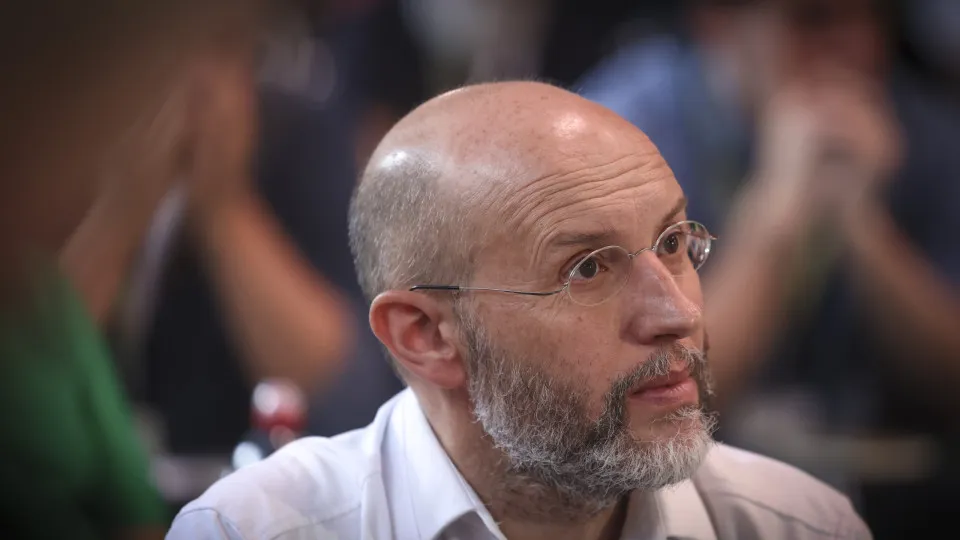
The historian and deputy Rui Tavares warns that democracy is at risk of getting lost without citizens noticing and accusing the media of irresponsibility in the way they treat the growth of the extreme right.
© Lusa
05/10/2026
by
Lusa
Athe reflections of the writer also arise regarding his latest book, “How a Republic is lost”, which will be edited by Tinta-da-China and which the author hopes to be able to publish later this month.
In this essay, Rui Tavares analyzes the last months of the First Portuguese Republic (1910-1926), reconstituting the process that led to the coup of 28 May 1926 and questioning some of the traditional explanations about the end of the democratic regime.
Rui Tavares follows about 800 days, between November 1924 and February 1927, to realize not why the 1st Republic fell, but how it was to live this process.
For this reason, he sought to rebuild the daily life of the last years of the regime, from what was heard and sung, to the stories that occupied the newspapers, passing through the conversations of the Portuguese, to see how they lived while the Republic was moving towards its end.
“In a way, I’m writing this [book] not to write the other one,” Rui Tavares said in an interview with the Lusa agency, explaining that “the other one” would be a book on how to lose a democracy.
For the historian and founder of the Free Party, there is today an evocative idea about what it means to be at risk, as if the arrival of a dictatorship was immediately recognizable by those who live it.
“ The ‘how’ is absolutely fascinating, because it brings us a little closer to what we are living now, and realize that we may be concerned about democracy being at risk – and we all feel that democracy is at risk – but we have a rather fanciful idea of what democracy is at risk’, he said.
“ We think that when there comes a dictatorship, that television is black and white”, ironic, remembering that in the “mad 1920s” it was not like that either, there were terraces, cafés, cabarets, it was the age of jazz, Charleston and Foxtrot, therefore: “They were like us”.
Even after the military coup of 28 May 1926, the Portuguese did not yet know that the Republic had ended and initially viewed it as another of the various coups that had marked the regime.
“ We too, when democracy is over the day it is over, do not know exactly if it is that day. Let's keep saying: ‘No, this is not very serious’”, he said.
Here, Rui Tavares also points responsibilities to the media, accusing journalists and directors of contributing to turning the growth of the far right into a spectacle that generates audiences.
“ We are distracted, we are irresponsible, their colleagues, information directors, are very entertaining with this that is happening, because it gives audiences, and so everyone stays in this”, he criticized.
The Member of the Assembly of the Republic evoked the examples of Marine Le Pen, in France, of the Alternative for Germany (AfD) and André Ventura, in Portugal, condemning the media exhibition given to the president of the Aquida.
“ When this is all fucked up, and there are my colleagues writing about the 'because', there will be a lot of people who will have to review their conscience and realize: it was because we were irresponsible, it was because we were distracted, it was because we were not up to the responsibilities ", he said.
Parliament will also have to make some “revisions of conscience”, because “it looks like a circus and, unfortunately, in there it is sometimes even worse, and it is something that saddens me”, he said.
His view of the “how” a Republic is lost also led him to challenge ideas that he considers to have been associated with the coup of 28 May, among them that the military dictatorship put an end to the chaos of the 1st Republic: “Wrong idea. The chaos continued, it was no longer civil chaos, it became a military chaos”.
Another “myth” that Rui Tavares contests is that the Portuguese, tired of republican instability, accepted without resistance the installation of the dictatorship: “Tie, the people resisted. [...] When they began to realize that they were not going back, people began to revolt.”.
According to the historian, the initial promises of the military that the parliament would not be closed and there would be no censorship soon were abandoned, progressively leading the Portuguese to realize that they were not faced with another passing coup.
“There are promises that last very little. Parliament closes on May 31 and does not reopen. Then censorship begins to be introduced and there for October, November is a serious censorship ", recalled.
The resistance materialized in the revolts of February 1927 in Porto and the people were “slaughtered”, the “artillery was used and died about 80 people” and hundreds of others were injured, he pointed out, considering that it was “a great massacre for a history like Portuguese”.
Later, “maybe too late”, the people of Lisbon also rose and the result was the same, so “there the dictatorship showed what it was capable” and “there the staff realized: this is serious, this is to last”, he said.
“ These days there's no idea, because we don't have plates to talk about this. One of my wishes as a politician is that in February [20]27 we, please, as a country, celebrate the people who went out in Porto to fight the dictatorship ", defended.
The honourable Member believes that, despite having lasted only 16 years, the 1st Republic has left profound marks in Portuguese society, from the flag and hymn to the values it associates to freedom, equality and social mobility.
In this regard, Rui Tavares defended the importance of the left and Democrats not letting the Portuguese flag, which he considers one of the symbolic achievements of the Republic, be appropriated by other political sectors.
“ The left must realize that this flag is our flag, the Republican flag. You should never let it, as in other countries, in Brazil and so on, where it is also the Republican flag, be stolen by others”, he said, countering it to the colors and symbols adopted by sectors that he classified as “fascistoids”, some of which, he added, are monarchic and “miguelist monarchic”.
“ I like it very much [the current Republic] and I want it to last for many years, I want it to be the longest of all years, it has already surpassed the New State and I hope that this Constitution will even overcome the Constitutional Charter and be the longest, and we have to fight for it, because it is not guaranteed”.