
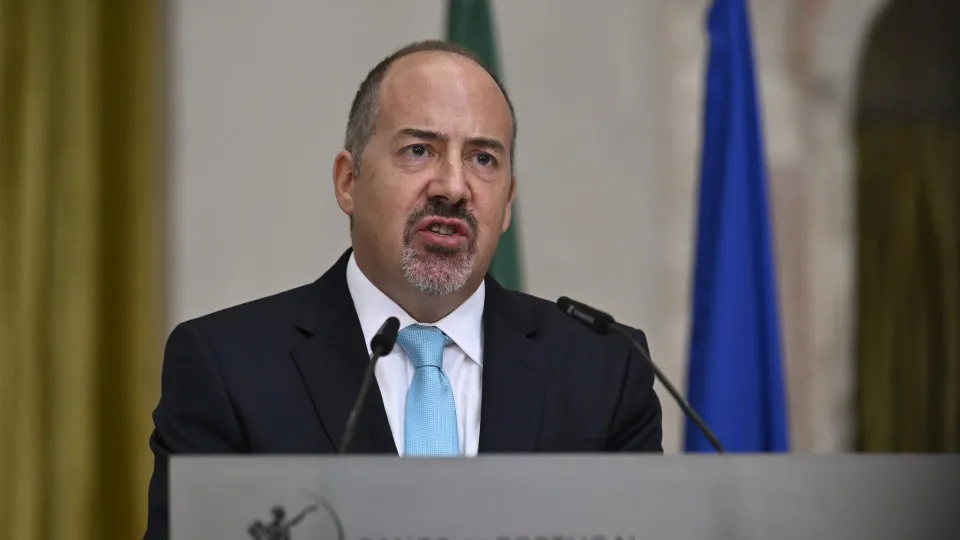
The governor of Banco de Portugal, Álvaro Santos Pereira, today considered longevity the “silent revolution” underway, as it will require profound adaptations in society and economy, including in public services.
© Horacio Villalobos#Corbis/Corbis via Getty Images
17/11/2026
by
Lusa
“ Paralelamente to artificial intelligence (IA) there is another revolution in progress, which does not make the cover of newspapers and does not open news, which is the revolution of longevity ", said Álvaro Santos Pereira at the opening of the 13th Conference of Banco de Portugal (BdP) “Portuguese economic development in the European area”, dedicated to the theme “Longevity and Demography”, in Lisbon.
According to the economist, who indicated that most children born in Portugal this year should exceed 90 years (data above the average life expectancy of 82 years, because they evaluate the evolution of mortality differently), this “silent revolution” will have “severe consequences” on the lives of citizens and economies, especially if there is no proper adaptation of public institutions and services.
In the face of education, social protection and health systems organized in the post-World War II for societies with much less hope for life than today, Álvaro Santos Pereira considered that it is urgent to think how they must be adapted.
“ If in the not so distant future the average life of a citizen is 95 to 100 years the consequences will really be radical, especially if we cannot adapt our institutions and change our public systems,” he said.
According to the governor of the BdP, in this “revolution” we must ensure that a longer and healthier life is not “privilege of some but an opportunity shared by all”, so there are several challenges that need to be addressed.
He considered, on the one hand, that it is necessary not to add only years of life but years with quality and health. In addition, there is the issue of inequalities, who has more income lives more than who has less.
The last question, he added, is how to organize work in a longer society.
According to Álvaro Santos Pereira, “it is expected, if not imperative, that the age of retirement will continue to grow in the various countries of the world under the penalty of questioning the sustainability of social security systems”, public accounts.
Nevertheless, it considered that it is necessary to analyze various impacts, such as the health conditions of older workers, the existence of three or four generations working side by side in the same company, training and retraining in long careers.
According to the governor, there are still no closed answers to this “silent revolution”, but societies and institutions that begin to face the challenge today will have more benefits in this transformation. Banco de Portugal will make its contribution.
Today's conference had as main speaker the British economist Andrew Scott (teacher at London Business School) for whom longevity should not be regarded as a burden, but as a social and economic opportunity. Scott speaks of the “dividend of longevity”, the social and economic benefit of people living longer, healthy and productive.
In the European context, Portugal has relatively high rates of participation of the older population in the labour market. In 2025, between 65 and 69 years of age, the activity rate was 29% in men and 22% in women, today he mentioned Álvaro Santos Pereira in his intervention.