
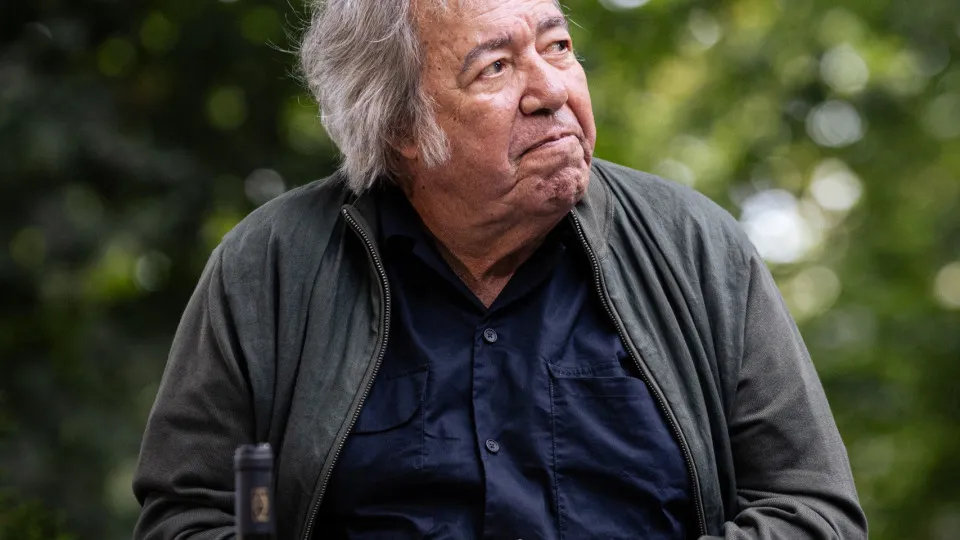
The musician Sérgio Godinho shares, in the first person, memories of the two times he was arrested in Brazil in the 1970s and 1980s, in a book published today, November 16.
© Getty Images
16/11/2026
by
Lusa
O musician Sérgio Godinho shares, in the first person, memories of the two times he was imprisoned in Brazil, in the 1970s and 1980s, “and other scenes of current life”, in a book that is published today.
In what is his first book of memories, at the age of 81 Sérgio Godinho revisits especially the two times he was arrested in Vera Cruz lands, the first in 1971, initially in Ouro Preto and then in Belo Horizonte, and the second in 1982, in Rio de Janeiro, but also shares other episodes, especially of contextualization.
In “Memories of two prisons in Brazil (and other scenes of current life)”, edited by Quetzal, Sérgio Godinho begins by saying that he is not “a good archivist and not a historian”. Throughout about 130 pages, “all that is promised” are “only memories conjugated and revived”, “and affective”.
The two arrests were “lived in such diverse circumstances and times.”.
Today one of the most important figures of Portuguese music, in 1971 Sérgio Godinho was still an anonymous one year from the release of the debut album. To tell about the first episode lived in Brazil, where he moved due to an invitation to join the Living Theatre theatre company, Sérgio Godinho backs a little in time, to 1965.
It was in that year that he first saw that company, in Geneva, Switzerland, where he had moved, at the age of 20, “supposedly to attend Psychology”.
After two years of school, he left Switzerland and hitched a ride through Europe, eventually settling in Paris, where he lived May 68, performed theater, recorded his first album, “Survivors”, and again contacted the theater company of which artists from various countries were part.
In 1971, Brazil was already “in full control of President Medici, one of the artisans of the Brazilian military dictatorship”, which the members of the Living Theatre would eventually feel.
Without “notes attesting all the details”, Sérgio Godinho reveals memories of prison conditions, of the days when, with other elements of Living Theatre, he heard and recorded “dreams of prisoners”, of the sessions of subversion crimes and possession of marijuana, of which he would later be acquitted.
Before the acquittal and two months after the arrest, Sérgio Godinho would end up expelled from Brazil, “by order and decree of the president”, as well as other elements of the theater company.
The expulsion took him to New York, United States, from where he moved to Canada, the home country of the woman and mother of the first child, settling in Vancouver, where he was on April 25, 1974.
Sérgio Godinho finally returned to Portugal, where in addition to music he also devoted himself to theater and cinema, before being again detained in Brazil.
The return to Brazil in the early 1980s happened, because it had planned a new album “made of musical partnerships with Brazilian composers”.
Because he was acquitted, like the rest of the Living Theatre, of the crimes he had been accused of in the 1970s, he considered that he could return “freely”, but “the police authorities had resurrected old judicial lists”, where his name was “as expelled”.
The arrest, with violent contours, ended up receiving attention both in Brazil, where it became “first-page news, several times with photo rights”, as in Portugal, where it was already a known figure.
The Portuguese musician eventually left prison, but had to stay in Rio de Janeiro until the trial ended. After being expelled from the country, the album, “Coincidences”, published in 1983, was only partially realized as planned. The musical partnerships with Milton Nascimento, João Bosco, Novelli, Chico Buarque and Ivan Lins happened, others that he had in mind, as with Caetano Veloso, no.
Although he was again imprisoned in Brazil, his love for the country “had increased”, especially for “people and their attitude”.
Later, Sérgio Godinho ended up convicted at first instance a year and a half in prison, for illegal re-entry into the country and possession of drugs, a sentence that would be revoked by the Supreme Court of Justice.
Throughout the work, in addition to details about the whole process of arrests and trials, the reader learns how some of the many songs he created emerged, such as “Barnabé” or “Last night”, or under which circumstances he met fellow artists, who became friends, people he admires and girlfriends.
Sérgio Godinho's first book of memoirs is now available in the bookstores.