
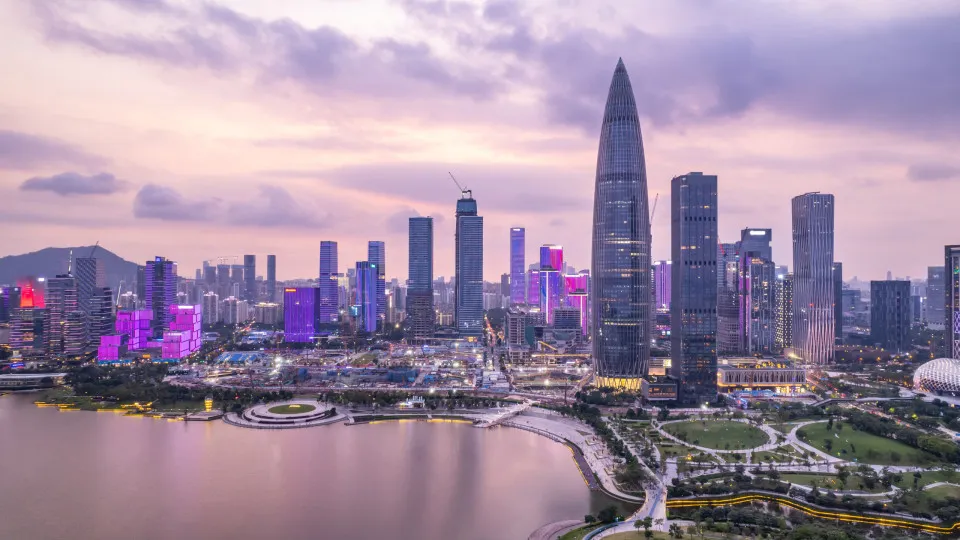
Zhao Deli, a Chinese businessman who introduced a flying car to the Web Summit, began as a factory worker in Shenzhen, embodying the economic transformation of the city of southern China hosting the Asia-Pacific Economic Cooperation Summit (APEC).
© Shutterstock
16/11/2026
by
Lusa
Nan interview with the Lusa Agency in 2019, in a workshop with less than 100 square meters in Dongguan, a neighboring industrial town of Shenzhen, Zhao told of his route since he left Hunan Province in central China in 1998 and headed to Shenzhen, in the southeast end of the country, where he started working on a golf club assembly line.
Jobs as a doorman and insurance salesman followed, until contact with a group of remote-commanded helicopter enthusiasts aroused the childhood dream of building a flying machine.
“I dreamt again,” he said. “I then bought a helicopter by remote control, but at the first attempt I slapped it on the ground.”.
To repair the device, he began to study aeronautics on his own, through books and forums on the Internet, until he was able to build a small gasoline helicopter.
In 2013, he founded a company dedicated to the development and sale of drones, which employed 20 engineers and made 20 million yuan (€2.7 million) per year.
But the competition of the big Chinese manufacturers eventually dictated the bankruptcy of the business in 2016. “I had to fire the employees,” he recalled. “I only stayed with an assistant, who I keep until today.”.
In debt, Zhao refused the advice of friends and family to return to the restoration, a sector in which he had also worked.
“ As long as I have ideas and dreams, I will definitely go after them ", assured Lusa.
Seven years after that interview, the former worker presented himself on the main stage of the Web Summit in Lisbon as the founder and president of XPeng Aridge, a flying vehicle manufacturer valued at around 2.5 billion dollars (EUR 2.2 billion) and who is preparing an initial public entry (IPO) on the Hong Kong Stock Exchange.
Zhao's trajectory reflects the transformation of Shenzhen, chosen in 1980 as one of the first special economic zones created by the then Chinese leader Deng Xiaoping to experience the opening to foreign investment and private enterprise in a country then dominated by Communist orthodoxy.
Once a quiet fishing village, situated near the Hong Kong border, the city became one of the main technological centers in Asia, hosting companies such as Huawei, giant telecommunications company, Tencent, owner of the WeChat app, and BYD, manufacturer of electric vehicles.
On Mount Lianhua, situated in the heart of Shenzhen, a bronze statue of Deng Xiaoping symbolically dominates a landscape of skyscrapers, corporate headquarters and research centers that did not exist when the former Chinese leader launched economic reforms that transformed China into the second largest economy in the world.
“ None of the buildings at the front sight of the Deng Xiaoping statue can overlap this one,” Lusa explained the Lizhang urbanization expert during a visit to the top of the Ping An Finance Center, a skyscraper 550 meters high.
“ People refer to Mao [Zedong] as China’s historical leader, but Deng Xiaoping is highly respected in Shenzhen,” he added.
A Portuguese architect based in the city summed up to Lusa the spirit that attracted successive generations of migrant workers: “People arrive in Shenzhen with the dream of getting rich.”.
The city had 18.25 million inhabitants at the end of 2025 and recorded a Gross Domestic Product of 3.87 billion yuan (about 520 billion euros), a growth of 5.5%, according to municipal statistics.
In the first nine months of 2026, the local economy grew by 6%, driven by the technological industry, whose production increased by 11.6%.
Production of industrial robots fired 44.1% and foreign trade grew 38.8%, reflecting the weight of the city in the world production chains.
This is where China is hosting the leaders of the 21 APEC economies this week at a summit marked by commercial and technological rivalry with the United States.
For Zhao, the paradigm shift was already evident in 2019, when China was advancing with industrial modernization plans to rise in value chains.
“ At the beginning of economic reforms, China merely manufactured for major world brands, with reduced profit margins and environmental damage,” Lusa noted, after a demonstration of his flying vehicle in a wasteland in southern Dongguan.
“ The time has come to invest in research and development,” he said. “Now we want to innovate.”.