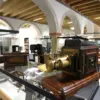
The shorts of an Olympic champion and a sample of a block of fat from London sewers are some of the objects on display in the new museum of the city of London, which reopens today.
© Reuters
28/11/2026
by
Lusa
Othe swim trunks of an Olympic champion and a sample of a giant block of fat formed in London sewers are some of the disparate objects on display in the new museum of the city of London, which reopens today.
Closed four years ago, the London City Museum moved to a new location, the Victorian building where before operated the Smithfield meat market.
A selection of reorganized objects runs through centuries of history in the British capital, from prehistory to contemporary struggles for equality and civil rights.
Among the oldest objects is an axe of the Neolithic period, dated about 3800 BC, found on the River Thames, and Roman stone tablets.
Still from the time of the Roman ‘Londinium’, a pavement mosaic and a fresco painted wall with two thousand years, recovered in 2007 from a renovated house.
Among the most unique historical pieces is a T-shirt with traces of blood with which, allegedly, English King Charles I was executed in 1649.
The swim trunks worn by jumper Tom Daley when he won his first Olympic medal at the 2012 London Games is one of the most curious objects, as well as a fragment of Whitechapel's 'fatberg'. Formed by a mass of fat and wipes, it weighed 130 tons and was about 250 meters long when it was discovered in the city sewers in 2017.
The exhibition also includes a chair of writer Charles Dickens, a dress of Queen Victoria worn in 1892 during mourning for her grandson, and an area dedicated to the British suffragette movement, which fought for the right of female vote in the early twentieth century.
An elevator from Selfridges stores, installed in 1928, the guitar immortalized on the cover of the 1979 album "London Calling", when bassist Paul Simonon broke it at a concert in New York, and the telephone center of Buckingham Palace, deactivated in 1970 and now displayed for the first time, are also part of the new layout of the collection.
In an effort to show daily life in the British capital, museum officials resorted to more mundane objects, such as luminous announcements and signs of old commercial or amusement spaces.
In the atrium of the museum is the coffee stand ‘Syd’s Coffee Stall’, an old horse carriage adapted at the request of Sydney Edward Tothill, a veteran of World War I, and which the family kept for 100 years in the same location in East London.
And right next door is the old van and a series of photographs and tools, in a display dedicated to the Italian grinder Silvio ‘Ray’ Binelli.
“I always like to say that he has more room in the museum than Queen Victoria,” graced one of the museum’s conservatives, Beatrice Behlen.
The opening of the new space represents the first phase of a wider project, which will expand to another area of the old market where it will host temporary exhibitions, a pedagogical center and a warehouse.
The director, Sharon Ament, said it took a decade to “imagin, plan, build and create” the new museum.
“There is so much to see and explore. Whether you are a Londoner or a visitor for the first time, we hope that our museum is a place where you can feel at home, feel inspired and identify yourself,” he added.