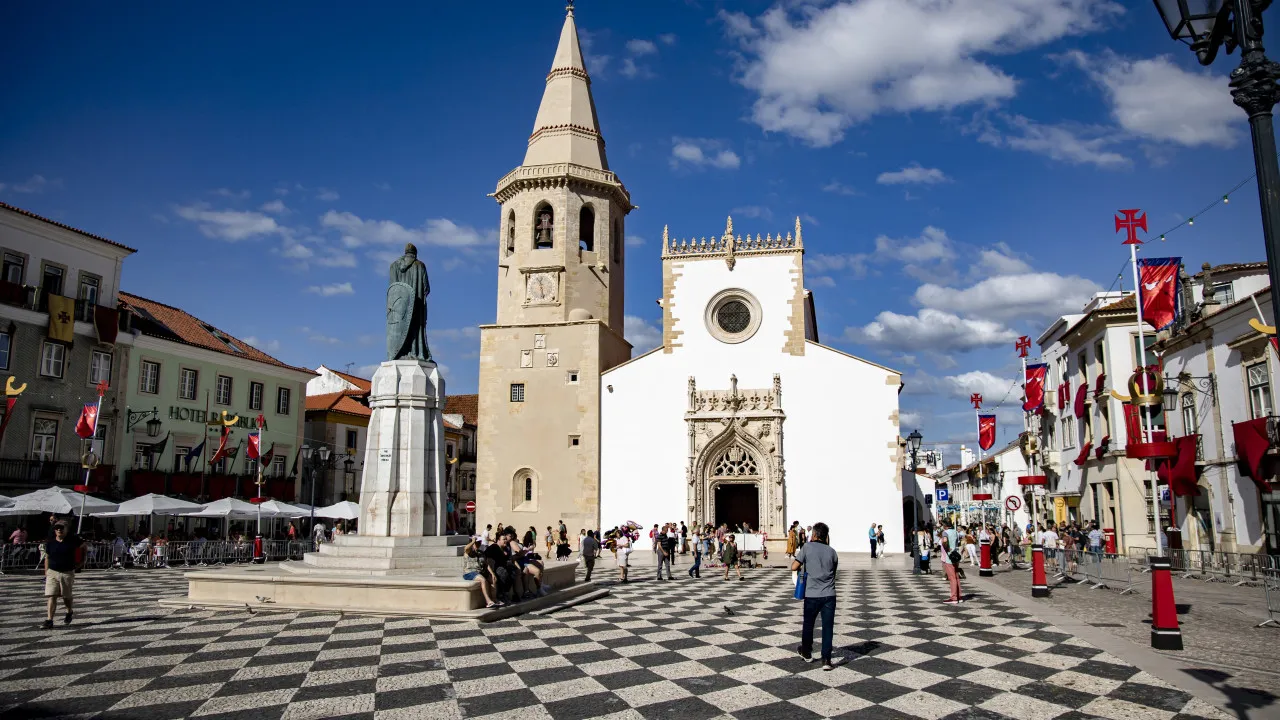
The Tomar House and the ICNF today presented a ten-year plan to recover the National Forest of the Seven Mountains after storm Kristin, with priority to the regeneration of the native forest and the fight against invasive species.
© Getty Images/Emmanuele Contini/NurPhoto
20/11/2026
by
Lusa
A Câmara de Tomar and the ICNF today presented a ten-year plan to recover the National Forest of the Seven Mountains after storm Kristin, with priority to the regeneration of the native forest and the fight against invasive species.
“ This strategic plan is really a great opportunity to think about the future”, said the mayor of Tomar, Tiago Carrão (PSD), defending that the damage should serve to rethink forest management and involve the community in its recovery.
By 2035, the Institute for the Conservation of Nature and Forests (ICNF) wants to return to the population of Tomar, in the district of Santarém, a more diverse and resistant forest.
Rui Natário, an engineer of the ICNF that presented the strategy, explained that the restoration goes through the natural regeneration of the oak-cerquinho, the replacement of the fallen cypresses by autochthonous leaves and the continuous combat against invaders, such as the ailanto and mimosa.
In about 39 hectares of the forest, the plan plans to protect and monitor the ten species of spontaneous orchids identified there, install shelters for the fauna and create a garden for pollinators.
The ICNF will also study how many red squirrels it can sustain, since the species already lives there, and evaluate the feasibility of introducing the hind.
Between 24 and 30 November, Tomar schools and five environmental organizations will participate in a planting action that covers five plots of the area already open to the public, a total of about 1.1 hectares.
The initiative provides for the planting of 411 specimens of ten native species, a number which, according to Rui Natário, may vary depending on the availability of plants.
The global plan is organized into eight axes of intervention and 13 action forms, which include the recovery of the water system and the creation of a documentation and memory centre.
The first phase, by 2028, gives priority to safety, repair of the walls and reforestation. The following are ecological restoration and rehabilitation, between 2029 and 2031, and consolidation and evaluation by 2035.
The ICNF and the municipality will monitor the implementation together, with annual reports and interim evaluations in the third and seventh year of the plan.
The indicative document estimates between EUR 20 and EUR 100 000 for the stabilisation of slopes and more than EUR 50 000 for forest restoration and management of fallen wood, and no overall amount has been released for the implementation of the plan.
The forest closed after storm Kristin passed on January 28.
Also according to Rui Natário, the storm knocked down about a thousand trees, an average of 25 per hectare, and left about 200 meters of outer wall fallen or degraded.
The space partially reopened on October 26 and the historic olive grove opened today.
The regional director of the ICNF of Lisbon and Vale do Tejo, Carlos Albuquerque, argued that reopening should be gradual and follow the progress of the work.
Tiago Carrão, on the other hand, announced that the House hopes to move forward in the coming days with a proposal for patrimonial classification, within the framework of the Templar Castle and the Convent of Christ, to cover the forest, including Charolinha, and the sections of the convent aqueduct that are outside the current classification as a national monument.
Charolinha, a quintenist structure almost totally destroyed by the fall of a pine tree during the storm, will be recovered by the House, in conjunction with the Cultural Heritage, I.P., and the ICNF.
The mayor estimated the reconstruction in “some hundreds of thousands of euros” and said that the funding is not yet guaranteed, admitting that the opening of the classification procedure can value the application.
The intervention begins with the safeguarding of the ruins, waiting for the authority to have the reconstruction underway or about to begin at the time of the Feast of the Tabuleiros in July 2027.
Until then, the priority of the municipality is to recover the entrance garden of Mata, where the boards will be exposed.