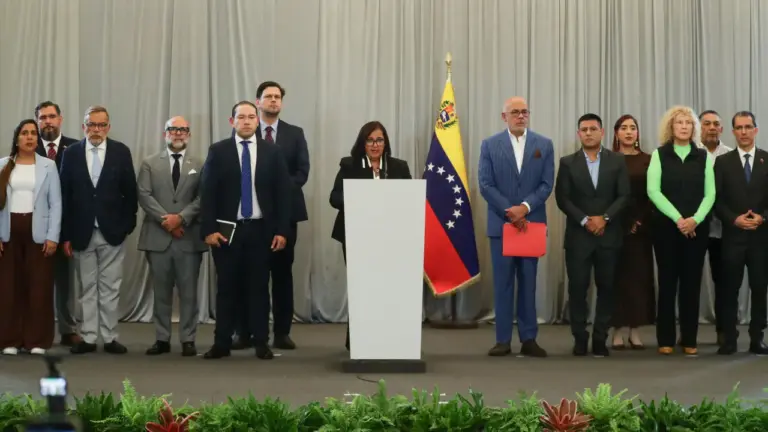
The delegations of the Venezuelan Government and the opposition concluded on Monday the fourth round of dialogues with virtually no significant progress, committing themselves only to continue working on issues already approved in previous rounds.
© Lusa
24/11/2026
by
Lusa
Adelegations of the Venezuelan Government and the opposition concluded on Monday the fourth round of dialogues with virtually no significant progress, committing themselves only to continue working on issues already approved in previous rounds.
In previous sessions the two sides discussed the release of gold reserves held at the Bank of England, the review of the status of non-legalized political parties and concessions to local media.
The delegation led by the president of the National Assembly, Jorge Rodríguez, and former deputy Dinorah Figuera agreed to follow up the work on these matters and also announced that it will move forward with the reform of the controversial Law Against Hate, denounced by many as an instrument of political persecution, as well as the Terrorist Finance Act, a legislation often applied against demonstrators.
The cycle of dialogue, from which concrete announcements such as the beginning of the renewal of the National Electoral Council (CNE) or the release of political prisoners were expected, lasted for ten days after the parties announced an extension to this day. The round ended this Monday with the promise of a new meeting in December.
Delegations have held technical tables to address these issues since August, when they initially agreed to renew the Supreme Court, often pointed out as close to chavism, and the unlocking of the gold held in the UK to support the earthquake victims of June 24, a measure that remains unrealised.
“A work roadmap was agreed that includes meetings with senior UK officials,” says the agreement read today by the parties.
In recent cycles of dialogue, delegations had agreed to unlock digital platforms to advance the lifting of restrictions on freedom of expression.
On Monday the process of updating and regularizing concessions in the radio spectrum for the media was also approved, most of which continue to transmit without difficulties.
Among these bodies are the television channel of the National Assembly, the community medium Fe y Alegría, the private station Globovisión, the state-owned Venezolana de Televisión, as well as the private channels Venevisión and Televen, as well as other Community means.
In the final statement, the parties today called on the National Telecommunications Commission (CONATEL) to “review the administrative measures applied to the subscription television system in accordance with the legal framework”, without providing further details on the request.
In addition, they proposed “a broad consultation process” with all political parties to work on the reform of the law that regulates party activity, as well as public meetings and demonstrations.
The parties also indicated that they will review the definitions and typifications provided for in the Organic Law against Organized Crime and the Financing of Terrorism, with the aim of approving legislative reform in 2026.
The reform of the Constitutional Law Against the Hate for Peaceful Living and Tolerance, the dialogue table stated that it will be integrated into the consultation and discussion process with civil society, with a view to “decriminalising certain conducts” and the introduction of a “structural change” based on a “preventive and formative” approach.