
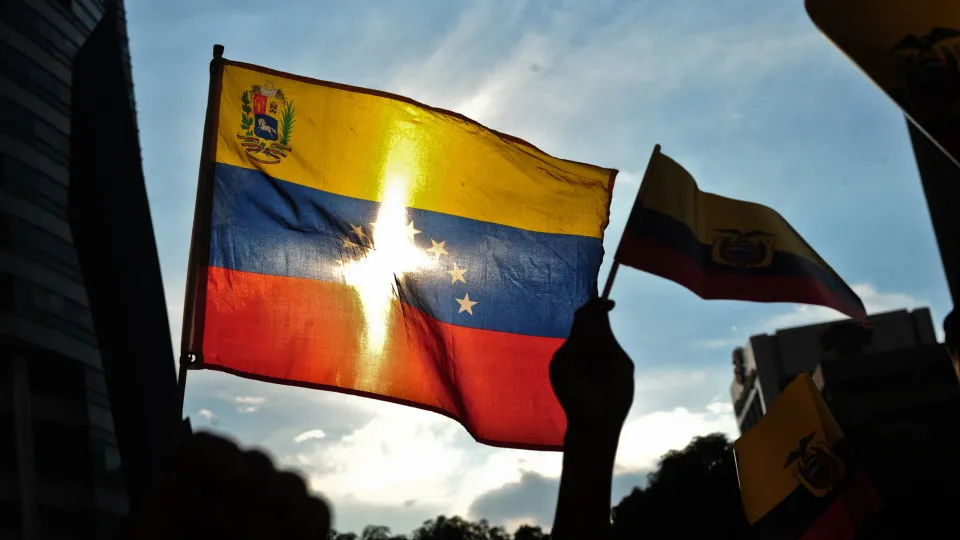
The Parliament of Venezuela, controlled by chavism, today unanimously approved a partial reform of the electric law to encourage private and foreign investment in the sector, whose prolonged crisis has worsened this year with increasing demand.
© MIGUEL GUTIERREZ/AFP via Getty Images
10/11/2026
by
Lusa
O Venezuela's parliament, controlled by chavism, today unanimously approved a partial reform of the electric law to encourage private and foreign investment in the sector, whose prolonged crisis worsened this year with increased demand.
The new Organic Law of the System and Electric Service, which adds to other changes in the Venezuelan legal framework to open strategic sectors to foreign capital, establishes that the production activity “will be carried out by the State operator, as well as by mixed and private companies that have the corresponding qualification”.
Concessions to private companies may be granted for a maximum period of 25 years in accordance with the standard.
The president of the National Assembly (AN), Chavista Jorge Rodríguez, said during the discussion that the law “does not in any way promote privatization” of the sector, but rather “the opening up so that private sectors can be incorporated into the generation and self-generation of electricity”.
The concessions will be granted by the Ministry of Electric Energy for a production that exceeds 50 megawatts (MW) or that involves or affects “public domain goods, stem transmission systems, distribution and marketing in exclusive service areas or integrated regional scale systems,” says the text.
Once the licence has been completed, the operator must return and transfer to the State-owned National Electric Corporation (Corpoelec) or to “whoever is designated, free of charge, all goods incorporated, constructed or acquired during its lifetime”.
The norm also indicates that doubts and controversies of any kind that cannot be resolved amicably by the parties may be decided by the Venezuelan courts or “through alternative dispute resolution mechanisms, including mediation and arbitration.”.
Regarding oil companies, the law states that they must “guarantee and ensure the continuous, regular, reliable, sufficient and stable supply of electricity for the execution of primary activities, through models of self-generation, cogeneration or hiring of third parties, aimed at ensuring their operational autonomy”.
Oil companies and independent electricity production companies do not need State authorisation “to generate energy for their internal networks, unless they are connected” to the national network.
Venezuela has suffered an electrical crisis for over a decade, but in the last year blackouts have increased, which has generated protests in several states of the country.
The opposition and experts argue that the flaws in the system are due to corruption and lack of maintenance, although the government ensures that the problem results from sanctions, climate phenomena and supposed sabotage.
Venezuela’s interim president, Delcy Rodríguez, recently promised that “soon” will come the relief of the crisis.