
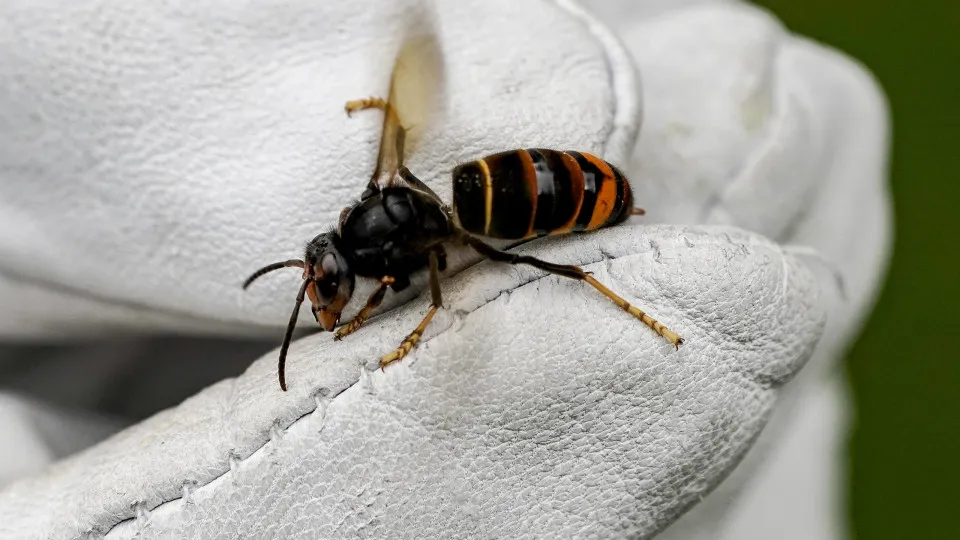
The municipality of Vila Flor warns about the significant increase in the Asian wasp, with triple nests destroyed this year compared to 2025, according to the mayor.
© Getty Images
07/10/2026
by
Lusa
Asian wasp
A asian wasp is proliferating in the municipality of Vila Flor, having already been destroyed this year three times the nests compared to 2025, today warned the mayor, who considers these figures worrying and asks for measures.
In statements to Lusa, the mayor Pedro Lima revealed that in 2025, the municipality destroyed 55 nests, while this year, which has not finished, 156 have already been destroyed.
“ By this floor, this year, we will get close to the 200 nests and that means that, ... predictably, we will destroy four times the number of nests we destroyed last year and I think that means we will have to have a greater commitment, teams, tools, adequate training ", pointed out.
For the mayor of Vila Flor, this “significant acceleration” of the spread of the wasp is “worried” and therefore requires a “more complex” work and a “largest” effort of the municipality, which has invested in human resources and tools in the fight against wasp.
“ Our goal is to protect the economic activity associated with beekeeping and we will do whatever it takes to destroy the nests. As soon as we have the information of their existence, we act daily and immediately ", vincou.
The Asian wasp nests on the tops of trees, poles and bushes, and feeds on insects, including bees, which can have a strong impact on beekeeping.
Therefore, the municipality has distributed traps by beekeepers of the municipality. Last year 65 traps were installed, which captured 2,293 wasps. This year 80 were installed and the capture doubled, having killed to date 4,327 wasps.
The traps with the highest number of dead wasps are in the Vilariça Valley, believing Pedro Lima that may be related to the climatic conditions of this area of the territory, conducive to agriculture.
“ I would say that it is worrying, no doubt, the spread of this species, because it has a prevalence in terms of size size in relation to our bee, which does not give any chance of survival”, warned, advancing that beekeepers “report loss of swarms and therefore also significant economic losses”.
For the president of the Trás-os-Montes Intermunicipal Community too, this work must be done in all municipalities, because “there needs to be a more integrated and perhaps more muscular response”, but also by the competent authorities.
“ I think it may be time (...) to do a more in-depth reflection, but also, above all, with technicians, with responsibility and knowledge and competence in the subject, and to have another perspective, see what other countries do, learn from other situations so that we can perhaps increase the degree of response, or rather the degree of warning, and have a slightly more muscular response”, he pointed out.
Still according to the mayor, people are increasingly attentive to the identification of Asian wasp nests, which has also helped in their fight.
The Asian wasp would have been accidentally imported into a food commodity from Asia. In Portugal it was first identified in 2011 in the region of Viana do Castelo, by entomologists and beekeepers.