
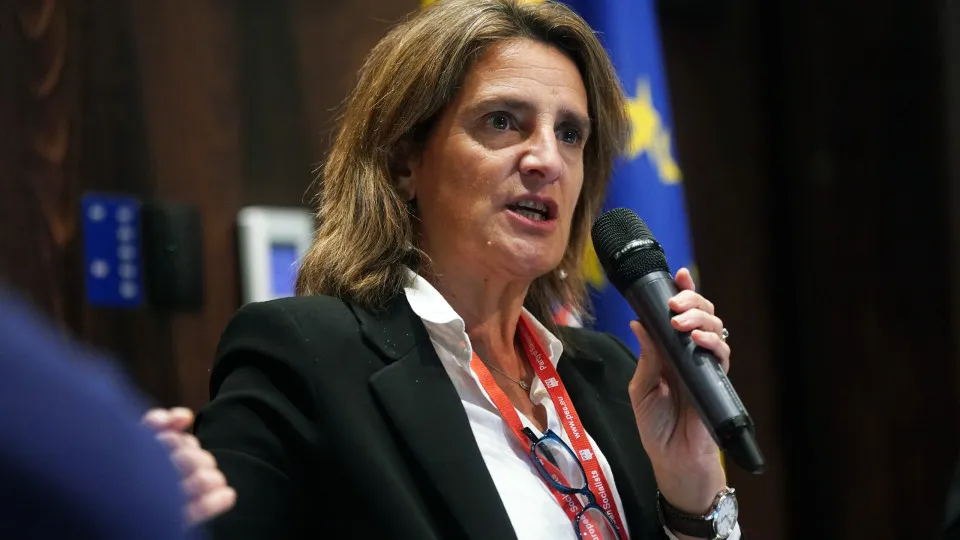
European Commission Vice-President Teresa Ribera called today for action at the UN climate conference to accelerate the response to climate change and facilitate the exit of fossil fuels.
© Getty/Alex Zea
09/11/2026
by
Lusa
A vice-President of the European Commission Teresa Ribera today called for action at the UN climate conference to accelerate the response to climate change and facilitate the exit of fossil fuels.
Teresa Ribera, responsible for the Clean, Fair and Competitive Transition area, spoke in Lisbon after a meeting with the Minister of the Environment of Portugal, Maria da Graça Carvalho, and referred to the 31st United Nations climate conference (COP31), which began today in Antália, Turkey.
Responding to journalists, the Vice-President of the European Commission has admitted that it is not easy to remove fossil fuels from production countries or consumers, but has added that “easier and simpler” is to facilitate electrification in final energy consumption, and has therefore welcomed the Turkish proposal to get out of COP31 the decision that 35% of energy consumption is electricity in 2035.
Maria da Graça Carvalho also considered the proposal a good measure, arguing that the origin of this electricity is renewable.
Teresa Ribera also said that COP31 should address the issue of technology transfer.
“ For a long time, in the space of climate conferences, one of the most difficult issues to negotiate was technology transfer. And today, the technologies associated with clean electrification are concentrated in some countries, perhaps it is also time to recover this idea of technology transfer and that it cannot be used as a geopolitical pressure tool ", he pointed out.
The responsible emphasized the importance of adaptation and resilience, praised Portugal’s work on this issue, and said that on a global scale “it is essential to continue to deepen cooperation on adaptation”, but also “to guide investment and financing decisions so that development is a development that can continue in time”.
Teresa Ribera advocated innovation in the debate on funding for the adaptation and mitigation of climate change and, personally, recalled proposals from UN Secretary-General António Guterres, who has demanded new international revenues.
For the adaptation fund, for the money needed to build resilience in the poorest countries and for global cooperation, “it might be a good idea to think about how the oil and gas industry contributes, which generates huge profits that end up in few hands, generating great damage that are socialized,” he said.
“It is one of these ideas that I think gain interest and debate in the technical aspect, the ethical aspect and the approach with which the different political leaders deal with the climate,” said Teresa Ribera, regretting that this space has not yet been achieved.
Also questioned by journalists, the Vice-President of the European Commission admitted that it is necessary to improve in the fight against extreme climate phenomena, and said that there are sometimes difficulties in prioritizing measures (e.g. heat wave or drought or floods).
Exemplifying with heat waves, he questioned how to develop a joint action, preventing deaths in these heat waves, the same applying in floods or droughts.