
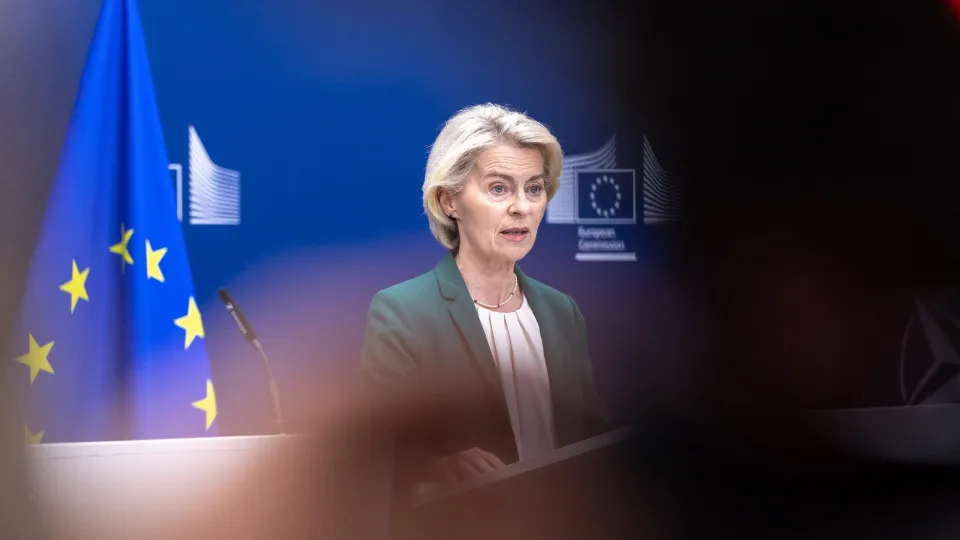
The President of the European Commission today warned of the risks of major cuts in the next long-term budget of the European Union (EU) by 2034, arguing that a significant reduction in funds could compromise Community priorities.
© Omar Havana/Getty Images
06/10/2026
by
Lusa
“ ANDi am aware that it is not easy to balance all limitations. I am also aware of the difficult budgetary situation in the Member States, but I would like to warn you of the risks of major cuts,” said Ursula von der Leyen.
Speaking in a debate in the European Parliament in the French city of Strasbourg on the preparation of the forthcoming European Council meeting, scheduled for mid-month, the leader of the Community executive stressed that “this could mean deep cuts in key priorities” agreed by all.
“That is why we have proposed a significant package of new own resources and I know that this Parliament will support me on this issue,” he recalled in an allusion to the new revenue proposed by the institution.
Ursula von der Leyen described the current price energy crisis as “an additional reminder that the next long-term budget needs to be up to the many challenges facing Europe”.
This is the Multiannual Financial Framework (MFF), which sets out EU priorities and expenditure limits for the period 2028-2034.
“ I believe that the priorities we have proposed in the MFF are the right priorities and, if we want to preserve our priorities and the level of ambition we have for Europe, we must do the difficult work on the revenue side,” the President of the European Commission called for, when a revised proposal from the Irish Presidency of the EU Council will be expected in the coming days to include new own resources.
Von der Leyen listed among the priorities for the next MFF the strengthening of investment in defence and security, competitiveness and innovation, but stressed the need to safeguard that traditional priorities for cohesion and agriculture “are not jeopardised”. Portugal also asks for such guarantees.
In addition, the strengthening of the EU’s financial capacity to respond to crises such as natural disasters and illegal migration, and “this summer reminded us how critical these instruments and funding are,” said the EU executive leader.
According to the person responsible, the debate is above all “a matter of ambition”.
The discussion on the budget should be among the themes of the European agenda in the coming months.
The final agreement requires unanimity from the countries and consent from the European Parliament.
The European Commission proposal for the MFF 2028-2034 provides for a budget of almost EUR 2 billion at current prices, equivalent to 1.26% of EU gross national income (GNI), including repayment of NextGenerationEU debt.
Brussels also proposes five new own resources – from the European carbon market, the carbon adjustment mechanism at borders, electronic waste, tobacco and large companies – to finance new priorities.
For its part, the European Parliament advocates a budget of 1.27% of GNI, either the repayment of NextGenerationEU debt outside the budget ceiling and calls for at least EUR 60 billion annually in new own revenue from new sources of taxation and carbon market revenue, large companies and the digital sector.
At Council level, the proposal presented by the EU Cypriot Presidency in June pointed to EUR 1.73 billion, a reduction of EUR 32.8 billion compared to the Commission proposal, and equivalent to 1.23% of GNI.
The Irish presidency of the Council of the EU should, in the coming days, bring the positions of the Member States closer together with the own resources among the most sensitive dossiers of the negotiation.
The decision on new sources of revenue requires unanimity in the Council and ratification by the Member States.