
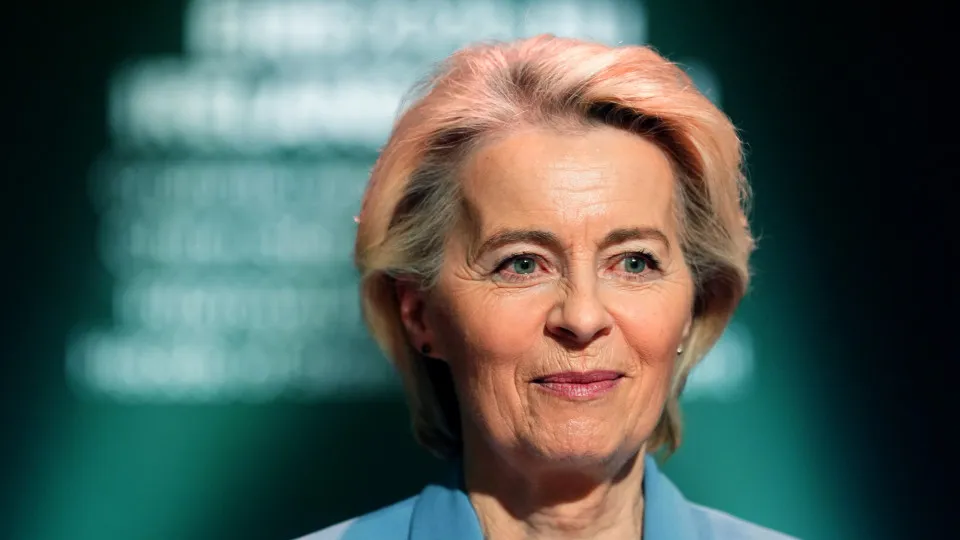
The President of the European Commission today warned that Europe “can’t make mistakes” on Artificial Intelligence (IA) at the end of the first European Summit on the risks and benefits of this technology for the economy and society.
© Brian Lawless/PA Images via Getty Images
13/11/2026
by
Lusa
A president of the European Commission today warned that Europe “can’t make mistakes” on Artificial Intelligence (IA) at the end of the first European summit on the risks and benefits of this technology for the economy and society.
“ Each generation faces a technological turning point that shapes the following decades. For ours, it is the AI, and Europe cannot make mistakes,” said Ursula von der Leyen, who intends to continue to “accelerate” the use of AI while trying to contain its dangers.
The leaders of the European Union (EU) also discussed today how to mobilise public and private investment for the development of the AI, with the aim of reducing external dependence, while stressing the need to shield democracies against the risks that may arise from its use.
“AI is the most important technology of our time. Europe must make the most of its benefits, from increased productivity to better public services. We must also manage the risks and changes that it will bring, and contribute to setting global standards for responsible governance and a safe and human-centered AI”, also defended the President of the European Council, António Costa, at the press conference at the end of the informal European summit at which the topic was discussed.
The first debate on this technology at the level of EU leaders was attended by the CEO of Mistral (French AI company), Arthur Mensch, and the Nobel Prize in Physics 2024, scientist and academic Geoffrey Hinton, known as “the godfather of the AI”.
Mensch spoke of Europe's competitiveness and technological sovereignty, stressing the need to reduce external dependence and strengthen its own capacities.
In addition, it stressed the need to boost the adoption of AI technology throughout the European economy, through infrastructures supported by clean and accessible energy, as well as large public and private investments.
In turn, Professor Hinton analyzed the risks, security and social impact of this tool, with particular attention to its effects on fundamental rights, the protection of minors, democratic processes and the European social model.
It also stressed the need to address the challenges of cybersecurity, avoid market concentration in few companies and articulate the European contribution to international governance with a view to ensuring an advanced and secure AI.