
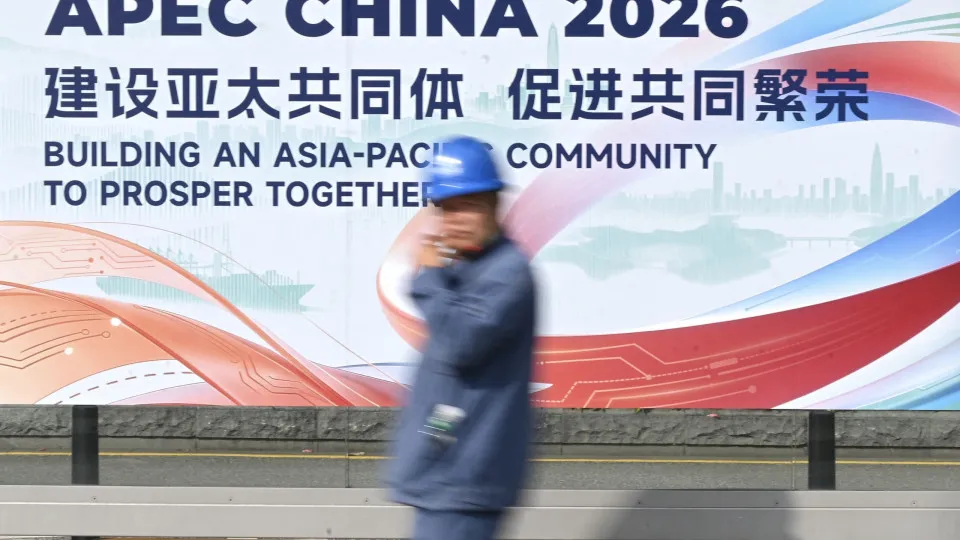
This week's APEC summit in China is expected to produce little concrete results, while the meeting between the leaders of the United States, China and Russia could aggravate tensions with Europe, according to analyses from various research centres.
© Getty Images
16/11/2026
by
Lusa
A this week's APEC summit in China is expected to produce little concrete results, while the meeting between the leaders of the United States, China and Russia may exacerbate tensions with Europe, according to analyses from various research centres.
The meeting of Asia-Pacific Economic Cooperation (APEC), scheduled for Wednesday and Thursday in the city of Shenzhen, takes place in a context of commercial, technological and military rivalry among the major world powers.
“ Neither side is preparing ambitious results for this meeting,” wrote Ryan Hass, director of the John L. Thornton Center for China, of the American Brookings Reflection Group, in an analysis published on Thursday.
According to Hass, the main issue of the meeting between US and China leaders, Donald Trump and Xi Jinping, respectively, will be the eventual extension of the trade truce, currently scheduled until January.
The two presidents can also announce progress in military communication and cooperation on artificial intelligence (IA), although without substantial compromises.
Jonathan Czin, Brookings investigator, was more pessimistic: “A lot of thunder, no rain,” he wrote, using a Chinese proverb to characterize the previous encounters between the two leaders.
“ Now both sides seem content to give priority to the image at the expense of any substance. The result is a pantomime diplomacy”, he considered.
The trilateral meeting with the Russian President, Vladimir Putin, raises further concerns for Europe.
Alicja Bachulska, a researcher at the European External Relations Council, in an analysis published by the Australian ‘think tank’ Lowy, warned that a purely symbolic meeting reinforces the perception that China agrees to discuss the future of European security without European participation, particularly as regards Ukraine.
“ It will be a very difficult balance exercise to reconcile the interests of the three parties involved,” he said.
Ryan Hass considered Putin to be the main beneficiary of the meeting by recovering diplomatic recognition without necessarily making concessions on Ukraine.
For Xi, the meeting reinforces China's international centrality, but also implies taking responsibility for the results.
The nuclear issue is another obstacle.
Heather Williams, director of the Nuclear Issues Project of the Center for Strategic and International Studies (CSIS) in Washington, considered that a trilateral disarmament agreement remains out of reach.
“ Negotiations on denuclearization imply a trilateral agreement on reductions or limitations, which Trump, Putin and Xi cannot achieve,” he wrote.
The expert pointed out, however, possibilities for understanding early notifications of missile launches and maintenance of human control over nuclear decisions in view of the progress of the AI.
“ This is not the time for substantial reductions in nuclear arsenals,” Williams warned.
For Deborah Elms, a trade policy expert at the Hinrich Foundation, rivalries between the major powers are also compromising APEC's ability to promote regional economic integration, supported an analysis published by the Australian Lowy Institute.
The researcher noted that the organization composed of 21 economies faces growing difficulties in reaching consensus, at a time when trade and geopolitical tensions overlap multilateral cooperation.
“ The differences between members remain profound and there is very little time left to resolve the outstanding issues,” Elms noted.