
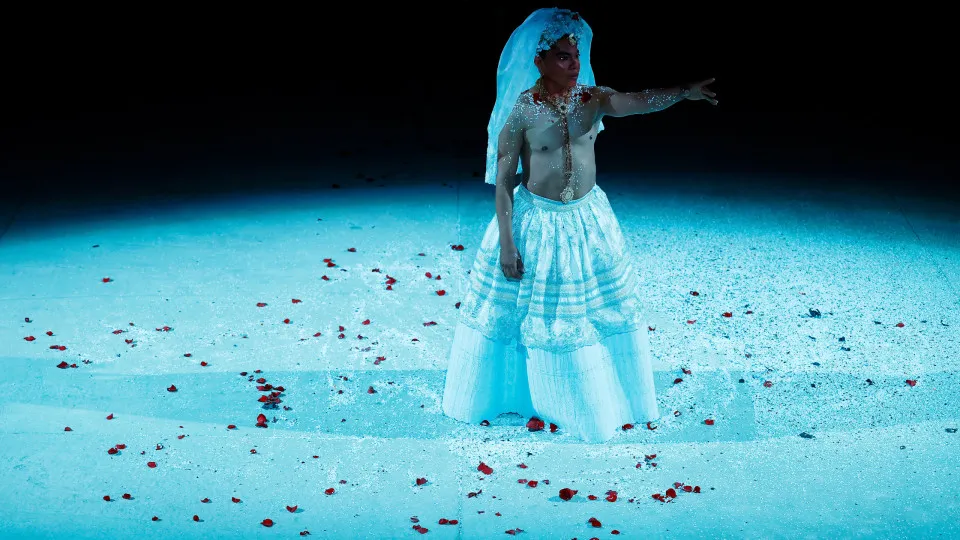
The European Dance Award Salavisa was awarded today to Lukas Avendaño, a natural artist from Mexico, who told Lusa that the award represents “a great responsibility”, for giving international visibility to their communities.
© Leopoldo Smith Murillo/Getty Images
17/11/2026
by
Lusa
O Today, the European Dance Award Salavisa was awarded to Lukas Avendaño, a natural artist from Mexico, who told Lusa that the award represents “a great responsibility”, for giving international visibility to their communities.
The prize, in second edition, worth EUR 150,000, created by the Calouste Gulbenkian Foundation in collaboration with eight European cultural institutions, was delivered today at a ceremony at the institution in Lisbon.
“ Being at the center of the world’s attention, coming from a periphery, seems to me a great responsibility”, said Lukas Avendaño, who develops a work at the intersection of dance, performance, anthropology, ritual and activism, linked to Zapotec culture and diverse sex-generic identities.
For Avendaño, the distinction goes beyond individual recognition, by allowing to put on the dance map a very small community that remains practically invisible in Mexico itself as a producer of dance, art and performance.
“I want to imagine that this reward can also become a kind of historical repair of these identities that we still have in America,” Lusa said, referring to communities and identities that have remained at the margins of dominant cultural narratives.
Avendaño explained that he intends to take advantage of the international projection now achieved to continue to build spaces of security, expression, visibility and, above all, hope through artistic creation, in a context he considers marked by the growth of “discriminatory, xenophobic and racist discourses”.
“ When free expression comes full of discrimination, xenophobia, racism, it seems to me that it can lose this right to freedom that is claimed for all and all ", sustained, justifying the responsibility it associates with the international recognition of his work.
The distinction was attributed by a jury made up of River Lin, La Ribot and Ilgaz Gurur Ertem, who selected Avendaño from among five finalists, considering that his artistic practice is distinguished by the “ singular form” as it brings together “performance, choreography, ritual, social anthropology, writing, pedagogy and political action”.
In the foundation, the jurors highlighted the cultural wealth and the multiplicity of dimensions of Lukas Avendaño's work, in which dance, costumes, text, testimony, music, ritual structures, public intervention and collective memory coexist without being subordinated to a single discipline.
The jury also considered that Avendaño demonstrated “an exceptional capacity to communicate the different cultural, historical and political dimensions of his artistic practice, without reducing its complexity”, seeing in his work a form of expression, archive, testimony, ritual and collective survival.
The remaining finalists of this edition were Italian Chiara Bersani, Australian Dan Daw, Dutch and Swedish Jefta van Dinther and South African Mamela Nyamza.
Born in Oaxaca, Mexico, Lukas Avendaño is trained in dance and anthropology, and develops a transdisciplinary practice that crosses choreography, performance, ethnography, writing and activism, exploring issues of identity, sexuality, power and memory.
Its creation is also part of the Zapotec culture and Muxe tradition, a social and gender identity that challenges the binary division between male and female, integrating a reflection on the way in which the native peoples and diverse identities are represented in society, according to information disclosed by the organization of the prize.
In the statements to Lusa, Avendaño drew attention to the difficulty of accessing indigenous artists to the main cultural circuits of Mexico, where, in his reading, “programming policies tend to favor a Western aesthetic and classify the proposals of the native peoples as folklore or manifestations of a rural culture”.
Lukas Avendaño considers that this recognition is also a form of historical resistance, in a country that, despite about two centuries of existence as a republic, continues, in its perspective, not to fully recognize indigenous peoples as producers of knowledge, aesthetics and transmitters of heritage.
The disappearance and violence in Mexico also cross his work, including the disappearance of his brother, Bruno, to whom he dedicated the performance “Searching for Bruno”, in which personal experience intersects with collective memory and political denunciation.
In addition to the financial prize, Avendaño will have the opportunity to present his work on the stage of the partner cultural institutions of the award.