
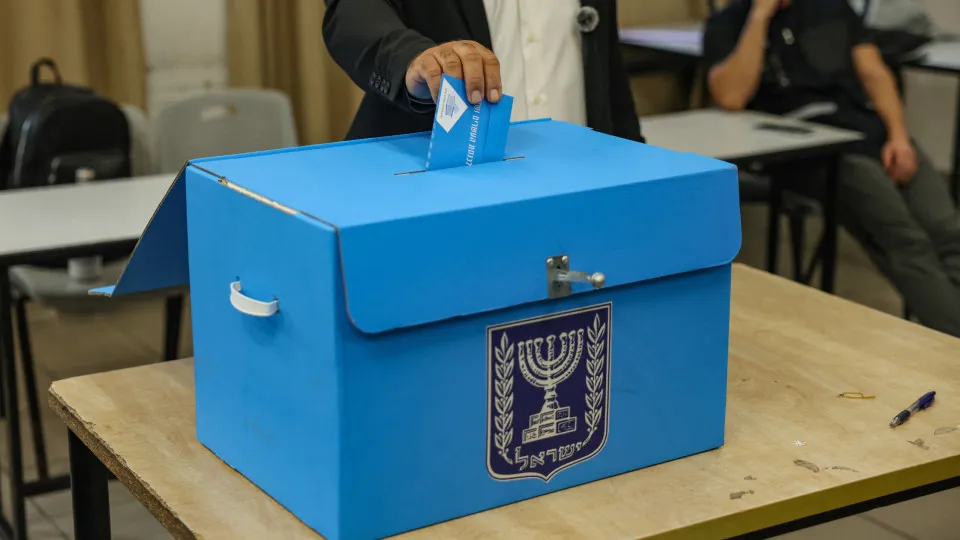
Shin Bet found no evidence of vote buying in the October Israeli election, according to the Central Election Commission.
© AHMAD GHARABLI / AFP via Getty Images
17/11/2026
by
Lusa
O israel's internal information service (Shin Bet) found no evidence of claims to purchase votes in the Arab community during the legislation of October 27th, today informed the Central Election Commission.
“The analysis of evidence and information raises numerous suspicions. However, at this stage, there is no evidence that bribes have been paid to voters on a scale that could affect the election results,” said the electoral body in a statement, regarding complaints raised by the party of the outgoing Prime Minister, Benjamin Netanyahu.
The statement, authorized by the chairman of the electoral committee and Vice President of the Supreme Court, Noam Sohlberg, and released with the consent of Shin Bet’s head, David Zini, adds that the investigation will continue “untiringly”.
According to the text, research will now focus on “more security issues”, specifically “subversion and foreign influence issues, which are not central to the electoral process or its results”.
Two days after the vote, Sohlberg asked Shin Bet to start an investigation into possible foreign interference in the elections after the Central Election Commission received data from the information service itself that justified the opening of an investigation.
In addition, during and after election day, allegations emerged that Arab party activists Ra’am would have participated in a scheme to offer financial incentives to voters in exchange for their support.
Three Ra’am members were arrested shortly before the polls opened and later released.
Benjamin Netanyahu released a video of these arrests and stated that the Arab parties were trying to “steal the elections”.
The following day, his party, Likud, reiterated the claim and used the term “Ra’amgate”.
The Joint List, the main coalition of Arab parties in Israel, and several opposition groups accused on Monday the outgoing Prime Minister of orchestrating an operation for the unfounded detention of Ra’am politicians in an attempt to discredit the vote of this minority, whose two political forces obtained a record election of 19 deputies.
The Joint List also requested the establishment of a state inquiry committee on the alleged transfer of information from the Prime Minister's office to the Israeli police prior to the elections, which triggered the arrests, according to a report from Channel 12 released on Sunday.
For its part, the Ministry of Justice announced on Monday, in a statement, that the government’s legal adviser and the Attorney General would meet to discuss the matter.
Both stated that they would ask the police to suspend their internal investigations, meanwhile announced, until the subject “is coordinated in an orderly manner and the appropriate format for the investigation is defined”.
The Joint List has submitted a second request to the prosecutor to open a criminal investigation against Netanyahu.
The elections in Israel resulted in a political stalemate, since neither the Netanyahu bloc nor the opposition, led by Yashar! (Integer!), the former head of the Gadi Eisenkot armed forces, managed to obtain a parliamentary majority to enable an executive.
Eisenkot was tasked on November 7 to form government within 28 days, extended for another 14, but still did not signal the way to gather the support of 61 deputies needed for an absolute majority.
Netanyahu for his part has advocated the creation of a government of “national unity”, without Arabs and including the Zionist opposition, which nevertheless rejected this option.
The leader of Yashar! proposes alternatively an executive of “national emergency” that removes the current Prime Minister.