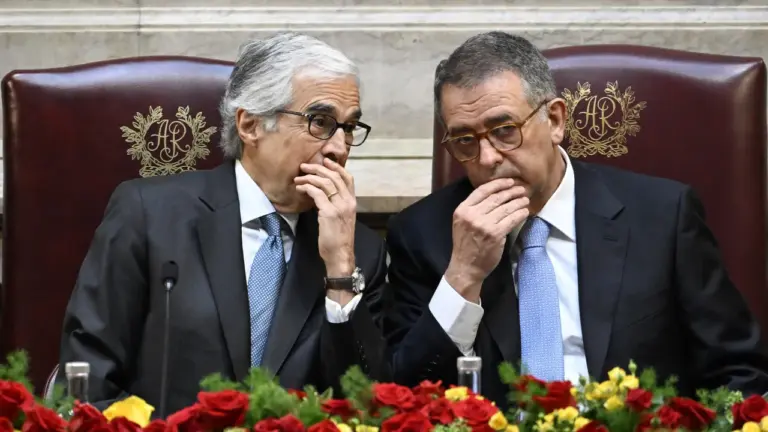
Patrícia Fernandes, António Costa Pinto and José Adelino Maltez spoke this Wednesday with the News to the Minutes about the speech of November 25 made by the President of the Assembly of the Republic. Between “consensus” and a possible “pycardia”, this is the analysis of one of the moments that marked the solemn session.
© Horacio Villalobos#Corbis/Getty Images
25/11/2026
by
O to mark from November 25 brought no less than expected: controversy. If the date already divides the Portuguese political spectrum, this year another source of division were also the words of the President of the Assembly of the Republic (PAR), José Pedro Aguiar-Branco, who during his speech said that “it must be explained again that popular assemblies are not democratic forms of decision, that the constitutionality of a law is discussed with a judge and not with a police officer, that legislation is still made in this house [in Parliament], and not on the street”.
To these statements, António José Seguro, present in Parliament, replied: “The voice of the people should not be heard only when there are elections.”.
Come in other points of the speech, there was also criticism of the need for “consensus”, an expression widely used to remedy divisions. Can the search for consensus weaken the democratic regime?
O News to Minutes heard three experts in science and political theory on these issues, and opinions do not always coincide. Let's do it
What has been said about popular assemblies – which have been marking these last few weeks with protests for housing – is it rigorous in the light of political science or even in the light of the functioning of a democracy?
Ao News to Minutes, Patrícia Fernandes, researcher at the Center for Ethics, Politics and Society (CEPS), started by stressing that this is a subject on which the authors do not agree, being “democracy an essentially contested concept”. “Some people understand, such as PAR, that only liberal/representative democracy is true democracy and that other forms of participation or intervention disturb the functioning of liberal democracy. But I believe that this position, apart from not being a majority, does not respect the historical context of the emergence of democracy. Democracy was a political regime created by the Greeks (and was participative and not representative) and, therefore, to say that the democracy of the Greeks is not true democracy is a logical mistake”.
At this point, however, the PhD in Social and Political Philosophy from the University of Minho gives reason to Aguiar-White in one aspect: “As soon as a population opts for a liberal democracy regime (as with elections to the Constituent Assembly), this excludes the legitimacy of popular assemblies to decide on the common good – both are not compatible simultaneously. And that is why we should not look at this intervention of the PAR just in the light of ‘political science’, but we should consider the historical Portuguese context, particularly in view of today’s day.”.
For CEPS researcher, “it is possible to organize popular assemblies to make decisions in private organizations or associations – but what popular assemblies decide about the public good has, and cannot have, any value for the government or the Assembly of the Republic”.
For polytologist António Costa Pinto, Aguiar-White expressed the most classical position of “law and order”.
The political science researcher José Adelino Maltez he said that “in the background [PAR] evoked representative democracy against the multi-tudinary impossibility of a so-called popular assembly being able to represent this group – and has made this speech successively”. Adelino Maltez also recalled that the form of speech and combat presented “is not today”, given that until when the Magna Assembly of the Academic Association of Coimbra excluded Enough from all events, Aguiar-White reinforced that dialogue should be done with all parties.
This investigator also said that “Aguiar-White has made this pedagogy, representative democracy against gatherings that take place as popular assemblies”.
What about consensus? Does the search for consensus weaken democracy?
José Adelino Maltez is permanent in this field: “ He sent an indirect to the President of the Republic, who received representatives from the camps, on behalf of the word consensus. That’s what he did.”.
The investigator stresses that the use of this word, which marked Aguiar-White's speech, was not, in his view, appropriate: “The consensus is the pact, the pact is the equivalent of the Magna Carta, the creation of political Portugal was made in terms of pacts. And he uses the word ‘consensus’ denigrating it, forgetting that the previous name of democracy was consensualism. In my view, it's a mistake, you got the word out and you don't respect it. The consensus is the basis of democracy, above all of Iberian democracy. But then in his own speech he used another word equivalent to this to commend it, which is a social contract – consensus is a social contract. You got drunk with the word to piss off Insurance. And so, of course, you'll abandon what you said today. It is a rhetorical game that does not respect the origin of the word consensus – consensus is the basis of democracy. It offended a sacred word“.
“ But then the President changed his turns because, certainly, knowing the speech, he never used the word consensus ", he also pointed out, considering that here he was faced with a “picardia between Aguiar-White and António José Seguro”.
António Costa Pinto, in turn, does not agree with this vision: “The President of the Republic had a message consistent with his immediate past – looking for agreements, even with social movements.”.
In view of Aguiar-White's statements on the basis of democracy being the right to difference, several considerations were made. Here, Patrícia Fernandes attributes more reason to Aguiar-White and explains: “In this case, the position of the PAR seems to me to be better than that of the President of the Republic: it is part of the very essence of representative democracy based on dissension and dispute – and that is why decisions are taken by a majority and not by unanimity.”.
When it comes to talking about consensus, there are still two problems. It is because, if “on the one hand, it often serves as a discursive strategy to escape an electoral defeat (the majority in Parliament is lost and consensus is defended)”, “as societies are increasingly fragmented and polarized, the appeal to consensus becomes an empty and round discourse.”.
“ Political actors tend to seek consensus to generate social cohesion – but the opposite is true: when there is social cohesion, consensus is naturally generated. We must therefore work for social cohesion and not for consensus”, he said.
António Costa Pinto makes it clear that the PAR’s position on these statements is assertive, justifying: “Democracy is institutionalized conflict. Democracy is the institutionalisation of the conflict.