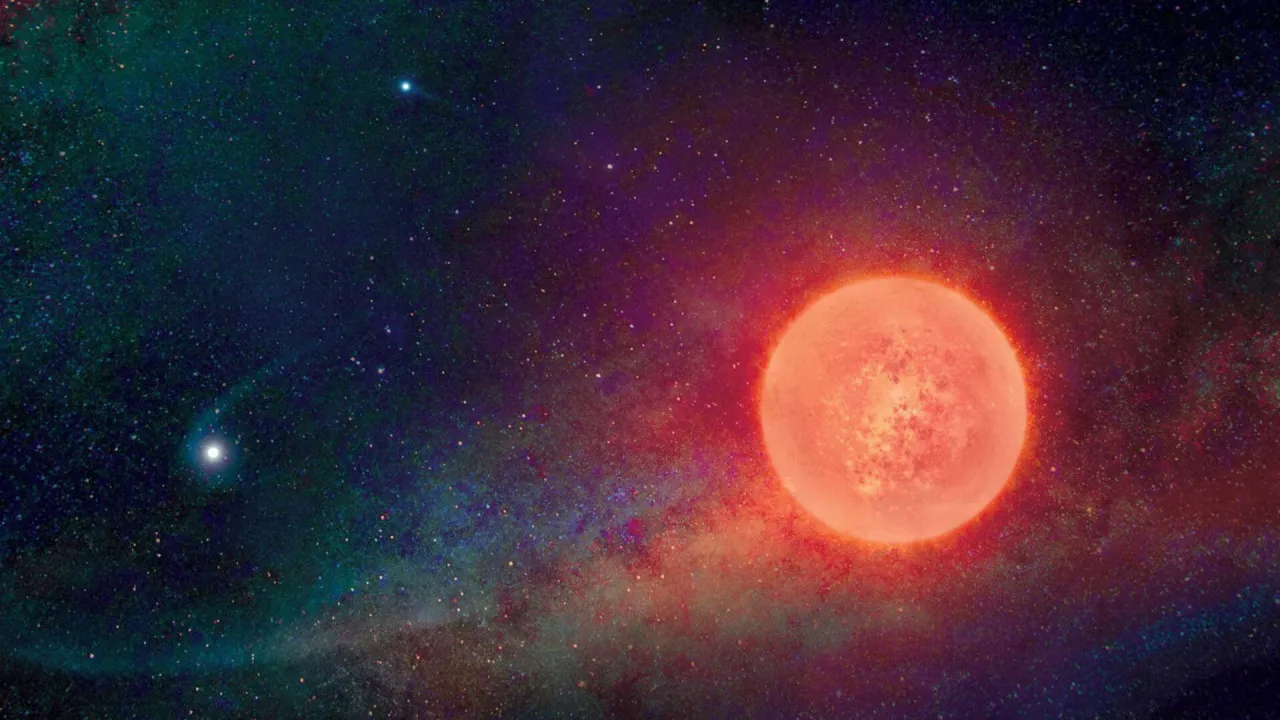
An international team of astronomers discovered a system from three stars to 28 light-years from Earth, in which one star survived the expansion of another.
© Benoît Gougeon/Université de Montréal.
19/11/2026
by
Lusa
Uthe international team of astronomers discovered the “only” 28 light years from Earth, a three-star system in which one star seems to have survived the expansion of another.
The system consists of a red dwarf and two white dwarfs, according to a study published today in the scientific journal Astronomic & Astrophysics.
The discovery was made by an international team led by the Trottier Institute for Exoplanet Research (IREx) of the University of Montréal, which initially sought planets orbiting the red dwarf.
The investigators detected changes in the velocity of this star that reached almost 16 kilometers per second, more than a thousand times what they hoped to find.
After several years of observation, they concluded that the star had an invisible companion with a mass greater than half that of the Sun.
“ The unusual combination of high mass and very low brightness left only one plausible explanation: it was the remnant of a dead star”, explained in the scientific article on the discovery, Charles-Antoine Parent, a graduate student at Laval University and coauthor of the study.
Later observations, carried out with the Gemini North telescope in Hawaii, made it possible to identify this companion directly as a white dwarf.
While a red dwarf is a small, cold star that still burns fuel in its core, a white dwarf is the dense, warm core that remains when a Sun-like star drains its energy and dies.
The team already knew that a second white dwarf, located the longest distance, was part of the system, forming a three-star configuration.
According to researchers, no other system comparable to less than 100 light-years from Earth is known.
The discovery is particularly relevant because the star that is now a white dwarf will have been, before dying, about 40% more massive than the Sun and will have increased several hundred times in size during the extinction process.
Under these circumstances, the expansion of the star could have swallowed the red dwarf or caused the fusion of the two, but the latter seems to have survived and remained in a stable orbit.
“ This system should not exist. We don't have a clear explanation for how you got here. This is the question that guides our next observations”, said Patrick Dufour, a professor at the University of Montréal, a specialist in white dwarfs and co-author of the study.
The team measured the newly identified white dwarf mass with a margin of uncertainty of less than 1%, a result that may help test star evolution models and matter behavior under extreme density conditions.
Researchers now intend to study gravitational interactions between the three stars to understand how the system has formed and how it has managed to maintain the current configuration.
“ Discoveries like this remind us that our own cosmic neighborhood [in astronomical terms 28 light years is considered close] still contains notable surprises,” says Étienne Artigau the main author of the study.
The name Welopō The Hua He Inoa combines words associated with a family inheritance and a circular orbit or trajectory.