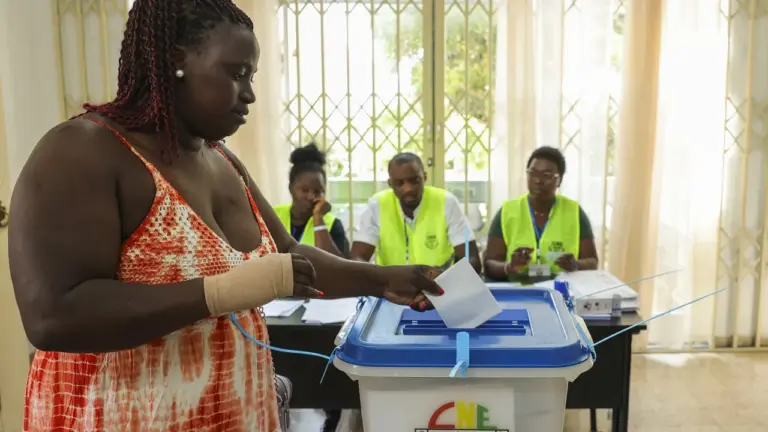
The candidate who claimed victory in the elections prior to the military coup in Guinea-Bissau, Fernando Dias da Costa, welcomed the relaxation of restrictions on parties, but urged the military to create conditions for the official proclamation of election results.
© Lusa
25/11/2026
by
Lusa
O candidate who claimed victory in the elections prior to the military coup in Guinea-Bissau, Fernando Dias da Costa, welcomed the relaxation of restrictions to parties, but urged the military to create conditions for the official proclamation of election results.
In statements released by the Guinean media, consulted by Lusa one day after the relaxation of the restrictions imposed on political parties by the military authorities that led the coup d'état on November 26, 2025, the main Guinean political parties and leaders announced the resumption of their activities.
Fernando Dias da Costa, candidate who gathered opposition support to the then President Umaro Sissoco In the elections held on 23 November 2025, he proclaimed himself the winner of the presidential coup interrupted by the military coup d'état, praised the political reopening, but demanded “concrete steps” in the electoral process.
While recognizing as positive the beginning of internal reconciliation, the leader urged the Military High Command to create conditions for the official proclamation of election results, reaffirming that the voting minutes confirm his victory, and called for serenity while waiting for the authorities to do “what is just”.
The reopening of political activities occurs following the decision of the self-proclaimed High Military Command for the Restoration of National Security and Public Order, author of the coup d'état of November 26, 2025, to authorize meetings, assemblies and congresses, “by prior communication to the competent authorities”.
The High Military Command, which has been running the country since the coup, stated that the measure “aims to ensure the functioning of party organizations without compromising public order”, remaining, however, “the prohibition of rallies, marches and public demonstrations”.
In response, the African Party of Independence of Guinea and Cape Verde (PAIGC) made official, through a note signed by the National Secretary, António Patrocínio Barbosa da Silva, the “immediate return” of the regular activities of all its basic, intermediate and superior structures.
The leadership of the party instructed the Regional Political Commissions to notify the local administrative authorities in advance of the scheduled meetings and called on the militants for strict compliance with the internal statutes.
The national headquarters of the PAIGC in Bissau have been banned since September by order of the transitional authorities, which invoke the new Constitution, which states that the premises of parties cannot be less than 500 metres from buildings of sovereign organs, diplomatic representations, military barracks, police stations and hospitals.
The PAIGC claims that the property was officially donated to it by the Guinean State in 1991.
In turn, the Social Renewal Party (PRS), through the wing led by Félix Nandunge, welcomed the decision to relax party activity during a communication held at its headquarters in the neighborhood of Santa Luzia, also in Bissau.
In statements to journalists, the leader Francelino Cunha classified the measure as a “positive step towards peace”, inviting the other political actors to an “inclusive dialogue focused on solving the country’s problems”.
In the Movement for Democratic Alternance (Madem G-15), the moment is seen as a “restructuring opportunity”, advocated, in a press conference, Abel da Silva, Secretary General of the wing led by Braima Camara.
Speaking at his residence in Bissau, Abel da Silva argued that the return to party activity should serve to “start immediately” a process of internal reconciliation between the two sides of the party, stressing that unity and cohesion are priorities for Madem to contribute to national reconciliation.
The Guinean military led a coup d'état on November 26, 2025, the day before the publication of the results of legislative and presidential elections, and removed from power the then President and candidate, Umaro Sissoco Embalo.
They created a National Transitional Council (CNT), which took over the powers of parliament, and appointed Ilídio Vieira Té Prime Minister and Minister of Finance.
The opposition considered that this was a coup d'état staged to allow Sissoco Embalo, who has lived regularly in Morocco since the coup, to return to power through new presidential and legislative elections marked by the military for 6 December and in the meantime postponed, without a new date.