
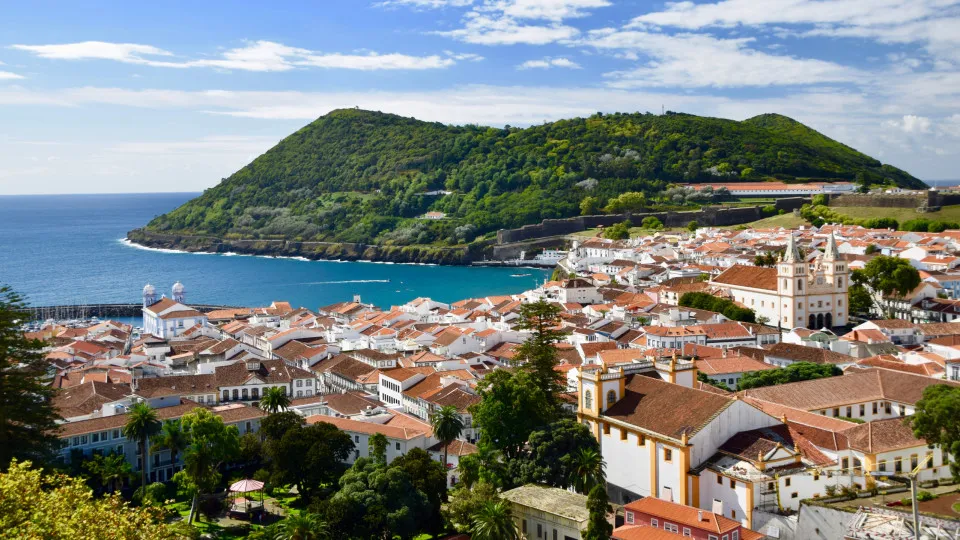
The 11th edition of the Portuguese cinema show Cine Atlântico, which starts on Friday in Angra do Heroísmo, in the Azores, pays homage to the director Paulo Rocha and presents the new cinema that takes place in Portugal.
© ShutterStock
15/10/2026
by
Lusa
Atlantic Cine
A 11th edition of the Portuguese cinema show Cine Atlântico, which starts on Friday, in Angra do Heroísmo, in the Azores, pays homage to the director Paulo Rocha and makes known the new cinema that is made in Portugal.
“Paul Rocha was, say, the founder of the new Portuguese cinema in the 1950s, 1960s. He is a director already deceased in 2012 and relatively forgotten. We understand that it was interesting to make a review of his main films”, said in statements to Lusa, the president of the Cine-Club of Terceira Island, Jorge Paulus Bruno.
The show, promoted by the cinema club, which has as programmer the film critic José Vieira Mendes, extends this year for two weekends.
In the first, from 16 to 18 October, six films are shown in the room of the Philharmonic Society of Instruction and Recreation of Artists five films by Paulo Rocha and in the second, from 23 to 25 October, six films that seek to reflect the new Portuguese cinema, with the theme “open wounds and new languages”.
The Island Cine-Club Terceira had already shown another edition “Os Verdes Anos”, by Paulo Rocha, which according to Jorge Bruno is the “foundational film of the new Portuguese cinematography of the middle of the century [XX], which discovers other forms of filming and another country” and which “creates a rupture with what was the cinema of the regime of the Estado Novo”.
Now the Cine Atlântico takes stock of the work of the Portuguese director, in a partner with the Cinemateca Portuguesa.
“ So we understand that we make a bridge to the next weekend, which is precisely contemporary Portuguese cinema. Because just as Paulo Rocha created a break with the previous cinema, at the moment, in Portugal, at the level of the films that are being made, there is, in a way, also a crack look with a cinematography that, in recent years, was being practiced ", advanced the president of the cineclub.
This year, contrary to what is usual, there is no common line in the selection of contemporary films displayed in the show, but Jorge Bruno considers that these directors “seek to review and understand the country in another way and eventually through another film language”.
“It is a mirror of today’s country that treats, in a way, contemporaryness and, in some cases, the past itself, but revised in the light of the present. All this I believe is very linked with what Paulo Rocha did about 50, 60 years ago, which was precisely a search for transition between tradition and modernity ", he stressed.
Founded in the 1970s, the cineclub was reactivated in 2013 and since then has been relying not only on this show, but on the cycle “The Cinema of My Life”, which displays foreign films that are outside the most commercial rooms.
“ Over the years, we have gradually been checking the viewer statistics for an increase. It's not an exponential increase, it's not movies that exhaust a room, but we're progressively increasing. And if we compare the population of the island with the number of people attending the sessions, we have a very good ratio, if we compare it with other cities in the country,” Jorge Bruno said.
On average, the audience looking for these events is over 30 years old, but the cineclub does not charge tickets to children under 18 and has partnerships with libraries and schools to try to encourage the younger ones to discover the cinema of author.
The Atlantic Cine starts on Friday with “Change of Life”, Paulo Rocha’s second film, released in 1966, which “follows the return of a soldier from the colonial war to his village in Furadouro”, depicting a “country suspended between tradition and modernity”, reads in the material of promotion of the exhibition.
On the same day, "The Desired or the Mountains of the Moon", 1987, "one of the most enigmatic and ambitious works of Paulo Rocha", inspired by the Japanese classic "Genji Monogatari" and the Portuguese myth of D. Sebastião.
On Saturday, it is presented “O Rio do Ouro”, from 1998, “considered by many the masterpiece of Paulo Rocha”, followed by “The Root of the Heart”, from 2000, “one of the most free and provocative films” of the director.
The weekend dedicated to Paulo Rocha ends with “Vanitas or the Other World”, in 2004, described as “the director’s most radical and crepuscular film”.
On 23rd, the show is resumed with “Playback”, by Sérgio Graciano, who follows the life path of Carlos Paião, “one of the most popular composers of Portuguese music”.
The next day, “O Barqueiro”, by Simão Cayatte, “a nightly social drama about the difficulty of coming home when the biggest obstacle may be what is brought inside”, followed by “Justa”, by Teresa Villaverde, a drama that addresses “the difficulty of returning to life when the idea of normality itself has lost meaning”, in the context of the fires that affected the country in 2017.
On the same day, Pedro Cabeleira presented “Introduction”, which “gives face to a periphery rarely represented in Portuguese cinema”, in a language “between drama, criminal film and an almost documentary observation”.
The exhibition ends on the 25th with the exhibition of “18 Holes for Paradise”, by João Nuno Pinto, “a drama about the fragility of the earth, human relations and a world that insists on approaching the abyss as if it still had time”, and “The Risus and Knife”, by Pedro Pinho, “a work on the encounter between Europe and Africa, but also on everything that this encounter continues to prevent, deform or make possible”.