
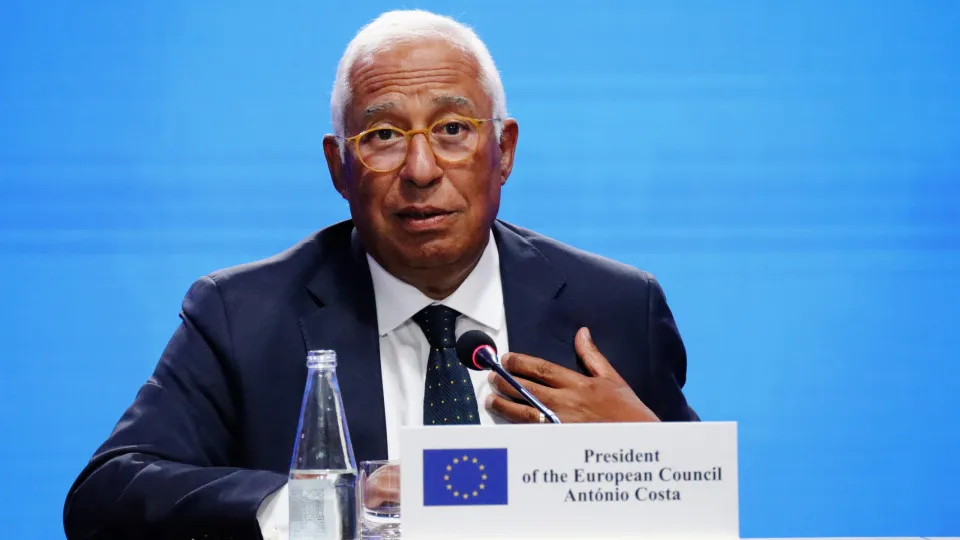
The President of the European Council, António Costa, will be the main negotiator of the EU's multiannual budget by 2034, after criticism from north to south of Europe of the Irish Presidency's proposal.
© Andriy Zhyhaylo/Oboz.ua/Global Images Ukraine via Getty Images
11/10/2026
by
Lusa
O president of the European Council, António Costa, will now be the “principal negotiator” for the multiannual budget of the European Union (EU) by 2034, after criticism from north to south of Europe of the proposal put forward by the Irish Presidency of the Council.
Today, the opinion was conveyed to Lusa by various European sources linked to the process, which indicated that António Costa will thus be “the main negotiator” of the EU’s next long-term budget 2028-2034, and it is up to him to conduct negotiations between the Member States.
After, on Saturday, the Irish presidency of the EU proposed 8% cuts from the initial Brussels document, concluding its intervention in the process, the responsibility goes to the President of the European Council, who will have to find a balance between the different national positions and seek conditions for an agreement.
On the one hand are the cohesion countries, such as Portugal, which have already criticised the cuts and lack of ambition on Community priorities, and on the other hand the so-called frugal Member States, with Germany at the head, which consider the reductions insufficient.
It is up to António Costa to manage these differences and to bring positions closer together to get governments to reach an understanding of the volume and distribution of European resources.
In the last month, the President of the European Council has already held a round of contacts with European capitals, seeking to understand the positions of governments and identify the main points of divergence, work to enable him to prepare a new compromise proposal, correcting aspects of the Irish proposal that countries consider problematic.
A new version of the proposal is now expected, but it is known that by the end of the year, summits are scheduled for October, November and December.
The timetable is another challenge, as the objective remains to reach an agreement by the end of the year, in order to allow the next European budget to enter into force on 1 January 2028.
However, the Spanish elections scheduled for November could hinder substantial progress at the extraordinary meeting of the European Council scheduled for this month, making negotiations between governments more complex, at a time when it will be necessary to move towards compromise positions.
While the conclusion of the agreement by the end of the year remains important, the European sources heard by Lusa admit that the timetable may become more difficult if the process extends beyond December.
Costa's challenge will thus be to manage the timetable and differences with a view to a political understanding.
To this end, it has the technical support of the European Commission, at a time when there is a “good working relationship” between the two institutions, advanced the Community sources to Lusa.
On Saturday, the Irish Presidency of the EU Council proposed 8% cuts in the European Commission's proposal for a multiannual budget for 2028 to 2034, for a total of €1.62 billion, without substantially moving cohesion and agriculture.
Portugal keeps a share of EUR 35.1 billion in its national envelope, to which the country wants to see EUR 900 million added for the outermost regions, Azores and Madeira.
The decision on the financing and the level of ambition of funds for the outermost regions will depend on the commitment to be made between the Member States and promoted by António Costa within the framework of the next EU budget.