
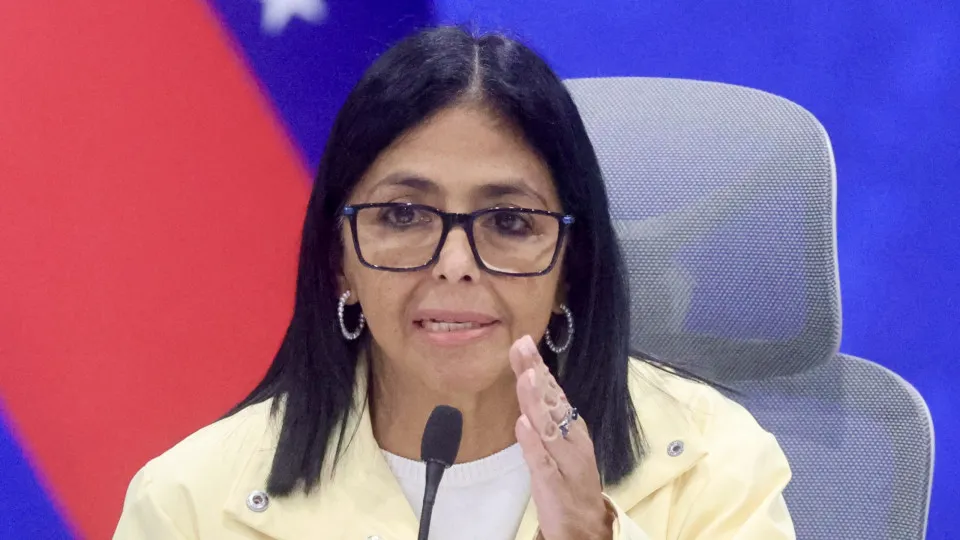
Venezuela’s interim president, Delcy Rodríguez, announced today in Rome the launch of the “Venetarian Food Plan” and a new law of local economy, with the aim of ending hunger in the country by 2030.
© Lusa
12/10/2026
by
Lusa
A interim president of Venezuela, Delcy Rodríguez, announced today, in Rome, the launch of the “Venetarian Food Plan” and a new law of local economy, to achieve the goal of “zero hunger” in the country, by 2030.
The announcement was made in front of the FAO World Food Forum, during which it highlighted the reduction of the prevalence of sub-food to 3% in Venezuela this year.
“I want, from this platform, to announce the Plan Venezuela Feeds, with the aim of articulating all the food production processes in achieving this supreme goal: zero hunger. And (...) I announce that in the coming days I will present to the Venezuelan Parliament a new law for the local economy,” said Delcy Rodríguez.
The president of Venezuela stressed that this is a law that will allow, alongside the communal, community and entrepreneurship economy, “the integration and productive chaining for food production with the large agri-food industry”.
Delcy Rodríguez began his intervention by stressing that Venezuela has a deep conviction that food is an inalienable right, directly linked to life, dignity and the integral development of people.
“Saving this right requires inclusive and sustainable public policies, but it also requires production, investment, science, technology, financing and cooperation. Peace is needed and an international system capable of cooperating, even beyond our differences. I come from a country that has learned to rise again, to rebuild on the basis of its own capabilities and to look to the future with confidence and hope. A country that seeks to be reborn”, said thanking the World Food Program for the support given to Venezuelans after the double earthquake that shook the country on June 24.
He explained that to talk about rebirth, one must look back at the land, at those who work and sow it, a process that invites “to put science, technology, innovation, investment and traditional knowledge at the service of people, to transform the agri-food systems and, above all, to ensure that the solutions effectively reach those who produce and those who still face hunger and malnutrition”.
According to Delcy Rodrigúez, mankind faces the paradox of having unprecedented technology while millions starve and food is wasted.
The current challenge, he said, requires better and more efficient production, reducing losses and strengthening agricultural systems against the climate crisis and El Niño phenomenon in Venezuela and other countries in South America.
He warned that the agricultural calendar is now determined by climate change, requiring funding for adaptation, the use of Artificial Intelligence and early warnings in production.
“ Food should never become an instrument of political pressure or confrontation. Where there are differences between states, dialogue and diplomacy must prevail, and where there is hunger, our common responsibility must be to find solutions (...) we insist on our appeal to the end of the application of measures [sanctions] which, in the margins of international law, have negative implications on the realization of the right to food”, he stressed.
He recalled that at the beginning of the century, when FAO recognized the reduction of sub-food in Venezuela, from 14.1% to less than 5%.
But according to Delcy Rodríguez, the combination of internal political conflict with the impact of economic sanctions imposed since 2017 (which affected 16% of the agri-food sector) caused the production chains to collapse and a supply crisis that affected the entire society.
Recovery Factors: Economic and agricultural stabilisation and recovery are being driven by internal political dialogue with the opposition and direct diplomatic negotiations with the United States.
“ But we started to reverse that reality. The national dialogue with the opposition sectors, as well as the diplomatic dialogue with the United States of America, contributed to the political stability needed to produce and grow,” he said, stating that this process is pointed out as the basis for a new agri-food policy, requiring legal certainty over land and property to ensure investment in the field.
It also highlighted the strong improvement of social indicators in which sub-food fell to 3% this year (after 5.3% in 2025) and acute malnutrition in children under five years of age increased from 14.8% (in 2019) to 1.3% (in 2025).
“ We want to sow much more than food: we want to sow trust, opportunities and prosperity, because peoples, like the earth, have the extraordinary capacity to be reborn”, he concluded.