Spanish electors are divided between change and continuity in the legislative elections taking place today, portrait of a politically fragmented country.
© Juanma Serrano/Europe Press via Getty Images
29/11/2026
by
Lusa
Asome spanish voters say they expect a change, while others prefer continuity, but few risk pointing out what will be the result of the legislative elections that are being held today, a picture of a politically divided country.
“ I hope you win the right, but I don’t know”, said Lusa, 28, after voting in Montserrat high school, in the Retiro Park area, center of Madrid.
From the next executive, Maria says she expects “to arrange everything”, from housing to transport, and says that young people “do not expect a good future with this government”, led by socialist Pedro Sánchez and which results from a ‘generation’ of eight left-wing and right-wing parties.
“A change” is what most voters who spoke to Lusa this morning ask for.
Lola, also 28 years old, is thrilled when she says that “no hope for young people”, who live in a “very difficult” situation, with problems in access to housing and wages.
“I hope it changes for the better”, comments the young woman, born in Cáceres.
The Monserrat school is at the end of the street where Maricarmen Abascal lived, an 87-year-old woman who died in October days after being evicted from the house where she lived for 70 years.
The eviction motivated protests and a general strike, the first in 14 years, and led the Government of Sánchez to present a package of extraordinary measures for the sector, but which was initially failed in October, leading the Prime Minister to call early elections.
Carmen Maria, 46 years old, pointed out as a priority to combat corruption – a crime that overwhelmed Sánchez' mandates eight years ago in power, with several cases linked to figures close to the president of the Spanish Socialist Party (PSOE).
“ We hope that there will be a change, because those who are... ", he revealed, beside him, the aunt, who accompanied to vote this morning.
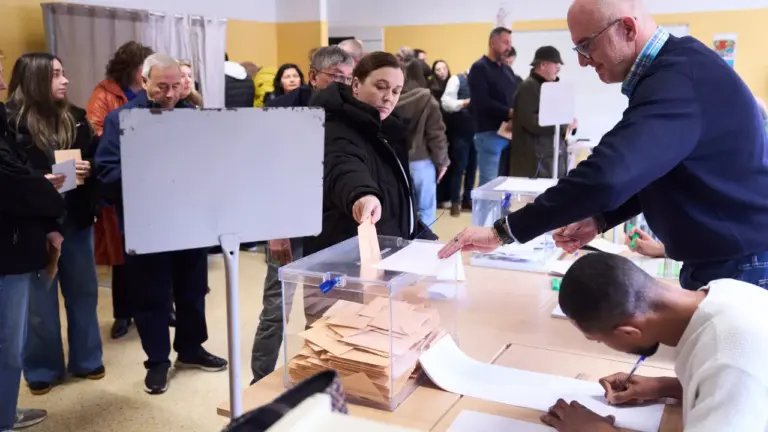
At the entrance of the school's main building, voters find at a table the ballots of the different parties, as well as ballots for the Senate and their envelopes. They collect the bulletin corresponding to the party in which they want to vote, which they put in the envelope, and which they then put in the ballot box.
In Spain, newsletters are also sent in advance by mail, so many voters already bring home the closed votes in envelopes.
Born in Argentina, Carolina, 37 years old, he was voting with his son, who rode on a bicycle without tires. “It is important that you participate in democracy and realize that it is part of the decision,” he explained.
About today’s elections, the woman said she hoped that “you will not go the wrong way”.
“I am Argentina and do not want to repeat the story”, he said. His country of origin is governed by Javier Milei, from the far right.
The possibility of the extreme right (Vox, third largest party) coming to power, in a possible coalition with the Popular Party (PP, right), leaves Gala and Fernando, both 65 years old, “very concerned”.
“ An extreme right-wing racist, xenophobic, sexist”, criticized the man, seconded by the woman: “It would be a setback.”.
Fernando also warned that if the right wins three fifths of the Senate seats, it can change the Constitution: “This always happens when non-Democrats win.”.
Peace, 53 years old, said he expected people to vote in mass and Spain to “continue to have a progressive government”.
The woman said she noted that today more people were voting than usual, stating that she hoped that an increase in participation would translate into a left-wing victory.
“ Otherwise, we could lose what we have. Because people do not realize that they are not here to defend them ", warned, referring to the right.
All candidates have made calls for high participation in today's elections, with socialists claiming that a vote of more than 75% can guarantee the necessary votes for Sánchez to remain in power.
In the last elections, in July 2023, the participation was 66.59%.
These are the 17 general elections in Spain since the end of the dictatorship of General Francisco Franco, who died in November 1975, and are called to vote 38,616,949 voters, plus 1.2 million more than in previous laws of 2023.
The Spanish law prohibits the publication of polls in the five days before the elections, so the most recent are last Monday.
Most polls published that day placed the PP, led by Alberto Núñez Feijóo, as the most voted force, but without an absolute majority, and the Vox, chaired by Santiago Abascal, with the possibility of doubling the current bench of 33 deputies.
PP and Vox together will have about 190 Members, 14 more than the 176 minimums required for an absolute majority, according to the average of all surveys, calculated by the Spanish media.
The two parties govern related in four autonomous regions and have also admitted to align at national level.
On the last day of the campaign, on Friday, the PSOE released internal studies that indicated that the left was close to the absolute majority.