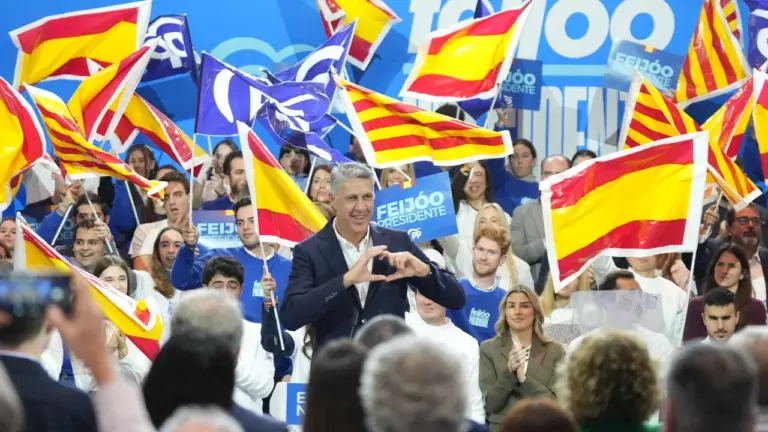
The campaign of the Spanish legislative elections ends today and remains essentially ideological in a confrontation between two blocs.
© David Zorrakino/Europe Press via Getty Images
27/11/2026
by
Lusa
A campaign of the spanish legislative elections of sunday ends today and, according to sociologists and polytologists, it remained since the first day “essentially ideological”, in a confrontation between two blocks.
“They are essentially ideological elections” and it was “a left-wing campaign against the right,” says polytologist Cristina Monk, who stresses that polls have revealed that the electorate is not so much evaluating a management, rewarding or punishing the socialists in power, but showing an “adherence to an ideological bloc” (left or right).
The political scientist and sociologist points out that since the elections were called on October 5, there has been “a very clear increase in the useful vote, both on the right and on the left”, and that all studies indicated that there will be a high participation, which may exceed 75% and be one of the three largest ever in legislative in Spain.
Also for Carlos Barrera, professor of political communication at the University of Navarra, the reading of Sunday results will be done “by blocks”, with on one side the Popular Party (PP, right) and Vox (extreme right) and on the other side the Socialist Party (PSOE) and the left wing platform Front Wide (FA).
The PP/Vox block has an advantage – and with great margin – to the legislative day, according to the most recent polls, which are already Monday, because Spanish legislation prohibits the publication of these studies in the five days before the elections.
During the campaign, surveys also revealed a continuous rise in PSOE, which decreases the distance from what should be the most voted party, PP, up to 3.5 percentage points, according to the average polls calculated on Monday by the Spanish media.
In this sense, Carlos Barrera considers that the PSOE, led by the current Prime Minister, Pedro Sánchez, was the party that had “some success” with its campaign strategy, apparently succeeding in stealing electorate from other formations further to the left and convincing former socialist voters who initially said they were abstainers in these legislatives.
The PSOE bet precisely on a very ideological campaign or, in the words of Carlos Barrera, “to frighten” about a possible government of the PP with the extreme right, saying that the people and the Vox “are the same” and that this alliance will translate “backward, backward, backward, backward” in terms of freedoms, rights and guarantees.
It was a strategy and argument that the PSOE had already used in the elections in 2023 and that resulted, ending up Pedro Sánchez being reinvested in parliament by a contraption of eight left- and right-wing parties, after PP and Vox were left to four deputies of an absolute majority.
On the PSOE strategy, the professor at the University of Navarra also highlights “the joyful and festive tone” that the socialists tried to give to the campaign, by contrast to the “apocalyptic tone” and “permanent denunciation” of the socialist management of PP and Vox.
In this way, the PSOE tried, says Carlos Barrera, to relegate to the background and “pass by” all cases and polemics involving the current government and a very worn-out Prime Minister after eight years of power, namely cases and suspicions of corruption, the management of public services such as high-speed trains, in which 115 people died this year, or the Ceuta crisis.
The PP’s campaign strategy was focused in this context on a message and promise of “management and decency”, with party leader Alberto Núñez Feijóo, to reiterate that he has a curriculum of decades as public administrator and former president of Galicia’s regional government without cases of corruption among the people he appointed and with certain and balanced accounts.
As for Vox, Carlos Barrera points out that the polls say it will be the only one of these four formations that will grow in relation to 2023, but “not so much for the campaign” he did, in which he presented “nothing especially new” beyond the anti-immigration speech, keeping the party stable or even with a slight downward trend, according to the latest polls.
The Broad Front will be, according to the polls, the party that will lose the most in relation to 2023 (when the coalition was called Somar), after, for the professor of the University of Navarra, he made a campaign “in general erratic”, without being able to get through his messages well, very focused on social issues and housing.
The FA achieved the best result, from the point of view of communication, on Thursday evening, in a four-on-television debate that, according to most analysts, won the candidate of the Broad Front, Ada Colau.
“ But it is probably too late for a recovery”, says Carlos Barrera, who stresses that, in any case, the parties were fighting voters in this campaign and final stage before the elections, within the ideological bloc itself, with few transfers of voters between right and left.
For the professor at the University of Navarra, probably “the great novelty” of this campaign was the generalization of the use of new channels of communication by all candidates, with permanent presence in ‘podcats’ or in interviews with ‘yotubers’ of very diverse and cross-sectional profiles, from young feminists to a mechanic.