
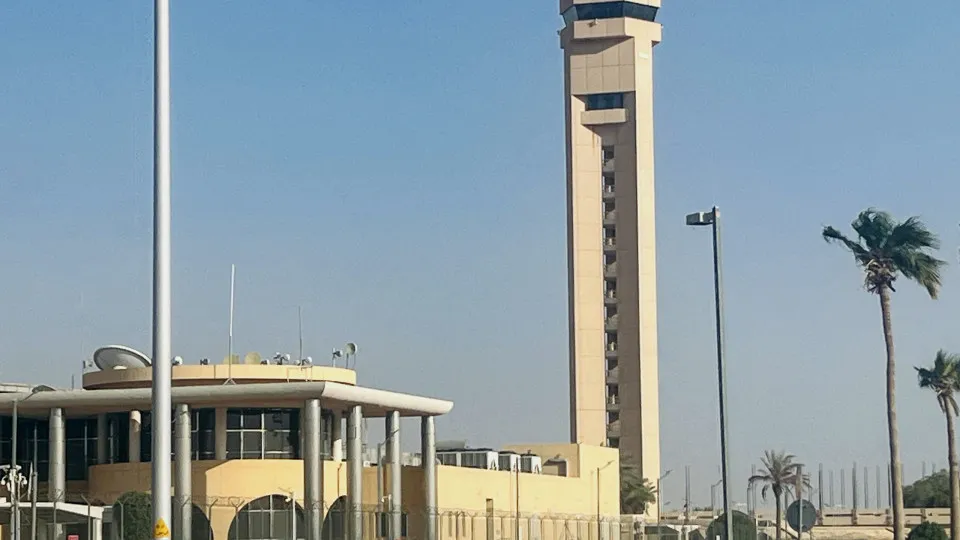
The Yemeni political and armed group of Huthis, supported by Iran, claimed today an attack on the Riyadh International Airport and again reached an Aramco refinery and military infrastructure.
© AFP via Getty Images
05/10/2026
by
Lusa
Os attacks, carried out with drones, ballistic missiles and cruise missiles, “were targeted at Riyadh International Airport,” said military spokesman Huthi, Yahya Saree, adding that “the Aramco refinery in Rabigh” was also hit, as well as military facilities and airports in the south of the country.
At the same time, the coalition led by Saudi Arabia in Yemen announced that it attacked “military targets” in al-Hudaydah, an important port of the Red Sea controlled by the Huthis.
Turkey and Pakistan, united by a mutual defense pact with Saudi Arabia, announced that they would send military forces to the kingdom, which has been the target of regular attacks by Huthis fighters.
According to the spokesman of the coalition, Turki al-Malki, naval forces “destroyed deposits of weapons, facilities that housed bomb boats and mines” and “brought a planned attack” on the waterways of the south of the Red Sea.
The hostilities between Yemeni government forces, supported by Saudi Arabia, and Huthis fighters, who rule much of Yemen a decade ago, were resumed in July after years of relative calm, opening a new front in the Middle East war.
After a lightning offensive in September, the Huthis took control of the entire western coast of Yemen, bathed by the Red Sea, and since then have regularly attacked the oil and military facilities of the neighboring kingdom.
Saudi Arabia and Yemeni government forces, fighting to repel the Huthis attacks, have repeatedly called for international support, particularly from the United States, so far without success.
After a meeting in Riyadh, Turkey, Pakistan, and Saudi Arabia agreed to “immediately activate the mutual defense agreement” signed in August at Mecca, and “take the necessary measures to provide the agreed military forces and resources and deploy them quickly in the kingdom,” according to a joint statement by the three countries.
The text does not directly mention the Huthis pro-Iran, but “condenas, in the strongest terms”, the attacks on the sacred cities of Medina and Mecca — attributed to the Huthis by Saudi Arabia — as well as “the continuous attacks on the cities and civil and economic infrastructures of the country”.
This is the first time that this agreement, which unites NATO's second largest army (Turkey), the main power of the Gulf (Saudi Arabia) and the only nuclear power of the Muslim world (Pakistan), has been implemented.
Supported by Saudi warplanes, Yemeni government forces announced on Sunday a great counter-offensive to resume territories recently conquered by Huthis, or even expel them from all over the country.
Huthis fighters, in turn, warned airlines that air space on Saudi Arabia “is no longer safe” — except for the sacred cities of Medina and Mecca, which, they said, were never targeted for attacks.
On Sunday, the East-West pipeline, of strategic importance and allowing Saudi Arabia to transport its oil – blocked to the east due to the closure of the Strait of Ormuz – to the west of the kingdom, was also the target of attacks and had its operations interrupted.
The president of Saudi oil giant Aramco warned the “dangerously low” level of global oil reserves.
The coalition also stated that “it will provide air cover for the Bab el-Mandeb Strait”, essential for the transport of hydrocarbons.
The Huthis strengthened their control over this strait in September, whose strategic importance increased with the blockade of the Strait of Ormuz by Iran, on the other side of the Arabian peninsula, after the start of the Middle East war in February.