
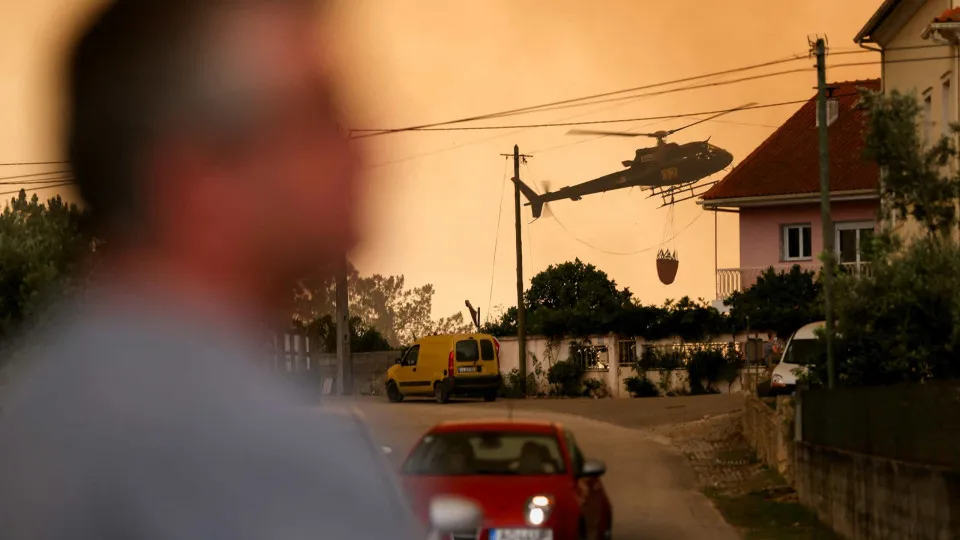
Human action continues to be the preponderant and worrying cause in rural fires in the Leiria Region, Lusa said to the agency the Subregional Commander of Emergency and Civil Protection, Carlos Guerra.
© Reuters
21/10/2026
by
Lusa
Region of Leiria
A human action continues to be the preponderant and worrying cause in rural fires in the region of Leiria, Lusa told the agency the sub-regional commander of Emergency and Civil Protection, Carlos Guerra.
“It should be noted that 76% of the identified causes have human action, which is truly worrying, namely what refers to pile burnings and the use of machinery,” Lusa Carlos Guerra said, citing data from the Republican National Guard.
According to information from the Subregional Command, this year, and until October 15, 270 rural fires were recorded, having burned 68 hectares (180 fires in the year 2025, when 616 hectares burned).
The largest number of fires was recorded in Leiria (106), followed by Pombal (55), Marinha Grande (28) and Porto de Mós (24). Already in burning area, Pombal (27 hectares) and Leiria (23) are the most expressive municipalities.
Burning (30%), burning of piles of forest or agricultural surplus (21%), use of machinery (13%) and transport and communications (12%) are the causes that stand out most in fires in the Region of Leiria, whose territory covers ten municipalities: Alvaiázere, Ansião, Batalha, Castanheira de Pera, Figueiró dos Vinhos, Leiria, Marinha Grande, Pedrógão Grande, Pombal and Porto de Mós.
Carlos Guerra highlighted the increase in the cause “‘transport and communications’, which may be directly linked to the damage of [electric] networks by storm Kristin”, which seriously hit this territory on January 28.
The commander considered that the Region of Leiria cannot “continue to have this paradigm in which, in four occurrences, three have human origin”, for “disregard, negligence, pain, intentionally”.
“ We need to worry about this,” he warned.
For the Civil Protection officer, one cannot “continue to have a forest that becomes hostage to negligent human action”.
“ We do not have the capacity for a device to endure that more than 75% of our occurrences are of human origin, because if it were not so, we would have our problem of rural fires, I would not say solved, but at least on a good way for us to manage what rural fires are,” he said.
The subregional commander gave the example of three or four occurrences simultaneously caused by human negligence.
“ They may say that they are small fires, that they have no danger at all, but this danger that people say they do not have, obliges us to dispatch means exactly the same as if it were a big fire”, besides that it can mortgage necessary means elsewhere, warned, insisting on the need for awareness campaigns and environmental education “to reverse this cycle of man-made fires”.
This year, in the Region of Leiria, the three largest fires occurred in the localities of Netos (25 July, with 19 burned hectares) and Carriço (04 August and four burned hectares), both in the municipality of Pombal, and also, on 3 September, in Picaminho (Porto de Mós, with six destroyed hectares).
According to the Civil Protection officer, the main constraints in the fight against fires are, above all, the “increase in the number of occurrences and the increasing scarcity of human resources in the different entities, both to strengthen the theatres of operations and to establish permanent teams”, considering that this “does not allow a more muscular reinforcement in increased attack” to fires.
Carlos Guerra also stressed that the “first workers” of the results achieved this year are all the operatives who “were present or in support of operations”, convinced that “without the spirit of sacrifice and total surrender” of these numbers would be others.