
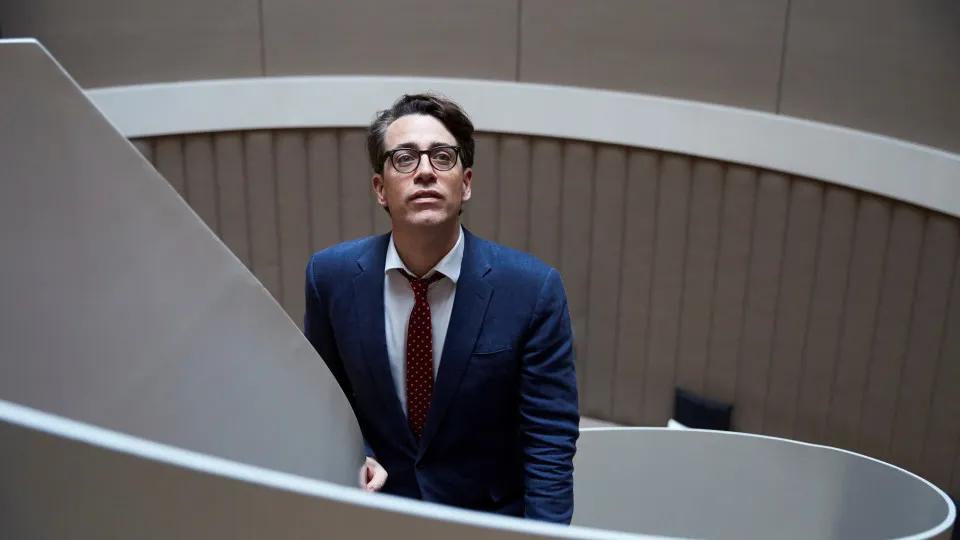
The writer Benjamin Moser considers that Israeli violence against the Palestinians results from the Zionist colonization project initiated in the 19th century and accuses the Israeli parties of competing to decide who will be the “owner of the concentration camp”.
© Lusa
08/11/2026
by
Lusa
O writer Benjamin Moser considers that Israeli violence against the Palestinians results from the Zionist colonization project initiated in the 19th century and accuses the Israeli parties of competing to decide who will be the “owner of the concentration camp”.
In an interview with Lusa, regarding the publication in Portugal of “Antissionism – A Jewish History”, edited by Penguin, the American Jewish writer considered that there is no real political opposition in Israel, accusing the main parties of sharing positions favourable to Jewish supremacy, violence against the Palestinians and military confrontation with Iran.
“ They are competing to see who will carry out genocide more efficiently. Who is going to be the owner of the concentration camp”, said the writer, distinguished with the Pulitzer Prize for Biography in 2020.
For Moser, the policies of the government of Benjamin Netanyahu, the expansion of settlements in the West Bank and the military offensive in the Gaza Strip do not represent a deviation from the Zionist project, but the continuation of a policy whose origins date back to the late 19th century.
“It’s not new. Nothing we see today is new,” he said, considering that violence has become more extreme because Israeli leaders are “desperate” and have lost the sympathy of international public opinion.
The writer establishes a direct link between the present Israeli policies and the thought of Theodor Herzl, author of “The State of the Jews”, published in 1896 and considered one of the founding works of modern political Zionism.
Benjamin Moser said that when his grandfather fled Nazi Germany, he took with him a single book, Herzl's writings.
The writer himself would not read this “manifest” until many years later and was particularly surprised by the indifference to the population that already lived in the territory where he intended to establish a Jewish state.
“ His indifference to Palestinians, he hardly mentions that it is a country that entirely, like Portugal, is a country that has people ", he said.
“What are you going to do with these people? It is an indifference”, he added, considering that this attitude remains present in Israeli politics.
For Benjamin Moser, the occupation of Palestinian territories and ownership of property in the West Bank are examples of a practice that goes through generations and has not begun with the current Israeli Government.
The writer referred to the chapter of the book dedicated to Israeli lawyer Felicia Langer, who documented the occupation of Palestinian dwellings and the protection granted by the army to the settlers.
“She describes exactly the process of colonization of the West Bank and how they were, room by room, apartment by apartment, house by house, taking possession of goods,” she said, adding that “this is a process that we see today, but it is very important to know that this process has a hundred years of theft.”.
In its view, the worsening of Israeli repression is parallel in recent years to the apartheid regime in South Africa, when violence intensified in the face of the possibility of loss of power.
“Apartheid was never as violent as just before losing power,” the author said, recalling South African military interventions in neighboring countries.
Benjamin Moser believes that Israel is pursuing a similar strategy by multiplying military operations in an attempt to preserve a political system that is losing international support.
“If violence were the solution, with the violence they have employed to date, they would have solved the problem,” he said.
The writer also established parallels with colonial wars, recalling that military superiority did not impede Algeria's independence from France or the former Portuguese colonies.
In his opinion, the Hamas attack of October 7, 2023 was used as a pretext to intensify a policy that already existed: “Before October 7, there was October 6. And before October 6, there was a century of attack, aggression, ethnic cleansing, theft.”.
Benjamin Moser also considers that military service in Israel contributes to perpetuating violence against the Palestinians by involving successive generations of young people in army practices, recalling the efforts of lawyer Felicia Langer to prevent her son from being incorporated into the Israeli Armed Forces.
The writer compared this process with the functioning of a criminal organization such as the mafia, in which participation in violent acts creates bonds of complicity between members, classifying it as a “crime sister”.
Referring to the documentary “Naza”, carried out by Israeli journalists Yuval Abraham and Rachel Szor on the basis of testimonies from 24 officers and former military personnel of Israel’s intelligence services, Moser considered that the importance of this type of investigation lies in the possibility of confronting the official Israeli version with testimonies and documents produced from within the country itself.
In this regard, he established a connection with Jewish historian Avi Shlaim, born in Iraq and raised in Israel, one of the figures depicted in his book.
Benjamin Moser recalled that Avi Shlaim integrated the movement of the so-called New Israeli Historians, who, from the 1980s, resorted to the archives of the State itself to question dominant interpretations of Israel's creation and conflicts with Arab countries.
“ They dismantled the myths we all absorb,” he said, admitting that he also grew up with a vision of Israel as a small country permanently threatened by its neighbours.
For the writer, investigations such as that of Yuval Abraham and Rachel Szor are part of this tradition of internal contestation, but also show an inequality in the attention given to the testimonies on violence against the Palestinians.
“ If this film were made by Palestinians, and there are tens and hundreds and hundreds of films and books and documents made by Palestinians, it would not have the same audience, because they do not have the same reach,” he lamented.
“It’s a little sad that we, out of racism, don’t listen to people who have been screaming for a century, over a century,” he added.
As for the political future of Israel and Palestine, Benjamin Moser pointed out the democratic transition of South Africa as an example of an alternative based on equal rights, regardless of ethnic or religious origin.
The writer recalled a conversation with South African activist Ronnie Kasrils, also depicted in the book, about the end of apartheid and the possibility of replacing a segregation system with a democracy without expelling the white population.
“South Africa shows that white people would not be slaughtered if there were equal rights for all citizens,” he said.
Benjamin Moser argued that a similar solution based on political and civil equality would have been his preferred choice for Israelis and Palestinians.
“ We must stop inequality, guarantee equal rights for all, including in the West Bank, and allow the return of refugees who have been out of the country for 80 years and who all have the right to vote. Equality for everyone and ready ", said.
However, Moser considers that the scale of violence in Gaza made the situation incomparably more difficult than that in South Africa at the end of apartheid.
The writer recalled that, according to the data found by the Commission on Truth and Reconciliation in South Africa, about 8,000 people died for nearly 50 years of apartheid, a number that – he stressed – was hit in Gaza in just a few weeks.
“ There was no black city in South Africa compared to Gaza. It's an impossible situation today. I do not think there will be a peaceful solution for the State of Israel,” he said.
The writer considers that his work can also be read as a kind of biography of Zionism, built from the lives of those who opposed the movement and the concrete consequences of his ideas.
“ I do biographies, but actually what I do is intellectual history, disguised as biography”, explained the also author of the biographies of Susan Sontag and Clarice Lispector.
For Benjamin Moser, the objective is to show that political ideas do not remain in the realm of abstraction, but translate into events that transform people's lives: “The ideas are real. I like to show how ideas affect people’s lives in real life.”.