
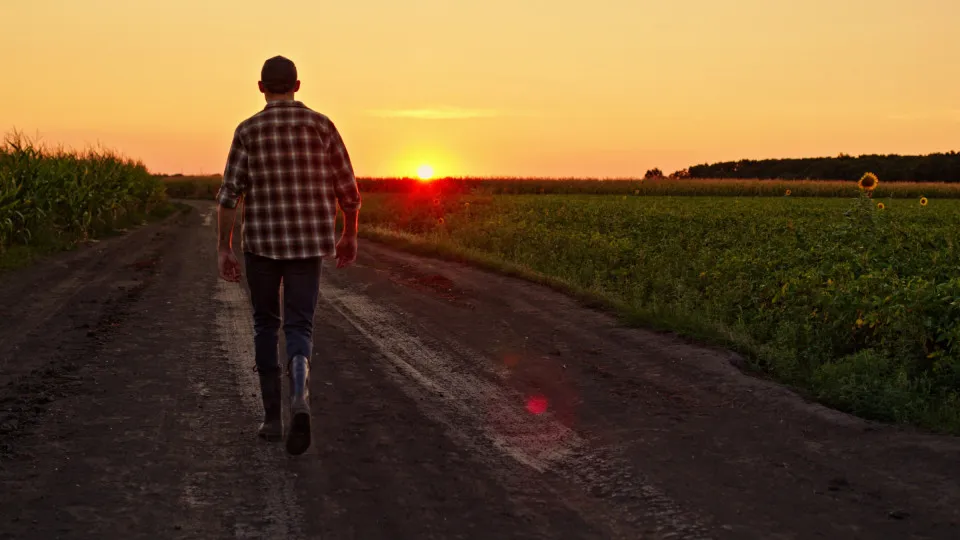
Young farmers from Trás-os-Montes are forced to have other sources of income due to the instability of the agricultural sector, which faces challenges such as climate change and high costs, according to Lusa.
© Shutterstock
17/10/2026
by
Lusa
Jfarmers from Trás-os-Montes are forced to have another source of funding because the agricultural sector is not profitable, given the challenges of today, such as climate change, told Lusa.
“ Few young people make agriculture their only source of income,” said Diana Alves, a young farmer in the village of Ala, the municipality of Macedo de Cavaleiros.
He grew up in agriculture, with his parents and grandparents, and recently submitted a young project for olive grove planting, to increase the exploitation that already exists.
However, she is also a professor of philosophy, another area that admits not to be easy, that of teaching, but that, still, “is more stable than the career of agriculture”, which is “very unstable” and which makes it “very complicated to be a full-time farmer”.
“ I have an olive grove project. Now an olive grove to start yielding only from the age of five, but I have to spend five years injecting money, by the way, investing in olive groves, and from there I can take some theft. Imagine what five years is to invest and have zero return. So it's very complicated. Even so, from the age of five or 10 the financial return is not so high that it is possible to maintain a house, keep a family, only with this income ", lamented.
For André Bragada, in the municipality of Bragança, the situation is not very different. It has farm animals, like pigs and goats, and still production of nuts and olive oil, but it is also real estate agent.
“ I have the luck and I can say that I am a farmer or semi-farmer thanks to the lands, the tractor that was left to me, the tailors that were left to me”, he explained, saying that without this family heritage he could never be a farmer these days.
For the young man, “today he is only a farmer or who was already very deeply rooted in this or who is stubborn and very fond”.
“ I know that nowadays I am in agriculture due to stubbornness”, he said.
André Bragada has tried to live only from this activity, but lacked “incentive”, because in a “bad year” of production it is not possible to “hold on”.
“ Now, at this moment, it is very difficult to live only of this and I think that young people will not cling to something that does not allow them to have a stable life”, he stressed.
Therefore, in their view, the incentives given by the government “should be worked on differently”.
“ I really like the way you work in Spain. ... There they are paid for production and not as here, that there is much talk of subsidies and so on. I think that even from the base of the school should be another kind of incentive ", vincou.
To contribute to the low profitability of the sector is the increase in fuel prices, which triggers the cost of production, the type of agriculture in the transmontana region, that is, the mini-fundium, which does not allow to compete with large-scale productions, and also climate change, as pointed out.
“ It's October and it's about 30 degrees. Therefore, the fact that we do not have structures and infrastructures to cover these climate change also does not help (...) here in my region we do not even have access to irrigation (...) we know that crops that have irrigation have a much higher level of production, because the plant never gets as stressed as it is purely dry", said Diana Alves.
These climate changes are also evident in small crops, for example cereal, to feed animals.
“ I sow pumpkins so I can give them to the nuts and I've had a very large casualty. I made the seed, it was also a weak year of sowing. Chestnut was the same year. Olive oil, last year, basically I didn't even hit the olive trees because it didn't make up for what I had to pay, whether it was jeira or a machine, it didn't compensate me, it was going to be literally working to warm up ", said André Bragada.
On large farms, such as that of the young farmer Miguel Reis, in the municipality of Macedo de Cavaleiros, climate change tries to fight with investments in irrigation, but which, according to him, are very high and “fear”.
“ All this investment that is behind only water collection (...) is close to EUR 15 000 for each pickup. If I am saying that we have 13 holes or 13 water pickups we are talking about a value very close to 200,000 euros ", it has gone ahead.
His family has 70 acres of peanuts, sours and olive groves. Although he mainly dedicates himself to agriculture, he is also president of his village, Owjas, in the municipality of Macedo de Cavaleiros.
The young farmer, 30 years old, acknowledges that climate change and the lack of irrigation infrastructure are one of the major challenges of agriculture in Trás-os-Montes, but also land sharing and the difficulty of having larger farms.
“ They are regions that have many plots, that is, the land is very divided and it is very difficult to find two hectares, three hectares, four hectares so that we can parcel. I'm talking about this in order to justify investments. ... A person who wants to settle down, young farmer, will have to start from scratch, prepare the soils, plant new crops. With the difference in climate, increasingly hot, it is necessary to use irrigation systems, therefore, if we are talking about investments (...) a large share of money [is to] start from scratch, more add to this in each parcel a irrigation system (...) becomes such a costly value per hectare or per share that will hardly get back”, he pointed.
Miguel Reis also considers that older people offer some resistance and see as “tabu” selling or renting land, which creates another obstacle.
He also criticised the “tax exemptions” for retired farmers who, in addition to receiving their pension, still have benefits by maintaining an agricultural holding.
“An elderly person who produces nuts can produce up to a certain amount of cash and will have tax exemptions on social security, etc., and another type of tax, while a young person will always have to be burdened with these taxes, that is, a young farmer in some part already begins more penalized,” he criticized.
To discuss the challenges of young people in agriculture, on Friday, in Macedo de Cavaleiros, there will be the First Meeting of Young Farmers of Trás-os-Montes, with entrepreneurs, researchers and management entities.