
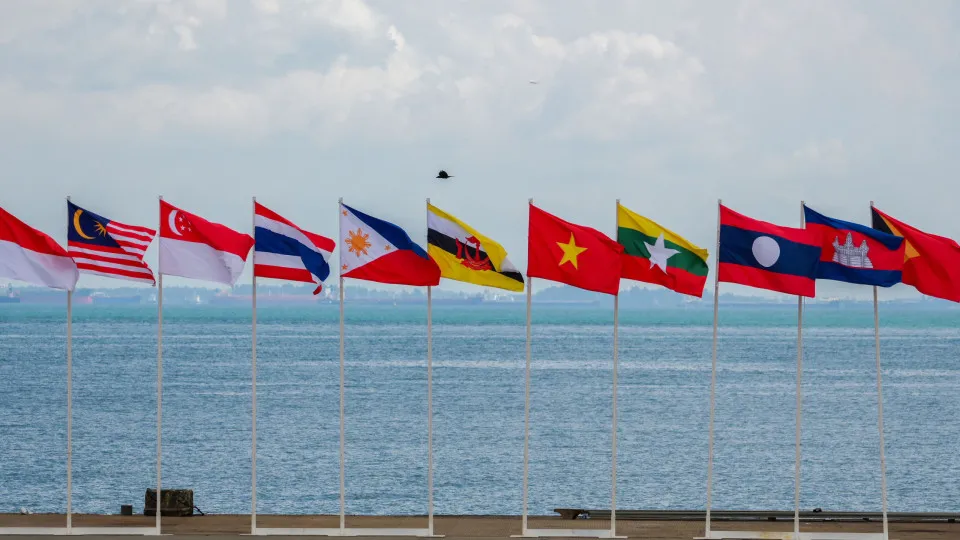
World leaders gather in Asia to discuss issues such as war in Ukraine, Artificial Intelligence and global trade, with meetings scheduled in Philippines and China.
© BAY ISMOYO/AFP via Getty Images
13/11/2026
by
Lusa
World leaders
A Asia receives in the coming days several summits that will debate, among other issues, the war in Ukraine, Artificial Intelligence and global trade, with several leaders converging to the continent, including the US and Russian presidents.
First, in the Philippines and already at the beginning of Sunday, the 49th summit of the Association of South-East Asian Nations (ASEAN) will take place, and then in China, the annual conference of the Asia-Pacific Economic Cooperation Forum (APEC) will take place between 18 and 19 November in the Chinese city of Shenzhen.
Russian President Vladimir Putin is expected at APEC, Indian Prime Minister Narendra Modi will attend the ASEAN summit, while American President Donald Trump and Canadian Prime Minister Mark Carney will attend both events.
Before leaving for China, the leaders who will attend ASEAN in Manila should hold a series of meetings on Artificial Intelligence (IA), trade and perhaps even nuclear disarmament, according to the news agency France-Presse (AFP).
At APEC, the host, Chinese leader, Xi Jinping, and US and Russian counterparts should meet to discuss solutions to the war in Ukraine, according to the Russian Presidency, which confirmed on Thursday the meeting on the margins of the summit in Shenzhen.
For a long time there were rumours about a potential meeting, but there were doubts about a three-way meeting between Putin, Trump and Xi, which appears to have been definitively confirmed by Moscow.
Putin has been pushing for issues related to Ukraine to be discussed, but Trump implied that the focus would be denuclearisation and the end of the war in Iran.
Several international policy analysts contacted by AFP, however, point out that the meeting may not result in final solutions to the problems of the different leaders of the major powers.
“Symbolism (...) will represent a good part of the content,” said Ryan Hass of Brookings Institution.
Leaders will probably limit themselves to “agree on great principles without committing themselves to concrete actions,” he anticipated.
“ There is a strong likelihood that discussions will end without progress,” said Wang Wen, Dean of the Chongyang Institute for Financial Studies at Renmin University.
In addition, a possible meeting between Trump and North Korean counterpart Kim Jong-un seems quite compromised, since Pyongyang rejected repeated attempts to approach.
It is also expected that, at APEC, the AI will occupy a prominent place following the decision taken in September by Xi Jinping and Donald Trump to establish a “communication channel” in the event of any incident related to these technological tools.
Despite the technological rivalry between the two countries, calls for cooperation are multiplied, driven by concerns about biological weapons and cyberattacks.
In September, Xi stated that Washington and Beijing were responsible for “ensureing that the development of the AI will always remain under human control.”.
APEC discussions may be based on the agreement between the two leaders on the “communication channel,” said Stephen Wu, founder of Carthage Capital.
“ Both parties need a result, and a direct line is the least expensive in diplomacy: free to advertise, free to ignore ", defended.
The espionage case surrounding Nvidia President Jensen Huang, initially planned to accompany Trump at APEC, may cast a shadow over these discussions.
Jensen Huang recognized that he had an extramarital affair with a woman the U.S. Secret Service suspected of working for Beijing.
Rather, in Manila, it seems that the Filipino presidency of ASEAN must come to an end without being able to sign a code of conduct for the South China Sea with Beijing.
The two countries have been facing each other for years in this sea, which Beijing claims almost entirely, despite an international decision that is right.
This year, the area was the scene of several clashes.
Another key point in both meetings in Asia will be trade, although experts point out that it will be difficult to advance regional free trade frameworks due to the frictions between China and the United States and Trump's tariff war.
Although Washington's tariffs against Beijing were extended until 10 January, tensions persist with Chinese rare earth exports, which are essential for electronic components.