
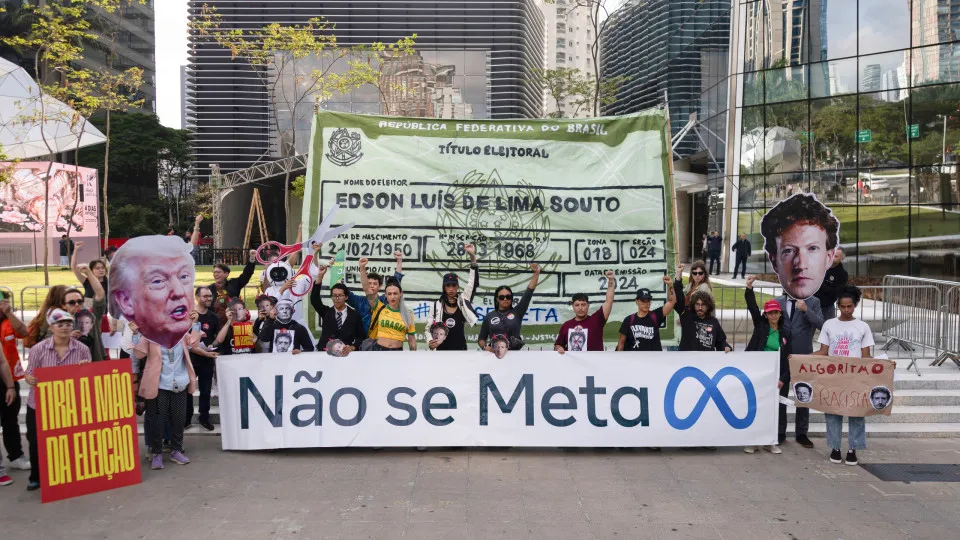
Dozens of protesters protested in front of the Meta headquarters in São Paulo to demand that the technological multinational stop interfering with Brazilian presidential and favor Flávio Bolsonaro in the election campaign.
© Lusa
20/10/2026
by
Lusa
Dezenas of protesters protested in front of the headquarters of the Meta in São Paulo to demand that the technological multinational stop interfering in brazilian presidential and favor Flávio Bolsonaro in the election campaign.
“Meta, do not interfere” was the slogan sung by protesters on Monday, in front of the building that houses the company’s office owner Whatsapp, Instagram and Facebook, in the famous financial center of the capital of São Paulo, Faria Lima, where creative flags and posters erected in the middle of the concentration gave the tone to the protest.
While holding tracks and posters with photographs of Meta’s owner, Mark Zuckerberg, and the President of the United States, Donald Trump, participants sang: “digital sovereignty, out Meta of the electoral process”, in reference to the alleged elimination of content or the reduction of its scope in the content in favor of the current Brazilian President, Luiz Inacio Lula da Silva.
“What we are demanding from the Meta is that, in addition to much more transparency, more detailed explanations beyond the generic explanations of technical problems that the company has been offering, that there be repair actions for what happened during this electoral period,” Lusa Daniela da Silva, Executive Director of CTRL+Z and one of the organizers of the demonstration told Lusa Daniela da Silva.
The head of the Brazilian organization that articulates people and institutions to defend digital rights and hold large technology companies accountable also denounced the interference of the US multinational as “a reality in these elections”.
Daniela da Silva also stressed that the complaints go beyond the public perception of problems on the platforms and pointed out more than 1,100 documented cases of content removal, accounting restrictions and reduction of reach.
“ A company the size of the Meta has to have the minimum responsibility to ensure equity and isonomy in the Brazilian elections and they are not doing this, so we can consider this context of interference a reality, yes ", he told Lusa.
One of several people who used the megaphone was Congressman Paulo Teixeira, who was taxing: “The Meta is manipulating the elections in Brazil and is at Trump’s service”.
The organizations said they would deliver an extrajudicial notification to the director-general of Meta in Brazil, Conrado Leister, so that the company will publish on Instagram a notice about the failures that will have affected the distribution of content during the campaign and apologize.
They also demanded the replacement of accounts and publications removed by legitimate political manifestation and the creation of a resource channel with human review.
The campaign of President Lula da Silva returned to the Superior Electoral Court, accusing the Meta of maintaining practices that allegedly benefit the rival candidate Flávio Bolsonaro.
Among the examples presented are images generated by the artificial intelligence of the company that would include the electoral number of Flávio Bolsonaro, the 22, without users having requested it, and automatic translations that allegedly would convert criticism of the senator into support messages.
The coalition also states that the same tool refused to create an image with the number of Lula, number 13, invoking restrictions on the production of electoral propaganda, and asked for sanctions against the company for alleged non-compliance with the determinations of electoral justice.
The Superior Electoral Court gave the Meta 24 hours to prove that it ensures equal treatment of Lula and Flávio Bolsonaro's applications on its platforms, after the company had not responded to a first request from the court.
In the first round, held on October 4, Flávio Bolsonaro obtained 47.03% of the valid votes, against 45.16% of Lula da Silva, an advantage of 2.224,965 votes, and since the introduction of the system of two rounds in the Brazilian presidential, in 1989, no candidate who finished the first vote in second place managed to win the election.