
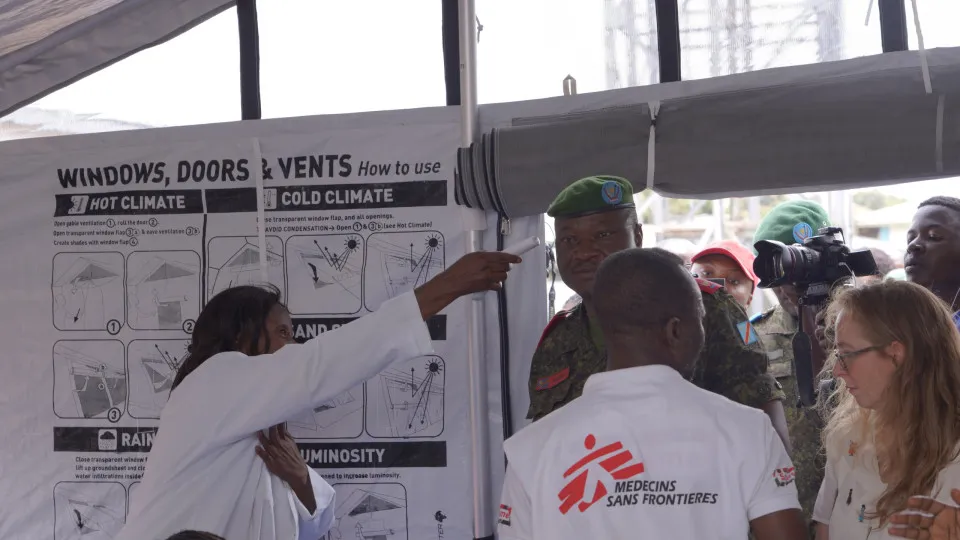
Portuguese doctor Rita Magano knows the reality at the front of Ebola in DRCongo, where patients arrive late at treatment centers, while others continue to die in communities.
© Lusa
11/10/2026
by
Lusa
Rita Magano
A portuguese doctor Rita Magano knows the reality at the front of Ebola in the Democratic Republic of Congo (DRCongo), where patients arrive late at treatment centers, while others continue to die in communities.
Coordinator of Doctors Without Borders (MSF) in Bunia, in the province of Ituri, Rita Magano follows clinical management at the Ebola Treatment Center (CTE), but also epidemiological surveillance and response to communities.
The routine begins early, with the shift shift to know how many patients are hospitalized, what difficulties and if there are cases that need to be transferred. The following is support for medical teams, the validation of medicines, the management of deaths and safe and dignified burials, as well as the monitoring of teams working in communities.
“ He spends a lot of everything, sometimes a bit of fireman”, he summarizes, to Lusa, the doctor, who also accompanies two health centers, with support in medicines and training for the treatment of other diseases.
In CTE, the reality remains marked by the arrival of patients in severe condition. Before entering high-risk areas it is necessary to comply with protective procedures and plan the intervention, but when patients arrive too late, it is not always possible to do something.
The death of a patient does not mean, however, that the team can stop. “It is not because you lose a life that will lower your arms,” says Rita Magano, explaining that other patients arrive and it is necessary to continue to be able to provide them with the best possible care.
The doctor points out that the number of deaths in the centres does not reflect the full extent of the problem. In Bunia, despite a reduction in admissions, “there are still many people dying at Community level”, which shows the need to strengthen the response outside treatment centres and in more isolated areas.
With cases reported in seven provinces, “it is still early to say that the curve begins to descend,” he stresses, pointing to the distrust and fear of the population as another of the difficulties in combating the outbreak.
“People continue to be afraid to go to an Ebola treatment center,” says Rita Magano, defending that the answer goes to clarify the rumors and work with communities.
“ Not to tell them that they are wrong, but to clarify the rumours that run in relation to the treatment centers ", explains, considering it essential to involve community and religious leaders, responsible for the early identification of cases and the cutting of transmission chains.
“ Without strong interaction and coordination with the community, community leaders, religious leaders (...) you can hardly stop and stop the epidemic ", warns.
The epidemiological situation is therefore still difficult to interpret. Although Ituri and Bunia show signs of slowing down in some indicators, other areas continue to report new cases.
“ It is difficult to say that you are actually entering a phase of stability, and that the curve begins to go down, it is still too early to say that”, he says.
According to the most recent data from the European Centre for Disease Prevention and Control (ECDC), DRCongo registered 8,603 confirmed cases and 4,148 deaths, with 896 in isolation. Ituri remained the most affected province, with 6,450 cases and 2,968 deaths.
The lack of a vaccine for the outbreak caused by the Bundibugyo virus makes the clinical response depend even more on early diagnosis, support care and transmission control, while studies on potential vaccines and treatments are being conducted.
The Ebola vaccine developed for the Zaire virus has now begun to be administered to front-line professionals, within the framework of the PARTNERS study which seeks to evaluate its possible effect on this outbreak.
Rita Magano wants to moderate expectations, but the possibility of a “cross-immunity” is a light at the end of the tunnel: “It is not the specific vaccine for this virus, (...) it is expected that there will be some cross immunity that will at least reduce mortality”.
The Portuguese doctor believes that the size of the outbreak — with a mortality rate close to 50% — makes it difficult to think that international effort can be reduced. And remember that, in addition to Ebola, care must be maintained for patients with malaria, cholera, HIV, tuberculosis or chronic diseases.
“ The great difficulty and the great pain of the soul is the fact that there is an epidemic that continues to affect a very fragile population, with a still very precarious health system, and in which the end still seems distant ", Rita Magano vents.
“It is still far away” the moment when it will be possible to say that the epidemic is controlled and will end, concludes.