
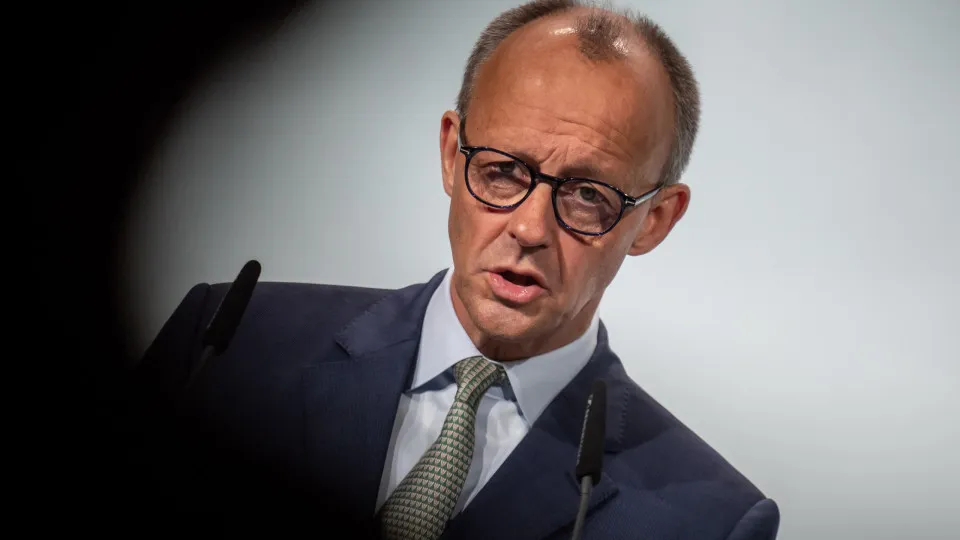
The German Chancellor, Friedrich Merz, today declared himself ‘horrified’ with the election of the AfD candidate for the presidency of a regional parliament, after the far-right party obtained support from deputies for the office.
© Michael Kappeler/picture alliance via Getty Images
07/10/2026
by
Lusa
Non Tuesday, a month after an overwhelming victory in the regional elections in Saxony-Anhalt, located in former East Germany, the Alternative to Germany (AfD), anti-immigration and pro-Russian training, managed to elect its candidate for the presidency of the regional parliament, with the support of a small left-wing pro-Russian party, the BSW.
However, after counting the ballots of the secret vote, it was found that the AfD candidate, Tobias Rausch, had received the support of four other parliamentarians who remained anonymous, generating speculation in the German media about possible votes from the Christian Democratic Union (CDU), the party of Friedrich Merz.
Today asked about the subject in a forum, the Chancellor declared himself “horrified” with the result, but pointed out that the CDU is not “the only” party suspected.
He also mentioned a possible conspiracy to discredit his party, whose guideline is to refuse any cooperation with the AfD.
“ Operations under ‘false flag’ do not exist only in the military sphere. They also exist in politics”, he said.
“ We are dealing (...) with three [groups] in the regional parliament of Saxony-Anhalt that do everything to undermine the cohesion of our democracy,” he added, appearing to refer to AfD, BSW and the radical left-wing party Die Linke.
The election of a president of a far-right regional parliament is an unprecedented fact in post-war Germany and paves the way for the AfD leader in Saxony-Anhalt to take over the regional government in December.
To this end, 35-year-old Ulrich Siegmund needs to win the support of at least three deputies from other parties.
So far, no party has agreed to vote for him, not even the BSW.
But the AfD reported having maintained contacts with parliamentarians from other groups, including the CDU.
So far, none of the major German parties have cooperated with the AfD, following the principle of “health cord” (“Brandmauer”).
However, the far right party has continuously grown in polls and won several electoral victories this year at the expense of the CDU.
After less than a year and a half in power, Merz is the most unpopular German post-war Chancellor.