
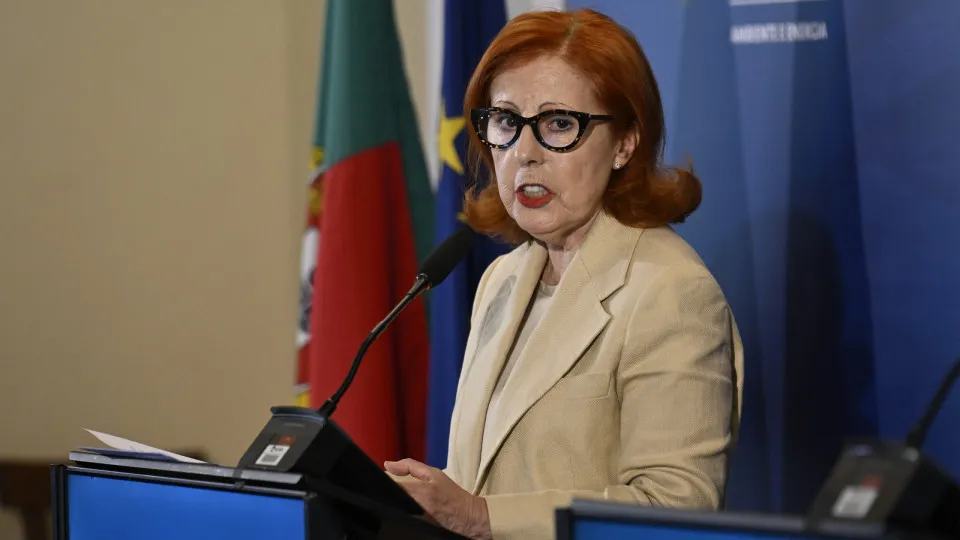
The Minister for Environment and Energy, Maria da Graça Carvalho, today highlighted the importance of investing in renewable energy to reduce dependence on fossil fuels and ensure supply in periods of international instability.
© Horacio Villalobos#Corbis/Corbis via Getty Images
13/11/2026
by
Lusa
A minister of Environment and Energy, Maria da Graça Carvalho, today highlighted the importance of investing in renewable energy to reduce dependence on fossil fuels and ensure supply in periods of international instability.
“ This is very important, it is a gamble in the future, it is a bet on the environment, on air quality, on the fight against climate change and on security of supply,” he said.
Maria da Graça Carvalho spoke to journalists in Porto Santo, Madeira, during the ceremony that marked the closure of the local thermoelectric power plant, with the transition from the island to a model 100% based on energy production from renewable sources.
The total closure of the generating groups of the Porto Santo Thermal Plant is due to the entry into operation of the new wind farm, consisting of two 3,8 MW wind turbines each, and the reinforcement of photovoltaic production, with a new solar park of four MW, combined with the storage systems in batteries with capacity of 20MWh.
This equipment represents an investment of EUR 34 million, financed by Community programmes, under the responsibility of the Madeira Electricity Company.
All electricity consumed on the island of Porto Santo will be produced from the wind and the sun for more than 200 days a year, with storage allowing more efficient use, keeping the thermal power station totally stationary.
“ It is self-sufficiency, it is sovereignty, it is committed to sustainability and the environment and competitiveness, because renewable energies are from natural sources here, they are cheaper than fossil fuels, especially now that fuels are at such a high price,” he said.
Maria da Graça Carvalho stressed the importance of reducing dependence on fossil fuels, especially in periods of international instability, as now.
“It is a path that Portugal, as a whole, is betting on,” he said, advancing that it will transmit this message at COP31, the main UN climate conference, which is taking place in Antalia, Turkey, until 20 November.
“I take this message, which is worth betting on these energies, that we have a way to reduce our dependence on fossil fuels, not only in electricity, but also in transport, in housing, to be more independent, more competitive and cleaner,” he added.
The Minister for Environment and Energy praised the fact that Porto Santo is the first island of the European Union’s ultraperipheral regions (PRU) with 100% renewable energy supply, stressing that it is “a great lesson and a great example”.
The president of the Madeira Regional Government (PSD/CDS-PP), Miguel Albuquerque, said that the closure of the Porto Santo Thermal Power Plant and the use of renewable energy are “a very important step in ensuring strategic autonomy in the autonomous region”.
“ We all know that Europe is going through very difficult times, challenging times, and it is essential that the decisions we make at the political level have a forward-looking sense, that is to say, that they take into account the future, what is predictable in the medium and long term,” he said.
Miguel Albuquerque, also leader of the regional PSD, stressed that investment in renewable energy in Porto Santo represents a bet on the “balanced growth and development” of the island, as well as on the “capacity to provide quality of life for the population”.
In this trip to Porto Santo, Minister of Environment and Energy also visited Central Dessalinizadora, the only source of drinking water used for public supply on the island, whose production capacity increased this year to 10,000 cubic meters per day.
The population living in Porto Santo is about 5,200 inhabitants, but in the summer months, especially in August, the island peaks with 30,000 people.