
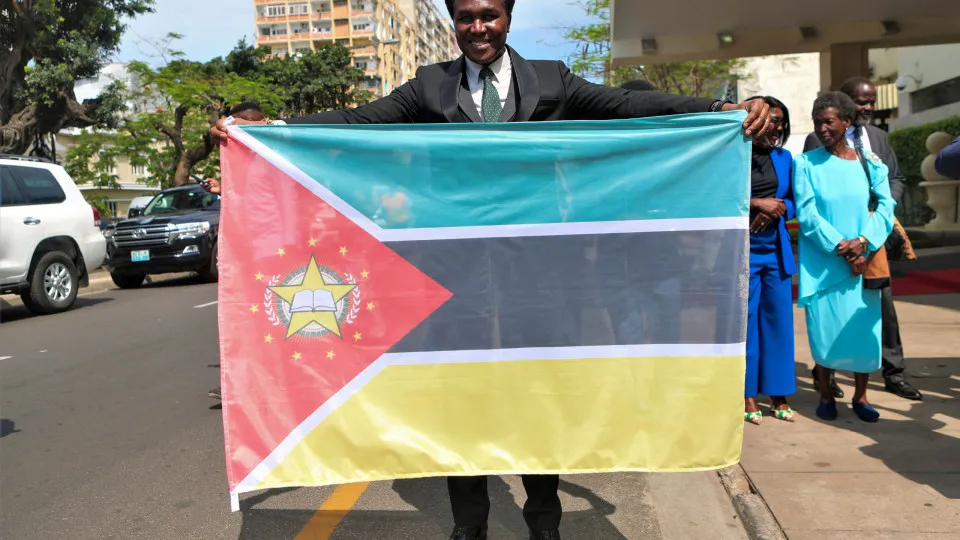
The Supreme Court of Mozambique ordered the release of the bank accounts of politician Venâncio Mondlane, who was the target of judicial investigations after the general elections of 2024. The decision was taken after the completion of the investigation.
© Lusa
08/10/2026
by
Lusa
Mondlane
O Mozambican Supreme Court (TS) ordered the banking institutions to unlock the accounts of the politician Venâncio Mondlane, in the context of the proceedings on post-election demonstrations, justifying no further assumptions to maintain the blockade, with the trial marked.
This is a decision by the Maputo City Judicial Court which, in November 2024, a month after the general elections, determined the blocking of all bank accounts of the former presidential candidate Venâncio Mondlane, also requesting information about their movements and transaction extracts throughout that year, with particular attention to values received from abroad or sent out of the country.
At that time judicial investigations were already taking place against the politician, who called the post-election protests and never recognized the official results of the general election on October 9, 2024, in which he was a candidate for President of the Republic.
In a copy of the Court’s order Supreme addressed to Banco Comercial de Investimentos (BCI) and to which Lusa had access today, the court recalls that the order to break bank secrecy and to block accounts was related to the proceedings filed against Venâncio Mondlane in the context of post-election demonstrations.
“ After the instruction and no further assumptions that justified this measure, I order the release of the accounts (...) entitled by the citizen mentioned above”, reads in the order signed by the judge adviser António Namburete.
The decision arises just over a month before the start of the trial of Venâncio Mondlane, scheduled for November 17 at the Supreme Court.
It is a criminal process driven by the Public Prosecutor (MP) in the context of post-election demonstrations, in which the politician answers for crimes of public apology to crime, incitement to collective disobedience, public instigation to the practice of crime, instigation to terrorism and incitement to terrorism, in a criminal framework that can exceed 20 years of effective imprisonment.
According to the prosecution order of the Public Prosecutor, to which Lusa recently had access, the evidence against Venâncio Mondlane is largely based on appeals to contest, strikes, paralysis and mobilization for protests made through live broadcasts on social networks.
In September, the Supreme Court rejected the request for live transmission of the trial by the media, claiming the need to safeguard “the law” of the case.
Counsellor Pedro Nhatitima then explained that the principle of advertising judicial acts and the right to information “is not absolute”, arguing that the decision sought to safeguard “morality, the security issue and also the lawfulness of the process”.
“ After hearing the prosecutor, the Supreme Court, through its criminal section, decided to reject the request for audiovisual transmission live from the trial; prohibit the recording of sound and image during the course of the trial, but, on the other hand, allow the media to accompany the trial by making the written record ", said.
At the time when the blocking of accounts was made public, in December 2024, the Supreme President, Adelino Muchanga, argued that any tailor-made challenge should be made in the process itself, stressing that “courts do not persecute people” and that Justice should not constitute an obstacle to social pacification.
Venâncio Mondlane never recognized the results of the October 2024 general election, which attributed the victory to Daniel Chapo, candidate of the Mozambique Liberation Front (Frelimo), a challenge that triggered a wave of post-election protests for about five months and caused hundreds of deaths, as well as episodes of destruction and looting.