
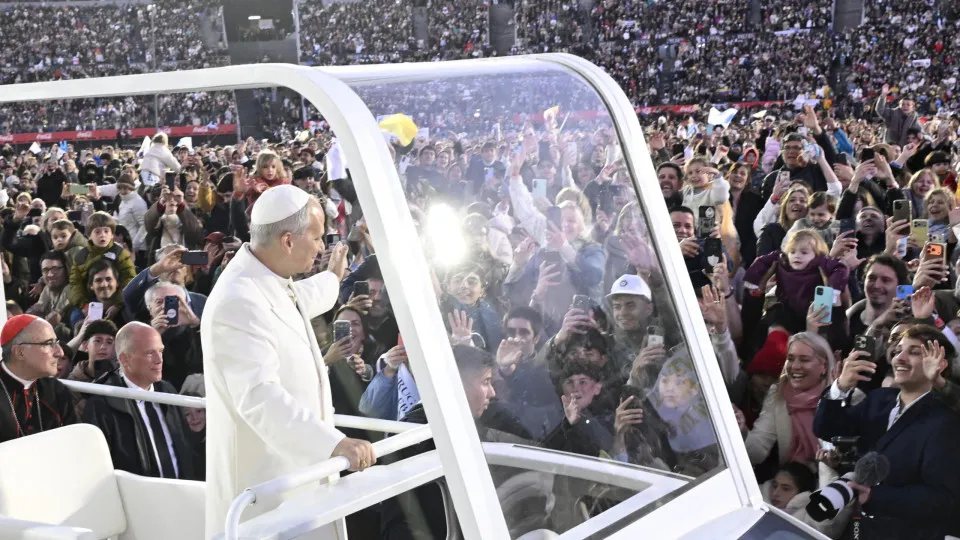
Pope Leo XIV appealed on Saturday in Uruguay that “school and university education contribute to the wise use of technologies and artificial intelligence, putting the person before the algorithm”.
© Lusa
08/11/2026
by
Lusa
O Pope Leo XIV appealed on Saturday in Uruguay that “school and university education contribute to the wise use of technologies and artificial intelligence, putting the person before the algorithm”.
In a meeting with representatives of the educational sector, at the Catholic University of Montevideo, the pontiff used the five senses – vision, touch, taste, smell and hearing – as the thread of a reflection on education, new technologies and the defense of human dignity.
“ It is urgent, therefore, that our school and university education contribute to the wise use of technologies and artificial intelligence, putting the person before the algorithm and harmonizing technical, emotional, social, spiritual and ecological intelligence”, the Pope said, during an intense journey that began with a Mass in Paysandú.
The head of the Catholic Church warned that “the current dehumanization process is a challenge for our school and university institutions”, and stressed that “those who feel embraced by the Father are inevitably a builder of peace”.
In his speech at the university’s noble hall, he quoted some passages from his encyclical “Magnifica Humanitas”, on technologies and artificial intelligence.
Citing an intervention he made in the United Nations Educational, Scientific and Cultural Organization (UNESCO), on September 25, he noted that “while intelligence is attributed to computer systems, we have difficulty recognizing the inalienable dignity of people whose lives are assessed according to the efficiency criterion and that, when it is considered that they are no longer productive, they are rejected and discarded”.
For the Pope, “it is necessary to proclaim again that human life must be respected in all its phases and conditions. No one can be rejected”, he said, in a new intervention against abortion and euthanasia.
“ The dignity of today's human being has suffered numerous blows, to the point of discarding, rejecting and depriving themselves of having become a nauseous odor, accepted by our smell ", criticized the pontiff, on the second day of his visit to Uruguay, integrated in a tour of Latin America.
After remembering that human hands serve to work, caress and embrace, he regretted that they are also producing “the most terrible of human works: war”.
Catholic education, he called, “cannot be conceived in a closed circuit”, but must get used to listening to families, civil society, political and administrative authorities, as well as representatives of productive sectors and professional categories.