
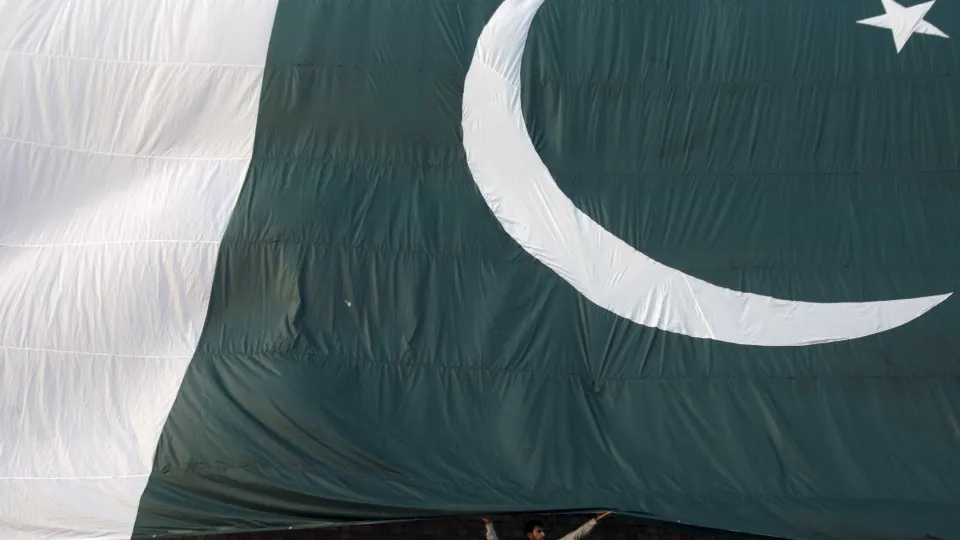
The Pakistani government sent hundreds of soldiers to Saudi Arabia, an ally involved in a growing conflict with Huthis of Yemen, told EFE sources of security.
© Reuters
08/10/2026
by
Lusa
O Pakistani government sent hundreds of soldiers to Saudi Arabia, an ally involved in a growing conflict with Huthis of Yemen, told EFE sources of security.
“Pakistan has been keeping troops mobilized in Saudi Arabia for decades for training and logistics purposes, but hundreds of additional soldiers have now been sent to the Kingdom under the Mecca Defense Agreement,” an anonymous security officer told EFE.
The Armed Forces, they've come forward, they're preparing to send more troops. The authority has not detailed how many soldiers have arrived, nor where they are based, and has refused to provide information on any mobilization of Pakistani aircraft on Riyadh bases.
Saudi Arabia, Turkey and Pakistan activated on Monday the joint defence pact — signed in August — to enforce the Tripartite Alliance assistance clause, according to which an assault on a partner is an attack on everyone.
The sending of personnel to Saudi soil aims to respond to the escalation of rebels Huthis Yemeni, supported by Iran.
The Pakistani Ministry of Information today classified as “false and manufactured” news about the use of Pakistani aircraft against the Huthis.
Pakistan, had previously told EFE security sources, already maintained more than 10,000 soldiers stationed in Saudi Arabia before the Mecca agreement was signed.
The mutual defence trilateral pact brings together Saudi financial resources, Turkish military power and Pakistani nuclear arsenal and stipulates that an attack on any of the signatories is tantamount to aggression on all, in a manner similar to Article 5 of NATO, the Western military alliance.
Pakistan's role in the tripartite alliance was consolidated in late September with the appointment of Lieutenant General Nauman Mahmood to lead the General Secretariat in Riyadh — a rotating position among the three nations.
Mahmood is a veteran military specialist in the fight against terrorist groups and in the surveillance of dangerous borders, such as Afghanistan at the time of the withdrawal of US troops.
The Huthis, whose official name is Ansar Allah, are a Shia majority political-religious movement militarily supported by Iran and since 2014 in civil war in Yemen with government troops, supported by an international coalition led by Saudi Arabia, which is why they have attacked the country.
On September 3, the Huthis launched an offensive on areas of the provinces of Taiz and Hodeida and, since then, gained significant territorial advances, including the taking of the port city of Moca and the outskirts of the Bab el-Mandeb Strait, which represented a harsh blow to internationally recognized authorities.
The Turkish Foreign Minister, Hakan Fidan, today stressed the defensive nature of the Mecca defense agreement and ensured that he would not authorize attacks by Turkish troops deployed abroad.
The statement was made at a joint press conference in Ankara, where Fidan announced that “the necessary procedures have been completed” so that the Joint Defense Agreement signed in Mecca in August this year will be presented to the parliament of the country.
“ If a signatory country is attacked, it will receive support for its defense. It is not an attack agreement,” the Turkish chief of diplomacy explained, stressing that the pact provides for mutual defence if one of its signatories is the target of an attack.
It also reiterated that Turkey's role in the framework of the pact is to “provide support” when another Member State is attacked, without allowing Turkey to position troops in the territory of another country with the aim of carrying out an offensive.
“ This is not an attack agreement. Turkey will not send its troops into the territory of another country to launch an attack from there. It is a defense agreement,” Fidan categorically said, regretting that “the cheap political rhetoric that sometimes arises does not match reality.”.
These statements were issued after Saudi Arabia-led international coalition forces, which support the internationally recognised Yemeni Government, announced attacks on more than 80 “legitive military targets belonging to the Huthi terrorist militia”.
These include “ballistic missile launch sites” in various areas of northern and western Yemen controlled by rebels.
Fidan justified these operations as a response to aggression Huthis to Saudi airports of Riyadh and Abha.