
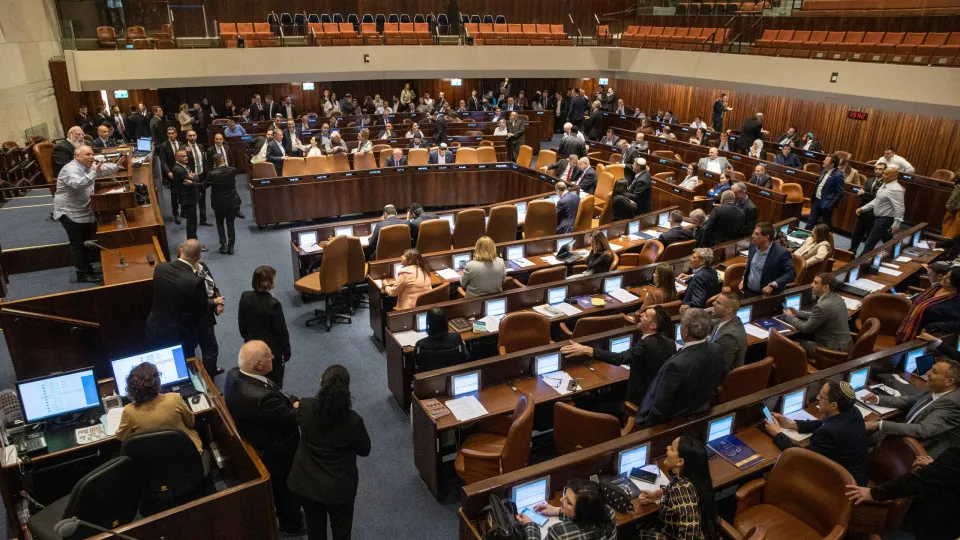
The Israeli Parliament begins the inaugural session with debate on an independent investigation into the failures that led to Hamas' attack on October 7, 2023, as well as the election of a new president.
© OREN BEN HAKOON/AFP via Getty Images
09/11/2026
by
Lusa
O Israeli Parliament begins Tuesday the work of the inaugural session with a debate on an independent investigation into the failures that led to Hamas' attack on October 7, 2023, as well as the election of a new president.
The 26th legislative session of the Knesset (Israeli Parliament) takes place in a context marked by the loss of the parliamentary majority of the bloc in favour of the leader of the Likud and outgoing Prime Minister, Benjamin Netanyahu, and by the opposition's attempt to seize its seats to take control of the House.
The 120 members of the Knesset will take office at a meeting scheduled for 16:00 on Tuesday, which will be chaired by President Isaac Herzog.
The main immediate unknown is whether the opposition will succeed in replacing the President of Parliament, Amir Ohana, of Likud and Netanyahu's ally, before the formation of a new government.
The opposition forces demanded that the election of a new president be included on the agenda of the inaugural session.
Ohana has ensured that he will convene the debate if he receives a formal request signed by at least 61 Members – the absolute majority in the Israeli Parliament – and that he will do so within a week.
The replacement is of political importance, as the presidency of Parliament controls a significant part of the parliamentary procedures and agenda, including the establishment of the provisional bodies of the new House.
These include the Organisation Committee, which manages parliamentary affairs until the formation of the Government, and may set up special committees and appoint their respective representatives.
It all indicates that the 67 opposition deputies, including the 19 Arab parties (Joint List and Raam), can join together to set up an independent commission of investigation into the events of ‘October 7’.
It is a requirement that Netanyahu has so far rejected, opting for a model of appointment of members by parliamentary consensus, which has already passed the first reading in July.
The election of the President of the Knesset does not in itself determine the type of committee that will be set up or its composition, but the monitoring of parliamentary bodies may facilitate the legislative process necessary for its creation.
In this sense, the opposition leader, Gadi Eisenkot, of the Yashar party!, intends to promote the creation of an independent state commission to investigate the events of ‘October 7’, through a law approved by Knesset, rather than rely on a governmental decision, as a way to circumvent the blockade of the outgoing executive.
The opposition also aims to repeal several laws of judicial reform promoted by the government since 2023, a controversial project that reinforced political influence on the appointment of judges and limited some mechanisms of executive control.
The initiative has led to large demonstrations and deep division in Israeli society. However, the 67 opposition Members, who coincide with the need to replace Netanyahu, do not constitute a cohesive government majority and may split internally.
Of this total, 19 belong to Arab parties, whose possible collaboration is rejected by the right-wing leader Avigdor Lieberman. Mandatory military service for ultra-orthodox, so far part of the Netanyahu block, is another important point of divergence as to the possibility of integrating formations of ultra-orthodox Jews (the haredi).
In parallel, Herzog commissioned Sunday Eisenkot to form government, after the 67 opposition members had recommended his name, against 46 who supported Netanyahu.
The President granted him a 28-day period, extended for another 14, with Eisenkot acknowledging the difficulty of the task, calling for “creative and unconventional” formulas to gather support.
Parliamentary arithmetic gives it an initial advantage, but the differences between its potential partners keep open uncertainty about who will rule Israel.